
Sorry, but your login has failed. Please recheck your login information and resubmit. If your subscription has expired, renew here.
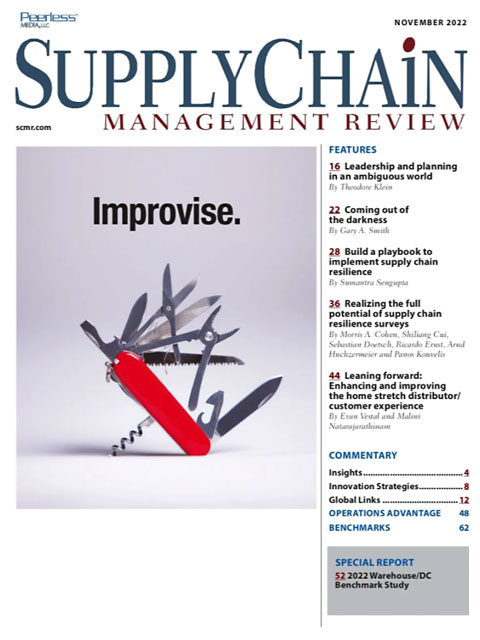
November 2022
Are you resilient? It’s not an idle question. If there’s one word that I’ve heard at every supply chain event I’ve attended this year, its resilience. It is, of course, in response to the last few years in supply chain management. I think its fair to say that supply chains have been knocked to the canvas more times than Rocky. What has become clear as we do our post-pandemic reviews is that the firms that demonstrated the ability to get up off the canvas and keep punching were those that invested in resiliency before the pandemic—even if they didn’t use that term. Browse this issue archive.Need Help? Contact customer service 1-508-503-1313 More options
The global cost of parcel delivery, excluding pickup, line-haul and sorting costs, is approximately $80 billion per year, and is growing annually at a rate of 7% to 10% in developed countries and almost 300% in developing countries such as India. The last mile is critically important because it represents a disproportionately large share of parcel delivery costs to the consumer. Hence, it is not surprising that there is much activity around finding innovative last-mile solutions that minimize costs and maximize service levels, especially in dense urban centers.
Aggregated solutions like parcel lockers and public drop-off points are being deployed, and multi-echelon options are gaining in popularity as large trucks become increasingly ill-suited to urban routes. But the technology that has perhaps received the most public attention is unmanned
aerial vehicles, commonly called drones.
The type of unmanned aerial vehicles for last-mile delivery (UAV-LMDs) envisoned by most last-mile logistics players is unique in three ways: low per-vehicle capital costs, autonomous operation and the ability to travel rapidly point-to-point. Yet the vision of fleets of drones traversing city airways to deliver parcels remains far from reality.

This complete article is available to subscribers only.
Log in now for full access or start your PLUS+ subscription for instant access.
SC
MR
Sorry, but your login has failed. Please recheck your login information and resubmit. If your subscription has expired, renew here.
November 2022
Are you resilient? It’s not an idle question. If there’s one word that I’ve heard at every supply chain event I’ve attended this year, its resilience. It is, of course, in response to the last few years in… Browse this issue archive. Access your online digital edition. Download a PDF file of the November 2022 issue.The global cost of parcel delivery, excluding pickup, line-haul and sorting costs, is approximately $80 billion per year, and is growing annually at a rate of 7% to 10% in developed countries and almost 300% in developing countries such as India. The last mile is critically important because it represents a disproportionately large share of parcel delivery costs to the consumer. Hence, it is not surprising that there is much activity around finding innovative last-mile solutions that minimize costs and maximize service levels, especially in dense urban centers.
Aggregated solutions like parcel lockers and public drop-off points are being deployed, and multi-echelon options are gaining in popularity as large trucks become increasingly ill-suited to urban routes. But the technology that has perhaps received the most public attention is unmanned
aerial vehicles, commonly called drones.
The type of unmanned aerial vehicles for last-mile delivery (UAV-LMDs) envisoned by most last-mile logistics players is unique in three ways: low per-vehicle capital costs, autonomous operation and the ability to travel rapidly point-to-point. Yet the vision of fleets of drones traversing city airways to deliver parcels remains far from reality.
SUBSCRIBERS: Click here to download PDF of the full article.
SC
MR

Latest Supply Chain News
- From salon to dock door: Repurposing scheduling software for inbound flow
- The biggest barrier to AI in supply chains isn’t technology
- Rebuilding a planning function around the physical world
- Why companies blame the wrong supplier … and miss the real failure
- NextGen Supply Chain Conference unveils agenda focused on AI, execution and the future of leadership
- More News
Latest Podcast
 Explore
Business Management News
- Innovators Netstock, Pickle Robot win NextGen Solution Provider awards
- Bigger trucks versus broken bridges and roads
- From salon to dock door: Repurposing scheduling software for inbound flow
- The biggest barrier to AI in supply chains isn’t technology
- Rebuilding a planning function around the physical world
- Why companies blame the wrong supplier … and miss the real failure
- More Business Management
Latest Business Management Resources
Subscribe

Supply Chain Management Review delivers the best industry content.

Editors’ Picks



