
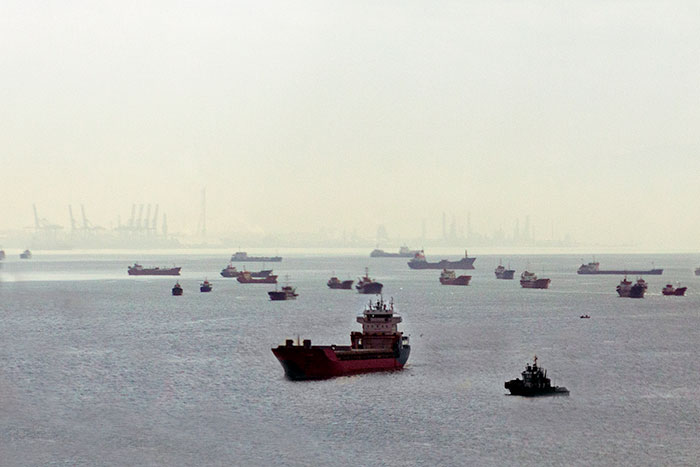
According to Fitch Ratings, U.S. cargo ports continue to see strong revenue performance as a result of sustained congestion and record volume.
However, maintaining operational efficiency is an increasing challenge as bottlenecks have not yet resolved due to disrupted supply chains, mismatched rolling stock, capacity-strained logistics networks and ongoing labor shortages. Ports are now expected to see congestion pressures persist through the holiday season, with throughput patterns not expected to normalize until early 2022.
As noted last summer, Fitch maintains that the San Pedro Bay Port Complex has been experiencing exceptionally high and growing volumes since mid-2020, driven by robust goods consumption.
Port of Long Beach’s (POLB; AA/AA-/Stable) total calendar 2021 YTD 20-foot equivalent units (TEUs) through September have grown 24% over the same nine-month period a year prior, while Port of Los Angeles’ (POLA; AA/Stable) YTD TEUs through September were up 27% versus the same period in 2020. Fitch-tracked West Coast port TEUs were up 25% through August 2021 from the same period in 2020, and up 15% from the same period in 2019.
“POLA recently announced it would move to 24/7 operations, as POLB did in September,” says Emma Griffith
Senior Director, Infrastructure and Project Finance. “Round-the-clock operations may help shift additional containers off ships, though ports are only the first stop along the way for imports, which make up the vast majority of cargo handled at West Coast ports.”
Griffith adds that “sticking points” remain in the form of warehouse capacity and trucking availability to move goods from the ports, particularly when expanded hours at ports do not match warehouses’ and distribution centers’ operating hours.
Additional investment in warehouse capacity and logistics will be necessary to support increased port operating hours, which are likely to become permanent. Cargo passing through POLA and POLB could see increases in handling costs related to extended gate hours, with added costs eventually passed on by retailers to their customers. In the near-to-medium term, margins could be pressured if congestion persists well into 2022, as yard efficiency and downstream capacity catches up with increased costs.
POLA’s and POLB’s ability to handle larger ships, sizable local market shares and strong representation across shipping alliances position them well to process strong volume levels despite current congestion issues.
The majority of Fitch-rated U.S. ports are protected from trade-related revenue volatility to some degree by contractual minimum annual guarantees, limiting the ratings effect of shipping backlogs. Minimum annual guarantees accounted for 88% and 80% of POLB’s and POLA’s operating revenues in fiscal 2020, respectively, consistent with prior years.
Counterparties have largely continued to honor their agreements, and financial performance is expected to remain steady in the near term.
Some East Coast and Gulf Coast ports have also seen large increases in container volumes, with Georgia Ports Authority (Savannah) and Port of Virginia growing the fastest (up 26% and 30%, respectively, through September 2021 versus the same nine-month period in 2020, and up 20% and 17%, respectively, versus 2019). East Coast port TEUs were up 24% through August 2021 versus the same period in 2020, and up 15% from the same period in 2019.
Cargo volume increases at most East Coast and Gulf Coast ports have historically been constrained by capacity limitations, Panama Canal ship size restrictions and comparatively more congested inland transportation networks.
However, logjams may drive additional volumes to East Coast gateways, even as many ports pursue capacity enhancing expansion and optimization plans. Savannah is expanding its storage yard and rail yard and will be increasing the size of one of its berths. Virginia’s semi-automated facilities coupled with rail access and whole-port operator status have allowed them to adapt more quickly to shifting vessel calls and cargo handling needs.
SC
MR

Latest Supply Chain News
- Schneider Electric’s Jackie Zhu: Why the best leaders build careers across the business
- AI is driving change in supply chain skills and talent
- 4 moves supply chains must make as AI triggers a memory supply shock
- Innovators Netstock, Pickle Robot win NextGen Solution Provider awards
- Bigger trucks versus broken bridges and roads
- More News
Latest Podcast
 Explore
Business Management News
- Innovators Netstock, Pickle Robot win NextGen Solution Provider awards
- Bigger trucks versus broken bridges and roads
- From salon to dock door: Repurposing scheduling software for inbound flow
- The biggest barrier to AI in supply chains isn’t technology
- Rebuilding a planning function around the physical world
- Why companies blame the wrong supplier … and miss the real failure
- More Business Management
Latest Business Management Resources
About the Author
Patrick Burnson, Executive Editor

Patrick is a widely-published writer and editor specializing in international trade, global logistics, and supply chain management. He is based in San Francisco, where he provides a Pacific Rim perspective on industry trends and forecasts. He may be reached at his downtown office: [email protected].
Follow SCMR on social media.
@SupplyChainManagementReview on Facebook
@SCMR on Twitter
SCMR on Linkedin
Subscribe

Supply Chain Management Review delivers the best industry content.

Editors’ Picks



