
Sorry, but your login has failed. Please recheck your login information and resubmit. If your subscription has expired, renew here.
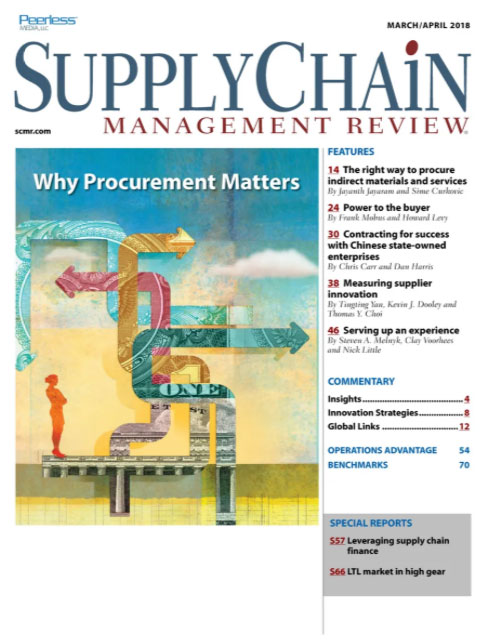
March-April 2018
"Inflation creeps into U.S. Supply Chain.” So said the headline on a Wall Street Journal article I read this morning before writing this column. The Journal went on to write that U.S. companies are grappling with rising material and ingredient costs on top of pressure from higher wages—a potential double whammy— and noted that companies like Whirlpool and Ford have already issued warnings to the market. Browse this issue archive.Need Help? Contact customer service 1-508-503-1313 More options
Is your global supply chain living dangerously?
It’s not a simple question. Globalism has been a boon to the supply chain by expanding sourcing, opening new markets, accelerating growth and highlighting opportunities to save money. It has also always had issues: supply chain complexity; global competition; information collection challenges; and greater risk from global events including natural disasters, port closures and anti-global sentiment.
Today however, the open trading system, which is the very underpinning of global supply chains, is increasingly questioned by large segments of populations and their elected officials. Corporations must come to terms with Brexit in Europe, the America First rallying cry in the United States and populism around the world. While the reaction thus far has been to treat these as isolated events that will blow over, the fact is that populists, shorthand for political movements that challenge the status quo, including free trade, have been gaining ground in elections worldwide. In fact, we haven’t seen this level of popular support for populist platforms since the 1930s. No one really knows how these political tides will affect the economy and trade relations with other countries. This uncertainty, while unsettling in the short term, has the potential to devastate a global supply chain.
It takes a broad suite of tools to effectively manage a supply chain today, including everything from software and systems specializing in logistics, data analytics and inventory management to tools enabling demand forecasting, freight management and ensuring security and beyond. The supply chain manager’s traditional arsenal is overflowing with tools designed to address all contingencies. It is increasingly clear that contingencies that were once only possible may become, in the near future, probable. But, how do you forecast and address these possibilities? A.T. Kearney contends that the C-suite must now elevate strategic decision-making from the traditional analytical exercise of evaluating factor costs arbitrage (labor, utilities, logistics etc.) to a more resilient “trade-game-theory” and “scenario planning” exercise to prepare for increasingly prominent political risks.

This complete article is available to subscribers only.
Log in now for full access or start your PLUS+ subscription for instant access.
SC
MR
Sorry, but your login has failed. Please recheck your login information and resubmit. If your subscription has expired, renew here.
March-April 2018
"Inflation creeps into U.S. Supply Chain.” So said the headline on a Wall Street Journal article I read this morning before writing this column. The Journal went on to write that U.S. companies are grappling… Browse this issue archive. Access your online digital edition. Download a PDF file of the March-April 2018 issue.Is your global supply chain living dangerously?
It's not a simple question. Globalism has been a boon to the supply chain by expanding sourcing, opening new markets, accelerating growth and highlighting opportunities to save money. It has also always had issues: supply chain complexity; global competition; information collection challenges; and greater risk from global events including natural disasters, port closures and anti-global sentiment.
Today however, the open trading system, which is the very underpinning of global supply chains, is increasingly questioned by large segments of populations and their elected officials. Corporations must come to terms with Brexit in Europe, the America First rallying cry in the United States and populism around the world. While the reaction thus far has been to treat these as isolated events that will blow over, the fact is that populists, shorthand for political movements that challenge the status quo, including free trade, have been gaining ground in elections worldwide. In fact, we haven't seen this level of popular support for populist platforms since the 1930s. No one really knows how these political tides will affect the economy and trade relations with other countries. This uncertainty, while unsettling in the short term, has the potential to devastate a global supply chain.
It takes a broad suite of tools to effectively manage a supply chain today, including everything from software and systems specializing in logistics, data analytics and inventory management to tools enabling demand forecasting, freight management and ensuring security and beyond. The supply chain manager's traditional arsenal is overflowing with tools designed to address all contingencies. It is increasingly clear that contingencies that were once only possible may become, in the near future, probable. But, how do you forecast and address these possibilities? A.T. Kearney contends that the C-suite must now elevate strategic decision-making from the traditional analytical exercise of evaluating factor costs arbitrage (labor, utilities, logistics etc.) to a more resilient “trade-game-theory” and “scenario planning” exercise to prepare for increasingly prominent political risks.
SC
MR


Latest Supply Chain News
- Schneider Electric’s Jackie Zhu: Why the best leaders build careers across the business
- AI is driving change in supply chain skills and talent
- 4 moves supply chains must make as AI triggers a memory supply shock
- Innovators Netstock, Pickle Robot win NextGen Solution Provider awards
- Bigger trucks versus broken bridges and roads
- More News
Latest Podcast
 Explore
Procurement & Sourcing News
- Innovators Netstock, Pickle Robot win NextGen Solution Provider awards
- From salon to dock door: Repurposing scheduling software for inbound flow
- The biggest barrier to AI in supply chains isn’t technology
- Rebuilding a planning function around the physical world
- Why companies blame the wrong supplier … and miss the real failure
- NextGen Supply Chain Conference unveils agenda focused on AI, execution and the future of leadership
- More Procurement & Sourcing
Latest Procurement & Sourcing Resources
Subscribe

Supply Chain Management Review delivers the best industry content.

Editors’ Picks



