
For last few decades, global manufacturing optimized around a simple equation: lowest unit price plus logistics cost equals lowest landed cost. In stable trade environments, that model worked. In today’s environment of tariffs, capital constraints, and commodity volatility, it does not.
While classic just-in-time execution may preserve unit cost in the short term, it can increase margin volatility, liquidity stress, and continuity risk. Supply chain leaders must now optimize not just for cost, but for resilience across origin, time, and capital exposure.

This article introduces a practical framework—the Resilient Grid Model—that replaces linear sourcing with a portfolio-based approach to managing geopolitical risk, supplier economics, and working capital.
Why lowest landed cost is no longer sufficient
Traditional sourcing models typically converge on one primary supplier at one best price. This creates fragile dependency on a single origin, tariff regime, and logistics corridor. When trade policy shifts or material markets tighten, margin erosion happens faster than most cost-reduction programs can respond.
In capital-constrained manufacturing sectors such as commercial EVs and energy storage, even short-term margin compression can stall production, delay programs, and weaken supplier ecosystems.
What is required instead is a sourcing architecture that balances cost, risk exposure, time to reconfigure and liquidity impact
The Resilient-Grid Model
The Resilient-Grid Model replaces linear sourcing—one primary source at one best price—with a network of qualified supply paths, each evaluated by both economic and geopolitical risk.
Rather than reacting to tariffs or shortages after they occur, the model treats geopolitical exposure as a quantifiable input into sourcing strategy.
The framework has three practical components:
A. Pre-emptive geopolitical arbitrage
Instead of selecting suppliers solely by price, procurement teams should compute a Risk-Weighted Origin Score that combines country-of-origin exposure, supplier concentration, alternate-qualification lead time, and cost pass-through behavior.
This score allows teams to forecast potential tariff or trade disruptions 9 to 12 months ahead and to qualify secondary sources before cost shocks occur.
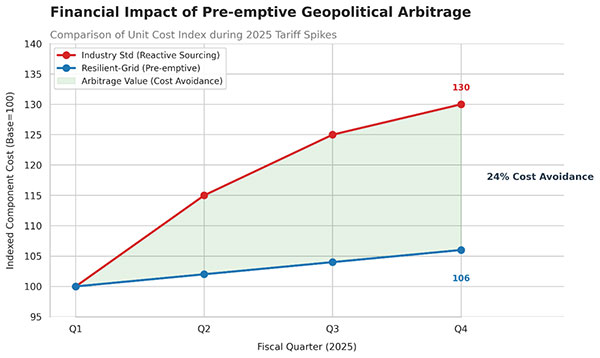
The objective is not to eliminate low-cost sourcing, but to ensure that cost leadership does not come at the expense of continuity.
B. Symbiotic margin preservation contracting
Traditional supplier agreements transfer most commodity and tariff risk to OEMs. In volatile environments, this creates sudden margin cliffs.
Under the Resilient-Grid approach, contracts are structured to share volatility in exchange for stability. Examples include volume guarantees tied to tariff thresholds, price corridors instead of fixed pricing, or suppliers absorbing an initial portion of tariff or commodity movement.
This structure incentivizes suppliers to hedge material exposure while giving OEMs predictable margin bands.
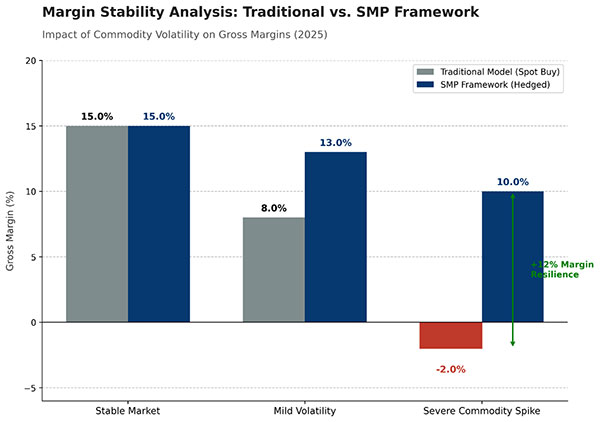
For mid-sized manufacturers, this approach functions as a practical hedge when financial derivatives are not viable.
C. Just-in-time liquidity (JIT-L)
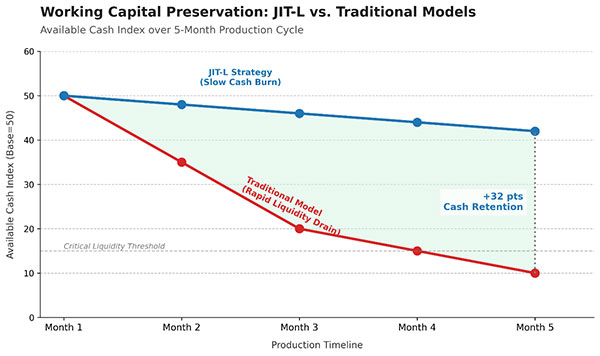
Just-in-time inventory reduces carrying cost but does not necessarily protect cash flow during demand or pricing shocks.
JIT-L aligns procurement release schedules to the cash conversion cycle, not just production schedules.
Operationally, JIT-L relies on SKU-level spend forecasting, integrated modeling of receivables, payables, and inventory turns, and predefined liquidity triggers tied to cash thresholds.
When working capital tightens, purchasing cadence adjusts automatically before financial stress becomes operational disruption.
Implementation timeline
The Resilient-Grid framework can be deployed without major system changes:
- Within 30 days: Risk-weighted origin mapping of top cost drivers
- Within 60 days: At least one credible alternate source qualified per critical component
- Within 90 days: Contract structures revised for volatility-sharing
- Ongoing: Quarterly liquidity stress testing tied to sourcing decisions
The key requirement is cross-functional alignment between procurement, finance, and engineering.
Strategic benefits
Organizations implementing Resilient-Grid sourcing can expect reduced exposure to sudden tariff impacts, improved supplier stability, more predictable gross margins, and better alignment between production planning and financial capacity.
Rather than chasing lowest cost in isolation, leaders gain the ability to choose when and where to absorb risk.
Conclusion
In an era defined by trade fragmentation and capital scarcity, competitive advantage increasingly comes from how supply chains absorb volatility, not just how they minimize cost.
The Resilient-Grid Model provides a practical playbook for executives seeking to protect margins, preserve liquidity, and maintain production continuity amid persistent uncertainty.
For supply chain leaders, the objective is no longer to build the cheapest network, but the most adaptable one.
Author Bio
Mukesh Sharma is vice president of global supply chain at Xos Inc., a U.S.-based commercial electric-vehicle (EV) and energy-storage systems (ESS) manufacturer. He leads sourcing strategy, supplier negotiations, and working-capital initiatives across batteries, power electronics, and vehicle systems.
SC
MR


More Supply Chain Management
- Managing human and AI teams across the supply chain
- AI won’t fix a broken supply chain foundation
- Stop moving boxes, start moving dollars: The new math of global supply chain velocity
- Consensus won’t cut it: Why assertive advocate CSCOs deliver sustained cost excellence
- Here comes the new supply chain: Is your organization ready?
- More Supply Chain Management
What's Related in Supply Chain Management
 Explore
Topics
Procurement & Sourcing News
- Innovators Netstock, Pickle Robot win NextGen Solution Provider awards
- From salon to dock door: Repurposing scheduling software for inbound flow
- The biggest barrier to AI in supply chains isn’t technology
- Rebuilding a planning function around the physical world
- Why companies blame the wrong supplier … and miss the real failure
- NextGen Supply Chain Conference unveils agenda focused on AI, execution and the future of leadership
- More Procurement & Sourcing
Latest Procurement & Sourcing Resources
Subscribe

Supply Chain Management Review delivers the best industry content.

Editors’ Picks



