
Sorry, but your login has failed. Please recheck your login information and resubmit. If your subscription has expired, renew here.
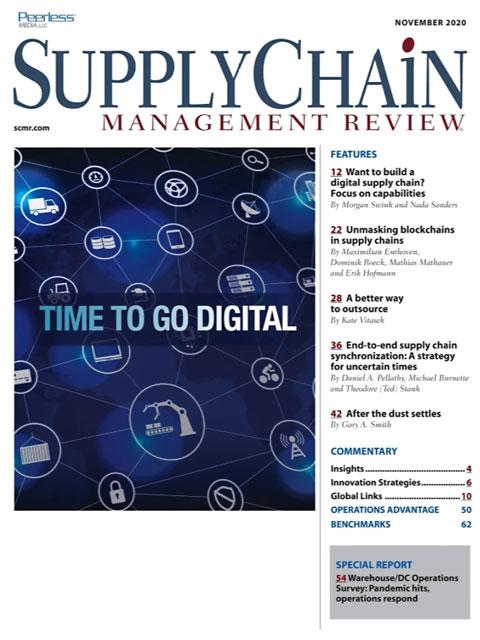
November 2020
Supply chains have been in the spotlight like never before over the last eight months. That hasn’t always been a good thing. The perception, reinforced by shortages of products essential to our daily lives, is that supply chains were not up to the task and failed. The reality, as argued by MIT’s Yossi Sheffi in his new book, “The New (Ab)Normal: Reshaping Business and Supply Chain Strategy Beyond COVID-19,” is that supply chains performed as designed—they did what we expected them to do. Browse this issue archive.Need Help? Contact customer service 1-508-503-1313 More options
This represents my fifth e-tailing update about the evolution of consumer e-commerce. The series has chronicled the evolution of e-tailing from the eyes of a supply chain analyst. It has primarily focused on the battles between the heavy-weights, brick-and-mortar Walmart and e-tailer Amazon, as a reflection of what has been happening in the industry.
In my last column, “Supply chain heroes and lessons from COVID-19,” I discussed the breakdown of two basic-need supply chains—food and medical supplies. I stated that what we have learned during the pandemic is that, despite creating very efficient supply chains, our efforts have sometimes fallen short of meeting some basic needs, even in affluent countries.
The U.S. food chain is really two distinct ones. The grocery industry that serves home consumption—think grocery stores and business-to-consumer (B2C)—and the other is the food service industry that delivers to restaurants and other commercial institutions for food consumed outside of the home (B2B). Prior to COVID-19, that second supply chain accounted for the majority of U.S. food expenditures, as Americans dined away from home more. Thus, this year’s update is all about COVID-19’s impact on e-tailing, because the disruption in the food supply has drastically affected the overall retail picture.

This complete article is available to subscribers only.
Log in now for full access or start your PLUS+ subscription for instant access.
SC
MR
Sorry, but your login has failed. Please recheck your login information and resubmit. If your subscription has expired, renew here.
November 2020
Supply chains have been in the spotlight like never before over the last eight months. That hasn’t always been a good thing. The perception, reinforced by shortages of products essential to our daily lives, is that… Browse this issue archive. Access your online digital edition. Download a PDF file of the November 2020 issue.This represents my fifth e-tailing update about the evolution of consumer e-commerce. The series has chronicled the evolution of e-tailing from the eyes of a supply chain analyst. It has primarily focused on the battles between the heavy-weights, brick-and-mortar Walmart and e-tailer Amazon, as a reflection of what has been happening in the industry.
In my last column, “Supply chain heroes and lessons from COVID-19,” I discussed the breakdown of two basic-need supply chains—food and medical supplies. I stated that what we have learned during the pandemic is that, despite creating very efficient supply chains, our efforts have sometimes fallen short of meeting some basic needs, even in affluent countries.
The U.S. food chain is really two distinct ones. The grocery industry that serves home consumption—think grocery stores and business-to-consumer (B2C)—and the other is the food service industry that delivers to restaurants and other commercial institutions for food consumed outside of the home (B2B). Prior to COVID-19, that second supply chain accounted for the majority of U.S. food expenditures, as Americans dined away from home more. Thus, this year’s update is all about COVID-19’s impact on e-tailing, because the disruption in the food supply has drastically affected the overall retail picture.
SUBSCRIBERS: Click here to download PDF of the full article.
SC
MR


Latest Supply Chain News
- Beyond the hype: Building flexible and scalable supply chains in a VUCA world
- Why your supply chain risk management plan will fail
- When component verification becomes operational
- Caught between a rock and a hard place: Mapping your supply chain
- What options do you really have? Shaping the supply chain resilience funnel
- More News
Latest Resources
 Explore
Procurement & Sourcing News
- Why companies blame the wrong supplier … and miss the real failure
- NextGen Supply Chain Conference unveils agenda focused on AI, execution and the future of leadership
- From fragmented negotiations to coordinated negotiation performance: an AI-enabled approach
- Supply chain resilience isn’t a data problem; it’s a judgment problem
- Why your supply chain risk management plan will fail
- When component verification becomes operational
- More Procurement & Sourcing
Latest Procurement & Sourcing Resources

Subscribe

Supply Chain Management Review delivers the best industry content.

Editors’ Picks



