
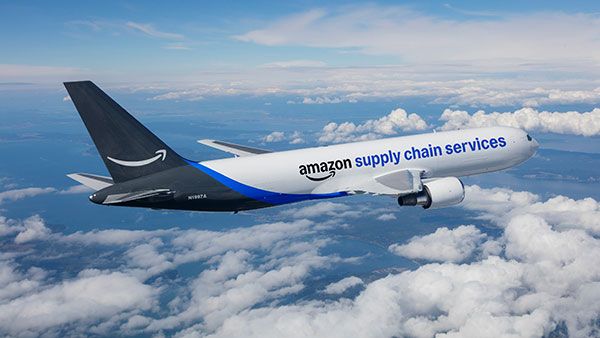
When Amazon announced the launch of Amazon Supply Chain Services (ASCS) on Monday, the headline was that the company was opening its end-to-end logistics network, across freight, fulfillment, and parcel delivery, to businesses of all sizes.
But for close observers of Amazon’s logistics operation, it was more a sign of finally, rather than surprise. Amazon changed the game in logistics with its Prime delivery service and two-day and then next-day shipping. Then it opened up that service to third party sellers on its platform, offering them the same fulfillment levers to pull. A few years ago, its Buy with Prime service launched, allowing companies to access Prime fulfillment services for off-Amazon sales, as long as they were a member of Amazon’s network.
Now, that same network has been opened up to any company, Prime member or not. Already, some big names have joined the fray, with Lands’ End, American Eagle Outfitters and Procter & Gamble are leveraging aspects of Amazon’s capabilities.
In a conversation with Supply Chain Management Review at the Gartner/Xpo Conference in Orlando on Monday, Peter Larsen, vice president of Amazon Supply Chain Services, said the move is less about a sudden strategic shift and more a culmination of a years-long build.
“We’ve been working on these supply chain capabilities for a long time, literally a couple decades,” he said.
The timing, however, is notable. Amazon is entering the broader third-party logistics (3PL) market amid ongoing volatility, capacity constraints, and rising transportation costs. Rather than viewing those conditions as a deterrent, Larsen suggested they were part of the rationale.
“I think we think that plays into our favor actually,” he said. “We’ve been dealing with as much volatility as anyone out there, and we’ve just got a couple decades of [experience under our belts].”
A gradual externalization of Amazon’s network
ASCS effectively extends the logistics backbone that powers Amazon’s retail and marketplace operations into a standalone service. The offering includes multimodal freight, distribution and fulfillment, and parcel delivery, all capabilities that have been incrementally opened to third-party sellers over time. It gives companies access to its transportation network that spans ocean, air, ground, and rail freight, supported by a fleet of 80,000+ trailers, 24,000+ intermodal containers, and 100+ aircraft.
According to Larsen, the final step of making the full suite available to any business required some internal restructuring.
“It took us a little bit of time to externalize our end-to-end supply chain so that business could have the options to use one piece of our network or all of it,” he said.
Much of that work involved decoupling systems originally built exclusively for Amazon sellers. What may sound simple at a high level, such removing the requirement for a seller ID, for example, was far more complex at Amazon’s scale, where hundreds of interconnected services had to be reconfigured.
The push to expand beyond sellers was also market-driven. Larsen noted that existing Amazon sellers were among the first to request broader access.
“They started to knock on our door [saying] ‘it’s a pain to have one supplier for our on-Amazon business and one supplier for our off-Amazon business. Can you open this up?,’” he said.
That demand led to rapid growth in off-Amazon logistics services for sellers, creating what Larsen described as a “logical extension” to now serve the broader market.
Not just excess capacity
Amazon’s move will inevitably raise questions about network utilization, particularly given its massive infrastructure investments over the past decade. Larsen acknowledged that additional volume can help smooth operations but pushed back on the idea that this is primarily about filling unused capacity.
“That’s certainly not the first reason we’re doing it,” he said. “The first reason is because our Amazon sellers started to knock on our door. Of course, more volume is always better for everybody who uses the network.”
In practice, that means ASCS may help Amazon better utilization in its network during off-peak periods, even if that’s not the core strategic driver.
Competing on scale, expectations, and data
By opening its network, Amazon is positioning itself more directly against established 3PLs, brokers, and freight providers. Larsen framed Amazon’s differentiation around three core advantages: capacity, operational rigor, and data.
“We build for a peak that very few, if any, other logistics companies build for,” he said, noting the company’s ability to absorb demand spikes or disruptions.
That capacity is paired with what Larsen described as a high operational bar shaped by decades of serving Amazon Prime customers.
“Prime customers have rising expectations, they always want delivery faster and with more certainty,” he said.
The third pillar—data and AI—is increasingly central. Amazon’s forecasting models operate at massive scale, enabling inventory placement and demand planning capabilities that many enterprises struggle to replicate.
“We’re forecasting demand and placement at a regional level for over 400 million SKUs every day,” Larsen said, arguing that scale helps mitigate one of the most persistent challenges in supply chain planning: the “cold start” problem for new products. By leveraging existing demand patterns across similar SKUs, Amazon can make more informed placement decisions from day one.
Extending Prime-like capabilities beyond Amazon
ASCS also includes parcel delivery and fulfillment services that can extend Amazon’s speed advantages to external customers. Through offerings like Buy with Prime and expedited fulfillment, companies can tap into delivery speeds that approach the Prime experience, though not always identically.
Over time, he added, those services will continue to improve as Amazon’s broader network becomes faster and more efficient.
A familiar playbook
The comparison to Amazon Web Services (AWS) is intentional. Larsen acknowledged that Amazon is applying a similar framework: identify a large, addressable problem, deploy internal capabilities externally, and build a scalable business around it.
“We’re running effectively the same playbook with Amazon Supply Chain Services,” he said.
But logistics is not cloud computing. Physical networks come with constraints such as capacity, labor, infrastructure, and regulation that are far harder to abstract away.
Still, Amazon is betting that its combination of scale, operational discipline, and data advantage can translate into a compelling alternative for companies navigating an increasingly complex supply chain landscape.
The bigger question now is not whether Amazon can enter the 3PL market, but how disruptive it will ultimately be once fully embedded within it.
SC
MR

More Third Party Logistics
- Amazon opens its supply chain network to everyone
- Top 50 3PLs: Growth collides with global disruption
- Beyond the contract: Why your 3PL should be a strategic collaborator, not a commodity
- C.H. Robinson rolls out AI agent to address LTL classification overhaul
- Trust the team, win the customer
- More Third Party Logistics
What's Related in Third Party Logistics
 Explore
Topics
Procurement & Sourcing News
- Innovators Netstock, Pickle Robot win NextGen Solution Provider awards
- From salon to dock door: Repurposing scheduling software for inbound flow
- The biggest barrier to AI in supply chains isn’t technology
- Rebuilding a planning function around the physical world
- Why companies blame the wrong supplier … and miss the real failure
- NextGen Supply Chain Conference unveils agenda focused on AI, execution and the future of leadership
- More Procurement & Sourcing
Latest Procurement & Sourcing Resources
About the Author
Brian Straight, SCMR Editor in Chief

Brian Straight is the Editor in Chief of Supply Chain Management Review. He has covered trucking, logistics and the broader supply chain for more than 15 years. He lives in Connecticut with his wife and two children. He can be reached at [email protected], @TruckingTalk, on LinkedIn, or by phone at 774-440-3870.
Follow SCMR on social media.
@SupplyChainManagementReview on Facebook
@SCMR on Twitter
SCMR on Linkedin
Subscribe

Supply Chain Management Review delivers the best industry content.

Editors’ Picks



