
For years, supply chain conversations around last-mile delivery have largely focused on routing optimization, carrier capacity, and delivery speed. But as retailers and logistics providers continue compressing fulfillment windows, attention is increasingly shifting to a much smaller but operationally critical challenge: what happens after the delivery vehicle actually arrives.
At Home Delivery World, HERE Technologies was on hand explaining how that “last meter” of delivery can be leveraged by organizations to improve the delivery experience.
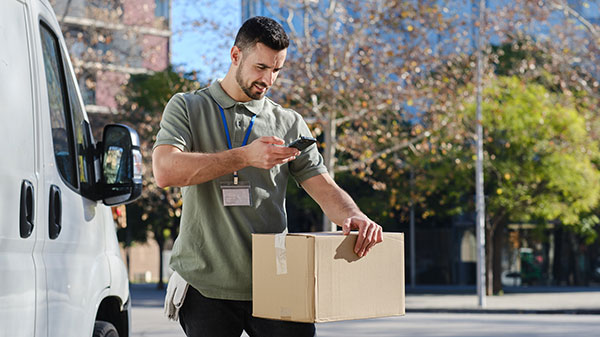
The concept moves beyond simply getting a truck to the correct address. Instead, it focuses on helping drivers navigate the final steps of delivery more efficiently, whether that means identifying the best parking location, the fastest walking path to a building entrance, or the correct access point inside increasingly complex urban and commercial environments.
Bart Coppelmans, senior director of product management, Business Unit Head Enterprise products, at HERE Technologies, told Supply Chain Management Review the industry is beginning to recognize that delivery execution depends not only on route planning, but on the constant feedback loop between planning systems and real-world driver behavior.
“The plan is not always realistic,” Coppelmans said during the interview at the event. “There are things changing [so you] need to be much more dynamic in last-minute orders. There’s certain things you need to change and also take the feedback from the driver into account in order to kind of improve the plan.”
As companies attempt to improve delivery density, reduce failed deliveries, and maximize driver productivity, resolving that operational disconnect between the plan and actual execution is becoming more important.
Moving beyond rooftop navigation
Traditional navigation systems have historically focused on directing drivers to a geographic destination, often a street address. But that level of precision is increasingly insufficient in dense urban areas, apartment complexes, campuses, hospitals, and commercial environments where the final delivery handoff can consume significant time.
To address that challenge, HERE recently unveiled an AI-powered “Last Meter” guidance solution designed to provide more granular delivery guidance after a driver exits the vehicle.
According to Coppelmans, the system uses sensor and positioning data collected from handheld devices and driver navigation systems to better understand how deliveries are actually completed in the field.
“What we basically do is deploy a client-side on that device and then it’s automatically in the background collecting the trace,” he explained.
The system attempts to differentiate between traffic stops, parking locations, walking paths, and building entrances. Over time, repeated delivery patterns allow the platform to identify commonly used parking areas and preferred delivery approaches.
“The more deliveries that are executed, the more it improves the directions for the next one,” Coppelmans said. “And it is also benefiting the broader community.”
The company says the goal is not to rigidly dictate driver behavior but to create operational recommendations that improve delivery consistency and reduce wasted motion.
That flexibility remains important, particularly as logistics providers attempt to balance automation with driver autonomy.
“We basically give different options of how they want to configure it for their customers,” Coppelmans said. “This is really tied to their operations and how much flexibility they want to give the drivers or not.”
Why seconds matter in modern delivery networks
While saving a few seconds on a single stop may appear insignificant, those efficiencies compound rapidly across large delivery networks. Coppelmans said one of the primary KPIs being evaluated during current pilot programs is whether the technology can reduce service time at each stop enough to increase total delivery productivity.
“If it saves 30 seconds of delivery, maybe it doesn’t sound that much,” he acknowledged. “But at the end of the day, maybe they’ve saved half an hour and now they can make another five deliveries.”
As labor costs rise and delivery expectations tighten, logistics organizations are increasingly searching for operational gains in smaller increments rather than relying solely on large-scale network redesigns. The challenge, however, is that many of those inefficiencies exist in areas traditional routing software was never designed to address.
The company’s current pilot programs in the U.S. and Europe are attempting to determine how effectively AI-driven guidance can improve execution precision while maintaining enough operational flexibility for real-world delivery conditions.
AI still struggles with geospatial reasoning
The conversation also highlighted another growing challenge inside supply chain AI initiatives: most large language models still struggle to understand geospatial reasoning. While generative AI tools have rapidly improved conversational capabilities and workflow automation, Coppelmans argued that many models still produce unreliable results when dealing with complex routing, mapping, and logistics constraints.
“What we’re seeing with AI … and all kinds of LLMs a little bit, is that they don’t understand geospatial,” he said. “And they really also hallucinate in certain complex queries.”
That limitation becomes particularly problematic in logistics operations involving truck restrictions, compliance requirements, delivery sequencing, or complex route optimization.
As an example, Coppelmans described how current AI systems may struggle with relatively straightforward logistics questions involving truck-routing constraints, mandatory parking requirements, or geographic stopover calculations.
To address that issue, HERE recently introduced what it calls “location reasoning,” a geospatial grounding layer designed to provide AI systems with contextual location intelligence.
The technology is intended to help AI agents and logistics systems better interpret routing constraints, location data, and real-world operational conditions before generating decisions or recommendations.
As more logistics providers implement Agentic AI systems capable of making operational decisions, those systems will require increasingly accurate location awareness to function reliably in physical environments.
From generative AI to physical AI
For much of the past two years, the industry’s AI focus centered heavily on generative AI. In 2026, however, more conversations are shifting toward what some are calling “physical AI” — the use of AI systems inside real-world operational environments involving robotics, autonomous systems, and dynamic execution workflows.
Coppelmans said the company is already exploring how its location intelligence technologies may eventually support curbside robotics and autonomous delivery systems.
“We’re monitoring the effect of robotics on curbside robotics deliveries,” he said.
That includes evaluating how mapping precision, geospatial grounding, and real-world execution feedback could support robotic delivery operations in the future.
“How effectively can these robotics [companies] automate in the operational space,” he said, “and how do they also need mapping and location technology grounding further to make sure that they can better deploy that in their operations.”
AI’s role in logistics is rapidly evolving beyond simple automation or predictive analytics. Increasingly, the next phase appears focused on helping AI systems better understand and operate inside physical environments where precision, location awareness, and real-time adaptability matter just as much as raw computational power.
SC
MR

More Last Mile Delivery
- AI is reshaping the last meter of delivery
- Last-mile delivery success begins before the driver arrives
- The final frontier: Navigating the last-mile paradox in 2026
- Tractor Supply to receive NextGen Supply Chain Visionary Award
- Demography is the missing variable in supply chain strategy
- More Last Mile Delivery
 Explore
Topics
Procurement & Sourcing News
- Wayfair executive to share lessons from building a tech-driven delivery network in NextGen Keynote
- Surging AI adoption doesn’t match mass layoff narrative
- Tillamook turns supply chain planning into growth engine
- Why supply chains fail at launch: It’s not the plan, it’s the execution
- Look who’s calling (from Mexico): Gang members deported from the U.S.
- AI won’t fix a broken supply chain foundation
- More Procurement & Sourcing
Latest Procurement & Sourcing Resources

About the Author
Brian Straight, SCMR Editor in Chief

Brian Straight is the Editor in Chief of Supply Chain Management Review. He has covered trucking, logistics and the broader supply chain for more than 15 years. He lives in Connecticut with his wife and two children. He can be reached at [email protected], @TruckingTalk, on LinkedIn, or by phone at 774-440-3870.
Follow SCMR on social media.
@SupplyChainManagementReview on Facebook
@SCMR on Twitter
SCMR on Linkedin
Subscribe

Supply Chain Management Review delivers the best industry content.

Editors’ Picks



