
Sorry, but your login has failed. Please recheck your login information and resubmit. If your subscription has expired, renew here.
E-commerce growth is now the operating environment in supply chains rather than a disruptive force. What began as a channel strategy has evolved into a structural shift that is redefining how supply chains are designed, managed, and optimized. Today, the question for most organizations is no longer whether to pursue omnichannel capabilities, but how to make them profitable at scale.
The latest research from the MIT Omnichannel Supply Chain Lab underscores this transition. Based on a survey of 647 supply chain leaders across industries, the findings reflect the priorities of large, operationally complex organizations: 72% of respondents represent companies with more than 1,500 employees, and most hold senior leadership roles. Nearly 80% report ongoing e-commerce growth, and a similar share are implementing or planning omnichannel distribution strategies—a 10% increase from the previous year.
SC
MR
Sorry, but your login has failed. Please recheck your login information and resubmit. If your subscription has expired, renew here.
E-commerce growth is now the operating environment in supply chains rather than a disruptive force. What began as a channel strategy has evolved into a structural shift that is redefining how supply chains are designed, managed, and optimized. Today, the question for most organizations is no longer whether to pursue omnichannel capabilities, but how to make them profitable at scale.
The latest research from the MIT Omnichannel Supply Chain Lab underscores this transition. Based on a survey of 647 supply chain leaders across industries, the findings reflect the priorities of large, operationally complex organizations: 72% of respondents represent companies with more than 1,500 employees, and most hold senior leadership roles. Nearly 80% report ongoing e-commerce growth, and a similar share are implementing or planning omnichannel distribution strategies—a 10% increase from the previous year.
Together, these trends point to a clear conclusion: omnichannel is no longer optional. But as adoption matures, companies are confronting a new reality that is defined less by growth and more by complexity, cost, and execution.
E-commerce growth meets operational reality
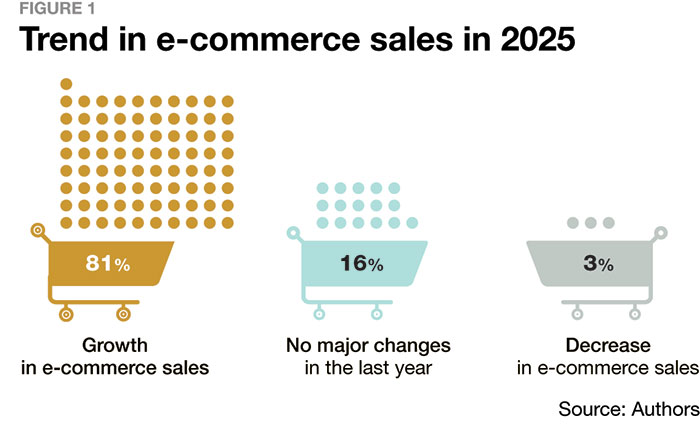
E-commerce continues to expand, with 81% of surveyed organizations reporting ongoing growth in this channel. However, the nature of that growth is changing. Organizations are increasingly confronting the operational consequences that come with higher digital volumes rather than focusing purely on revenue expansion.
As shown in Figure 1, e-commerce growth is nearly universal among surveyed companies. This sustained trajectory reinforces why omnichannel capabilities have become foundational rather than optional; yet, it also introduces new pressures across the supply chain.
Cost-to-serve and returns management are two areas where this pressure is most visible. The share of respondents citing cost-to-serve as a major impact increased from 38% to 42% year over year, while returns rose from 33% to 40%. These increases reflect the hidden complexity behind e-commerce growth: fragmented orders, faster delivery expectations, and higher return volumes all contribute to rising operational costs. At the same time, the impact of e-commerce is now distributed across the entire supply chain rather than being confined to a few functions.
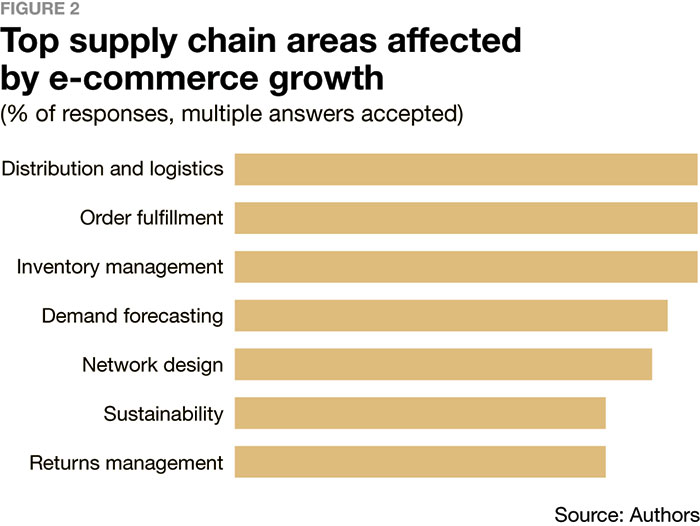
Figure 2 highlights how broadly e-commerce is reshaping operations. Distribution and logistics, inventory management, and order fulfillment each emerge as primary impact areas, all cited by roughly 60% of respondents. This clustering around execution functions suggests that companies are no longer struggling to enable e-commerce but are working to run it efficiently at scale.
Notably, sustainability has nearly doubled as a reported impact area, jumping from 27% to 48% in a single year. Returns management is also rising sharply. Together, these trends signal a shift toward a more cost- and impact-aware operating model.
As shared in a recent episode of the MIT Center for Transportation & Logistics’ podcast, Supply Chain Frontiers, companies are moving from building capability to enhancing and optimizing network performance from the end-to-end supply chain. (You can listen to the podcast here: https://ctl.mit.edu/podcasts/state-ai-warehousing-and-omnichannel) This shift from expansion to optimization is becoming the defining challenge of omnichannel supply chains.
The omnichannel operating challenge
If e-commerce growth is the catalyst, omnichannel execution is where the real challenge lies. Integrating online and offline channels remains the most significant strategic hurdle, cited by 51% of respondents, up from 44% the previous year. Close behind is the complexity of fulfillment decision-making, identified by 50%.
These challenges reflect the difficulty of orchestrating multiple channels within a single system. Decisions about where to fulfill orders, how to allocate inventory, and how to balance cost with service levels are increasingly interdependent.
Importantly, the data suggest there is no single bottleneck. Instead, pain points are distributed across core operational functions. Inventory positioning, demand planning, and logistics costs are each cited by 53% of respondents, highlighting the interconnected nature of omnichannel complexity.
Physical stores remain central to this equation as click-and-collect, curbside pickup, and in-store fulfillment are each used by roughly 54% to 55% of respondents. Rather than being replaced, stores are being reconfigured as fulfillment nodes within a broader network.
As co-author Ponce notes, “omnichannel isn’t just about adding more channels, it’s about having full synchronization.” That synchronization requires real-time coordination across inventory, orders, and customer touchpoints—which traditional tools struggle to achieve at scale.
AI as the backbone of execution
As operational complexity increases, organizations are turning to artificial intelligence and advanced technologies as foundational capabilities rather than experimental tools, as in previous years.
Figure 3 illustrates a clear shift toward more automated, data-driven fulfillment models. Technologies such as autonomous mobile robots (AMRs) and multi-shuttle systems are gaining traction rapidly, reflecting the need for speed, flexibility, and precision.
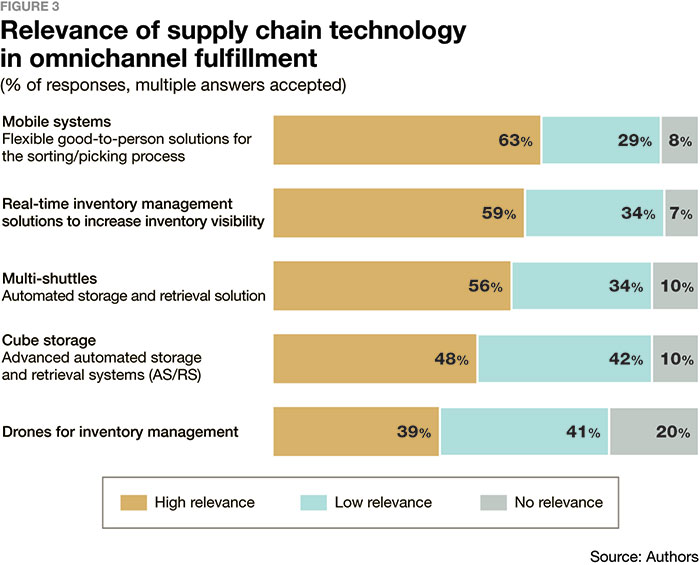
The perceived relevance of AMRs has increased from 50% to 63% in one year, while multi-shuttle systems have surged from 14% to 56%. These gains signal a move toward scalable, goods-to-person operations that can handle high variability in demand.
Beyond physical automation, AI is increasingly embedded across core decision-making functions. Respondents report high impact in customer experience (64%), demand forecasting (63%), warehouse management (61%), and inventory management (60%).
This marks a significant evolution. As Ponce explains, “AI is becoming foundational—it’s not optional anymore.” She notes that organizations are moving from isolated applications, such as demand forecasting, to broader deployment across “warehouse operations, inventory management, transportation, and fulfillment.”
At the same time, AI-driven personalization continues to expand, with marketing campaigns (69%), product recommendations (66%), and customer segmentation (66%) leading adoption. These front-end capabilities, however, depend on equally advanced back-end systems, further reinforcing the need for integrated, end-to-end orchestration.
From capability building to competitive differentiation
Taken together, the findings point to a fundamental evolution in omnichannel supply chains. In earlier stages, the focus was on building capabilities: establishing e-commerce channels, enabling integration, and experimenting with new technologies. Today, the emphasis has shifted toward optimization and profitability.
This shift is driven by increasing customer expectations. Consumers demand faster, more flexible, and more personalized experiences, often with little tolerance for error. Meeting these expectations requires not just infrastructure, but precise, real-time decision-making.
AI is emerging as the key enabler of that shift. As Ponce notes in the podcast discussion, the increasing complexity of omnichannel operations (more SKUs, more channels, and greater demand variability) means that “old-school tools are not as useful as they were in the past.” Instead, organizations need systems that can process large datasets and make decisions in real time.
As such, AI has become a prerequisite for competitiveness.
The road ahead
Omnichannel supply chains are evolving from digitally enabled networks to intelligently orchestrated ecosystems. The transition is not without challenges, but it presents significant opportunities for organizations willing to rethink how they operate.
The path forward will require a shift in mindset from viewing technology as a set of tools to recognizing it as the foundation of the operating model. It will also require deeper integration across functions and greater investment in data, systems, and talent.
For supply chain leaders, the message is clear: the era of omnichannel expansion is giving way to an era of intelligent orchestration. Success will depend not just on keeping pace with growth, but on upskilling the workforce to handle the complexity that comes with such rapid growth.
About the authors:
Eva Ponce, Ph.D., is a research scientist at MIT CTL and the Director of the Omnichannel Supply Chain Lab. She can be reached [email protected].
Laura Allegue is the Online Corporate Edge Coordinator at MIT CTL and supports applied research at the Omnichannel Supply Chain Lab. She can be reached at [email protected].
SC
MR

More Omnichannel Fulfillment
What's Related in Omnichannel Fulfillment
 Explore
Topics
Procurement & Sourcing News
- Why companies blame the wrong supplier … and miss the real failure
- NextGen Supply Chain Conference unveils agenda focused on AI, execution and the future of leadership
- From fragmented negotiations to coordinated negotiation performance: an AI-enabled approach
- Supply chain resilience isn’t a data problem; it’s a judgment problem
- Why your supply chain risk management plan will fail
- When component verification becomes operational
- More Procurement & Sourcing
Latest Procurement & Sourcing Resources
Subscribe

Supply Chain Management Review delivers the best industry content.

Editors’ Picks



