
According to the 2019 A.T. Kearney Foreign Direct Investment (FDI) Confidence Index, global shippers are more likely to invest broadly around the world in the years to come.
The global strategy and management consulting firm reports that more than 75 percent of investors surveyed say FDI is more important now than it had been in recent years. And almost four-fifths say their companies will increase their level of FDI in the next three years.
Investors provide mixed signals on where this investment is likely to go, however, as they appear to be open to investment in a wide array of markets.
Irrespective of their change in rank, all but two countries among the top 25 markets on the Index enjoy increases this year in their overall scores. More generally, almost all of the 70-plus countries included in this survey of global investors experience gains. These increases represent the most dramatic upward trend in scores in the 20-year history of the Index.
A paradox arises in the markets on which investors are focused. On the one hand, developed markets account for 22 of the 25 spots on the Index—hitting their highest ever share of positions, even outpacing last year's record. On the other hand, the average score for frontier markets included in the survey increases the most, followed by emerging markets, with developed markets bringing up the rear.
This paradox may be explained by the fact that there are far more emerging and frontier markets than there are developed markets, so it is simply more difficult for emerging or frontier markets to break into the top 25 spots on the Index. Or it may be that while developed markets are currently favored, investors have begun the process of examining emerging markets for future investment opportunities.
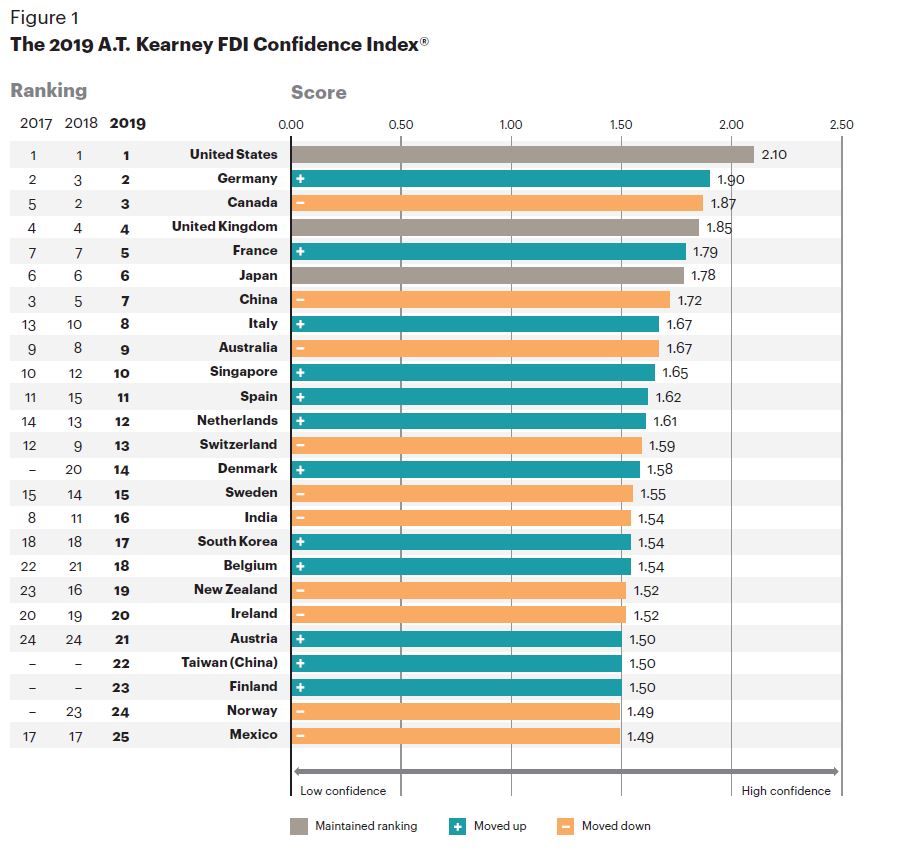
There is some evidence to support the latter rationale: Even as investors remain focused on FDI opportunities in developed markets, they also see risks rising within these markets. Investors point to political instability in developed markets as the most likely risk this year, followed closely by an economic crisis and a more restrictive business environment. Investors see these risks as far more likely to occur this year than the corresponding risks in emerging markets.
“The paradox inherent in investors' views on developed markets may be due to their greater focus on the risks in these markets because of their strong investment intentions there,” says Paul A. Laudicina, founder of the FDI Confidence Index and chairman of A.T. Kearney's Global Business Policy Council.
“At the same time, the risk of populism and protectionism in developed markets may actually be driving investment intentions as companies seek to maintain access to these key markets.”
A variety of other paradoxes arise for companies as a result of an increasingly complex global environment. The results of the FDI Confidence Index survey suggest that these paradoxes can be explained by investors prioritizing FDI as a part of business strategies to adapt to the age of “multi-localism” – a period characterized by the preference for local communities, industries, products, cultures, and customs.
One of the most interesting effects of the age of multi-localism on FDI flows is that it appears to be increasing the importance of cities in driving investment decisions.
Strikingly, almost 60 percent of investors do not start their investment destination decision-making process at the country level. Instead, they begin by selecting a region in which to invest or by analyzing city options at a global level. Investors say that megacities and large cities will attract the lion's share of FDI inflows in the coming years, regardless of the type of business activity.
“The concentration of talent, innovation, and economic activity is likely to further favor megacities and large cities over less-populated alternatives,” says Erik Peterson, managing director of the Global Business Policy Council and co-author of the study.
“This is clear in the strong correlation between the top-ranked countries on the FDI Confidence Index and the top-ranked cities on A.T. Kearney's most recent Global Cities Index.”
Courtney Rickert McCaffrey, manager of thought leadership in strategy and management consulting firm A.T. Kearney's Global Business Policy Council, and co-author of the Confidence Inex, told SCMR in an interview that the survey contains some unexpected responses.
“One surprising finding is that 62 percent of investors are more optimistic about the global economy this year than they were last year,” she says. “That contrasts with most international economic forecasts, which predict a deceleration in the global economy this year. Although investors' bullishness on the global economy does fall a bit from last year, the first such decline since 2016.”
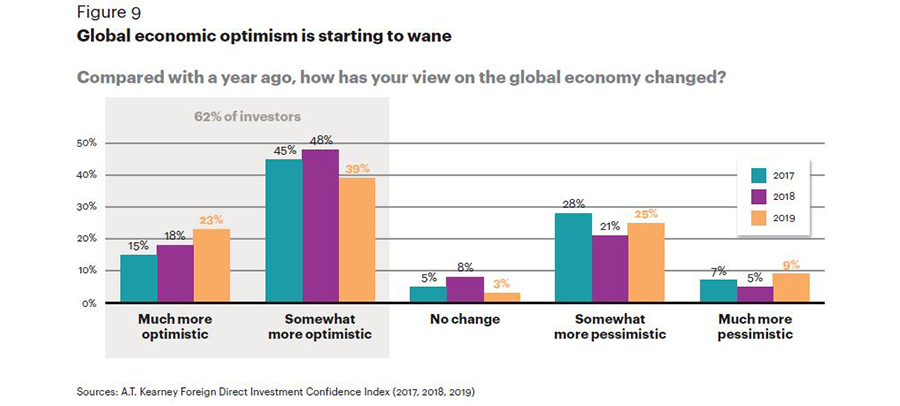
She also notes that in an environment of heightened geopolitical risk and rising political and economic risks within key markets, supply chain managers should focus on the unique dynamics in local markets.
“They should also consider shifting toward more regional supply chains and devolving management and operations to the local level,” she concludes. “That would include having supply chain teams engage more with local and city-level stakeholders than they have done in the past.”
SC
MR


Latest Supply Chain News
- 4 moves supply chains must make as AI triggers a memory supply shock
- Innovators Netstock, Pickle Robot win NextGen Solution Provider awards
- Bigger trucks versus broken bridges and roads
- From salon to dock door: Repurposing scheduling software for inbound flow
- The biggest barrier to AI in supply chains isn’t technology
- More News
Latest Podcast
 Explore
Business Management News
- Innovators Netstock, Pickle Robot win NextGen Solution Provider awards
- Bigger trucks versus broken bridges and roads
- From salon to dock door: Repurposing scheduling software for inbound flow
- The biggest barrier to AI in supply chains isn’t technology
- Rebuilding a planning function around the physical world
- Why companies blame the wrong supplier … and miss the real failure
- More Business Management
Latest Business Management Resources
About the Author
Patrick Burnson, Executive Editor

Patrick is a widely-published writer and editor specializing in international trade, global logistics, and supply chain management. He is based in San Francisco, where he provides a Pacific Rim perspective on industry trends and forecasts. He may be reached at his downtown office: [email protected].
Follow SCMR on social media.
@SupplyChainManagementReview on Facebook
@SCMR on Twitter
SCMR on Linkedin
Subscribe

Supply Chain Management Review delivers the best industry content.

Editors’ Picks



