
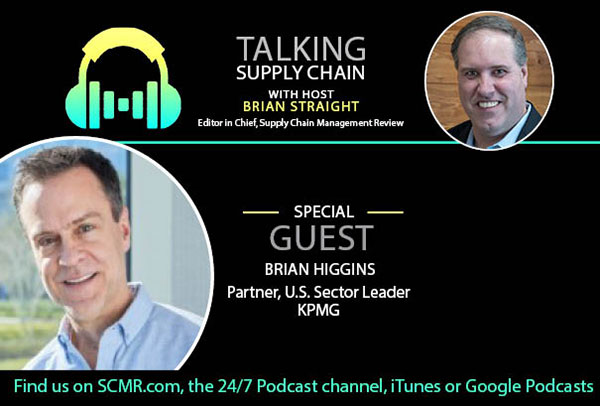
Six months after first discussing the possibility of a U.S. manufacturing renaissance, Talking Supply Chain host Brian Straight welcomes Brian Higgins, U.S. sector leader for industrial manufacturing at KPMG, back to the Talking Supply Chain podcast to assess what has changed.
While investment in domestic manufacturing continues to grow, Higgins argues that the real challenge has shifted from announcing projects to executing them. The conversation explores how tariffs, geopolitical instability, labor shortages, AI adoption and supply chain resilience are reshaping manufacturing strategy, while emphasizing that success will depend less on predicting disruption and more on building organizations capable of sensing and responding faster than competitors.
Key themes
1. The manufacturing renaissance has begun—but it’s still in its early stages
Despite continued investment in U.S. manufacturing facilities and foreign direct investment, Higgins cautions against declaring victory too soon. The industry has moved from announcements toward execution, but manufacturers continue to face permitting delays, labor shortages, supplier constraints and technology deployment challenges that slow progress.
Key takeaway: The opportunity is real, but execution, not investment announcements, will determine whether the manufacturing renaissance fulfills its promise.
Key quote: “We’ve seen the initial investment wave ... but the full op and supply chain transformation is still unfolding. We’re seeing a lot of movement from announcements to execution.”
2. Geopolitical uncertainty has become a permanent supply chain design requirement
Rather than viewing the conflict with Iran as a standalone event, Higgins argues that manufacturers should see it as another reminder that geopolitical disruption is now a permanent feature of supply chain management. From COVID-19 and semiconductor shortages to the Red Sea, Ukraine and tariffs, companies must design networks that assume disruption rather than hope to avoid it.
Key takeaway: Resilience is no longer about reacting to isolated crises, it’s about building supply chains that expect continuous disruption.
Key quote: “Geopolitical risk is an absolute permanent design consideration in the supply chain strategy.”
3. Labor remains manufacturing’s biggest execution challenge
While manufacturing employment has remained relatively flat, Higgins points to hundreds of thousands of open positions that companies struggle to fill. The challenge isn’t simply hiring more people, it’s finding workers with specialized skills in robotics, controls engineering, maintenance and advanced manufacturing.
Key takeaway: The manufacturing workforce challenge is increasingly about skills availability rather than overall employment levels.
Key quote: “Manufacturing investment and manufacturing employment ... are not moving in lockstep.”
4. AI is moving beyond pilots, but trust will determine adoption
Manufacturers are beginning to deploy AI in practical applications such as procurement analytics, contract management and operational decision-making. But Higgins argues that the technology’s biggest obstacle isn’t technical capability, it’s organizational trust. Employees need AI recommendations to be explainable before they’ll confidently act on them.
Key takeaway: The next phase of AI adoption will depend as much on explainability and trust as it does on technological capability.
Key quote: “Trust is quickly becoming the biggest constraint on getting as much value from AI. The human in the loop needs to feel like it's explainable.”
5. Clean, connected data will separate AI leaders from everyone else
As AI becomes widely available, Higgins believes competitive advantage will shift toward organizations with connected, trusted enterprise data. Manufacturers continue to struggle with fragmented information spread across ERP, MES, PLM and supplier systems, making data integration one of the most important investments companies can make.
Key takeaway: In the AI era, data quality will increasingly determine competitive advantage.
Key quote: “The differentiation is going to be who has the cleanest data and the most connected digital threads across the enterprise.”
6. Speed will define the winners
Higgins closes by arguing that manufacturers shouldn’t wait for uncertainty to disappear because it won’t. Instead, leaders should invest in connected data, AI-enabled forecasting and scenario planning so they can recognize change earlier and respond faster than competitors.
Key takeaway: The manufacturers that thrive won’t necessarily predict every disruption, they’ll simply respond to change faster than everyone else.
Key quote: “The biggest risk is not being wrong. The bigger risk is being slow.”
Overall takeaway
The conversation reinforces a theme that has emerged repeatedly across recent Talking Supply Chain episodes: resilience is evolving from a defensive strategy into an organizational capability. Whether the issue is reshoring, AI adoption, geopolitical risk or labor shortages, manufacturers are discovering that competitive advantage increasingly comes from agility—building supply chains that can sense change, make decisions quickly and execute before competitors do. Rather than waiting for uncertainty to fade, leading manufacturers are learning to operate effectively within it.Top of Form
Subscribe to the Supply Chain Management Review podcast
Sign up today and get the next podcast episode sent to you. Subscribe via Apple and Google Podcasts or choose another podcast platform. Subscribe via RSS or download an MP3 or media file.Latest Supply Chain Management Review podcast episodes
Here are a few of our latest podcast episodes.- Talking Supply Chain: The Strait of Hormuz is open, but normal is not near.
- Talking Supply Chain: Building the Supply Biome.
- Talking Supply Chain: Moving from AI pilot to execution with AWS’ Petra Schindler-Carter.
- Talking Supply Chain: How logistics leaders are winning in volatile times.
- Talking Supply Chain: AI and the new trade barrier.
- Talking Supply Chain: Rethinking supplier relationships.
SC
MR

Subscribe

Supply Chain Management Review delivers the best industry content.

Editors’ Picks



