
Artificial intelligence is widely expected to accelerate global trade, improve decision-making, and unlock new efficiencies across supply chains. But beneath that promise lies a reality few are grasping, and it is one that might result in more market barriers than anticipated.
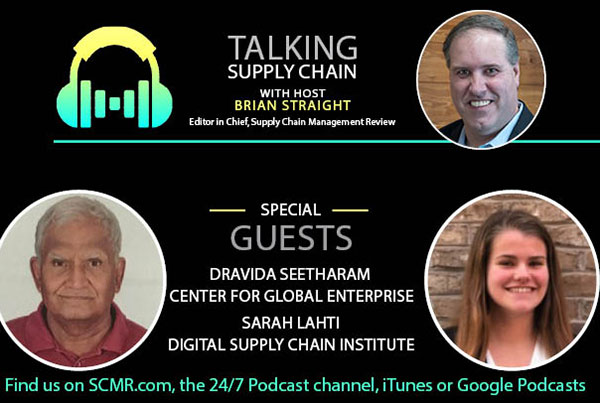
In this episode of Talking Supply Chain, host Brian Straight is joined Dravida Seetharam, a fellow at the Center for Global Enterprise, and Sarah Lahti, who is the Director of Operations and Program Management for the Digital Supply Chain Institute, to help make sense of AI and whether AI is truly leveling the playing field or quietly creating new barriers. From infrastructure and talent gaps to regulatory fragmentation and cyber risk, the discussion highlights how AI may be reshaping not just supply chains, but who gets to compete in them.
Key themes & takeaways
AI is both an enabler and a barrier to global trade
While AI can reduce costs and improve forecasting, it also introduces new requirements around data infrastructure, capital investment, and technical expertise that not all organizations or countries can meet.
Key takeaway: AI is not automatically democratizing supply chains, it is amplifying the capabilities gap between leaders and laggards.
Key quote: “AI is enhancing trade for those that can leverage it… while restricting trade for those that cannot.”
A new ‘invisible’ barrier is emerging: digital infrastructure and regulation
Unlike traditional barriers like tariffs, AI introduces challenges tied to data sovereignty laws, regional regulations, and access to computing power.
Key takeaway: Supply chain leaders must rethink what “market access” means in a digital-first, AI-driven economy.
Key quote: “AI is creating a new, invisible, structural sort of barrier.”
The AI divide is being driven by infrastructure, talent, and capital
High costs for data centers, limited access to skilled talent, and uneven capital availability are creating a widening gap between high- and low-income economies.
Key takeaway: The biggest constraints on AI adoption are not the technology itself but the ecosystem required to support it.
Key quote: “What matters is reliable power, affordable computing, and skilled people.”
Infrastructure constraints, especially energy, may limit AI growth
Data centers require massive power and long lead times for grid development, creating bottlenecks that could shape where AI-driven supply chains can operate.
Key takeaway: Energy availability and infrastructure investment will become key competitive differentiators in global supply chains.
Key quote: “Electricity demand for AI infrastructure is going to exponentially increase.”
Regulatory fragmentation is reshaping global supply chains
Countries are developing their own AI rules to address security and sovereignty concerns, but this is creating a more complex and fragmented digital trade environment.
Key takeaway: Global supply chains may become less interconnected as companies adapt to region-specific AI regulations.
Key quote: “Regulatory fragmentation is one of the major AI barriers at this point.”
Cyber risk must become a core operational capability
As AI expands the attack surface, companies must prepare for disruption, not just prevention, by building resilience across their entire value chain.
Key takeaway: Future-ready supply chains will treat cyber readiness like any other operational capability—tested, rehearsed, and embedded.
Key quote: “Cybersecurity needs to be addressed as a core business discipline.”
Winning companies will adapt for clarity
Leaders must assess digital readiness across partners, invest in talent, and build relationships with regulators and ecosystem players.
Key takeaway: The companies that succeed won’t be the ones with the best AI, they’ll be the ones that adapt fastest to the system around it.
Key quote: “These barriers are not temporary. They’re structural.”
Listen today.
Subscribe to the Supply Chain Management Review podcast
Sign up today and get the next podcast episode sent to you. Subscribe via Apple and Google Podcasts or choose another podcast platform. Subscribe via RSS or download an MP3 or media file.Latest Supply Chain Management Review podcast episodes
Here are a few of our latest podcast episodes.- Talking Supply Chain: The Strait of Hormuz is open, but normal is not near.
- Talking Supply Chain: Building the Supply Biome.
- Talking Supply Chain: Moving from AI pilot to execution with AWS’ Petra Schindler-Carter.
- Talking Supply Chain: How logistics leaders are winning in volatile times.
- Talking Supply Chain: AI and the new trade barrier.
- Talking Supply Chain: Rethinking supplier relationships.
SC
MR

Subscribe

Supply Chain Management Review delivers the best industry content.

Editors’ Picks



