
For years, supply chain technology has focused on the single goal of visibility, with companies investing heavily in tracking systems, dashboards, and control towers designed to show where products are, when they will arrive, and what might go wrong. But according to Mahesh Rajasekharan, CEO of Cleo, visibility may not the biggest problem facing organizations.
“What is missing is we lack coordination,” he Supply Chain Management Review during an interview at the recent Gartner Supply Chain/Xpo Symposium in Orlando. “What we [need to] do is the coordination and synchronization across systems, across partners, across the SLAs and how to deliver on it.”
More platform providers are moving to an end-to-end approach, and Cleo is no different.
From data to context
At its core, Cleo’s approach is built on aggregating data from across what Rajasekharan calls the “multi-enterprise supply chain”—customers, suppliers, logistics providers, and internal systems—and transforming it into a real-time operational view.
“We essentially get disparate information across the multi-enterprise supply chain… and we bring it all together,” he said.
But aggregation alone isn’t the differentiator. The key, he argues, is building context. A context layer continuously ingests signals from orders, shipments and inventory and interprets them within the broader flow of an active transaction. Instead of analyzing performance after the fact, the system identifies risk while orders are still in motion.
“You’re in the middle of an active fulfillment … and in the middle of an active cycle, you identify what the risks are,” he explained.
Moving from reactive to proactive execution
That shift from retrospective analysis to real-time intervention is central to true visibility. Today, too many companies operate in what Rajasekharan described as a reactive model where issues surface only after they have already impacted performance.
“Most people live on the concept of deductions and chargebacks that hit them after the fact,” he said, noting that the alternative is a proactive model where supply chain teams can anticipate disruptions and act before they cascade into penalties, missed service levels, or strained customer relationships.
“We’re shifting the world from the reactive supply chain to proactive management where you’re essentially seeing these signals and making sure you’re not violating your performance metrics,” he said.
Why context matters more than connectivity
The industry has made significant progress in connecting systems such as ERPs, WMS, and TMS, but Rajasekharan argued that connectivity without context still leaves companies struggling to act effectively.
“Right now, humans are chasing information across different systems and trying to put it together,” he said. “Almost always they miss things.”
A unified data model offers what Rajesekharan describes as “process choreography”—an understanding of how orders, shipments, and transactions should flow across the supply chain.
“We know an order is an object. We know inventory as an object, and based on signals, we combine deterministic and probabilistic data,” he said. That combination allows the system to not only identify what has happened, but also predict what is likely to happen next and prioritize which issues require immediate attention. The most critical information is funneled to a human for decision-making.
The financial impact of inaction
While the technology conversation often centers on operational efficiency, Rajasekharan put in into financial terms. He pointed to industry estimates suggesting that supply chains lose trillions annually due to inefficiencies in what he called the “informational supply chain.”
“Any typical shipper loses between 2% to 5% in chargebacks and short pay,” he said.
For a $1 billion business, that translates to $20 million to $50 million in lost revenue. “Two to 5% essentially takes your profit margin down a third to a half,” he added.
Beyond direct financial losses, poor execution can also limit growth opportunities, particularly in retail environments where supplier performance directly influences expansion potential.
Where AI fits—and where it doesn’t
In a market saturated with AI-driven solutions, Rajasekharan took a more nuanced stance on the role of artificial intelligence. He said that 95% of the time, the supply chain works just fine, but it’s that 5% where AI offers tremendous value. Cleo is using AI to manage exceptions by identifying disruptions, prioritizing actions, and enabling faster recovery.
At the same time, he cautioned against overusing AI where simpler approaches would suffice.
The next phase: orchestration
Rajasekharan framed Cleo’s broader vision as part of an emerging category: supply chain orchestration. To achieve more autonomous operations, he outlined a layered approach that goes beyond integration.
“You need integration but what is missing is a context layer and an intelligence layer before you put agents on top,” he said.
Without that foundation, he warned, many AI-driven solutions will struggle to handle the complexity of real-world supply chains, particularly the exceptions that drive most operational risk.
“The trick is in the exceptions,” he said.
Supply chains are not short on data. They are not short on AI solutions. But they continue to be short on visibility. That happens when data, AI and execution are coordinated into a context-driven solution.
AI will help organizations get there, but it still needs human guidance.
SC
MR

More Digital Transformation
- How Do You Really Do It?: Get ROI from digital transformation
- Why supply chains are shifting toward context-driven execution
- Körber Supply Chain, NVIDIA deal advances digital twin capabilities
- Shattering the AI pilot trap
- Decision velocity: The new operating advantage for supply chain leaders
- More Digital Transformation
What's Related in Digital Transformation
 Explore
Topics
Procurement & Sourcing News
- Why companies blame the wrong supplier … and miss the real failure
- NextGen Supply Chain Conference unveils agenda focused on AI, execution and the future of leadership
- From fragmented negotiations to coordinated negotiation performance: an AI-enabled approach
- Supply chain resilience isn’t a data problem; it’s a judgment problem
- Why your supply chain risk management plan will fail
- When component verification becomes operational
- More Procurement & Sourcing
Latest Procurement & Sourcing Resources
About the Author
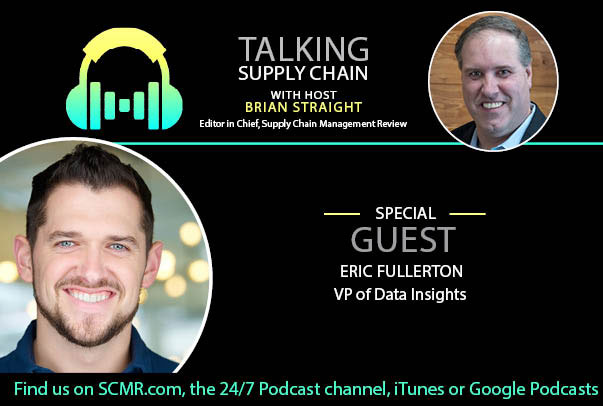
Brian Straight, SCMR Editor in Chief

Brian Straight is the Editor in Chief of Supply Chain Management Review. He has covered trucking, logistics and the broader supply chain for more than 15 years. He lives in Connecticut with his wife and two children. He can be reached at [email protected], @TruckingTalk, on LinkedIn, or by phone at 774-440-3870.
Follow SCMR on social media.
@SupplyChainManagementReview on Facebook
@SCMR on Twitter
SCMR on Linkedin
Subscribe

Supply Chain Management Review delivers the best industry content.

Editors’ Picks



