
Editor’s note: What It Really Means is a twice-monthly series on Supply Chain Management Review designed to clarify commonly used supply chain terms that often carry different meanings across organizations. The series aims to establish practical, shared definitions by grounding terminology in real-world planning and execution use cases. The series is authored by Andrew Byer, a former P&G supply chain leader, and Mike Dobslaw, who leads EY’s Supply Chain Planning Practice. New articles in the What It Really Means series publish on the second and fourth Thursdays of each month.
A term often used in discussions to improve supply chain performance is ‘bringing the outside in.’ But what does that mean in real-world, practical application?
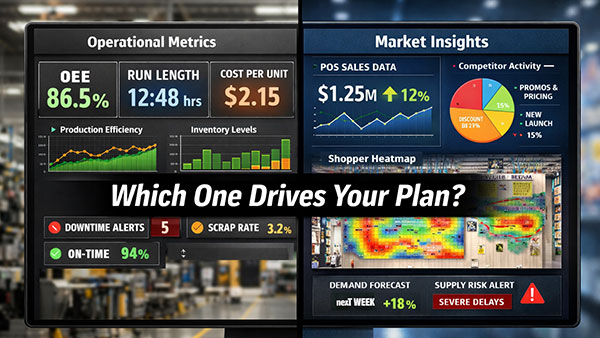
In short, bringing the outside in challenges the historical approach to planning and execution based upon internal views. Internal views are things like the organization’s goals and priorities, the data it has, and factors such as optimizing cost, staffing and OEE targets by maximizing run length and minimizing changeovers. Cost, staffing and OEE are internal metrics. External metrics are things like what’s really selling (POS data), response times and service levels (on time, in full.) Another example is demand planning: it can be easier to look at history, planned events/promotions and generate a demand plan. But for a more accurate plan, it’s wiser to look externally at POS data, customer orders, known competitive activity to develop a higher quality forward-looking demand plan.
The key point of bringing the outside in is to ensure your organization is focused on what’s really happening in the market—with your consumers, customers and competition. For some organizations, this can be a major paradigm shift. Internal perspectives are a gilded cage: easily available, can be clear and focused with line of sight from leadership to frontline employees. But internal perspectives do not reflect the real world. The real world is largely outside of your organization. The real world reflects market forces outside of your organization and where you are competing. Examples of outside factors are things like actual shopper purchases (POS/scanner data), channel data, competitive activity and external events (e.g. heat waves, supply disruptions, etc.) that can impact consumer behavior and customer patterns. These factors make it outside in.
Why is bringing the outside in important? To optimize supply chain performance, a business needs its planning and execution based upon information reflecting what’s happening in the marketplace. A simple test to know if your organization is bringing the outside in: are your operational plans based on data external to your organization like POS/scanner or channel sales information?
Benefits to bringing the outside in. An externally focused organization will deliver higher customer service, better response and execution. Costs will be improved with less expediting, scrap and fewer short-cycle plan changes. Cash will be improved by not planning/producing what was selling but may be out of favor in the future. The benefits show up in areas like:
- increased sales revenue
- higher customer service and in-stock at the shelf
- plan stability
- ability to execute the plan by operations
- reduced scrap and waste
- less cash tied up in slow moving and/or excess inventory
Watchouts: Unfortunately, there can be many intended or unintended barriers to bringing the outside in including:
- internal reward systems focused on stability not responsiveness
- access to outside data
- sufficiency and accuracy of outside data
- ability to process and effectively use outside data in internal systems
- latency: the data is constantly changing—how quickly can the organization access/use/respond
How to bring the outside in?
You may be thinking to yourself, we’re struggling with planning and execution using the easier to get internal data we have like history and our business plan. How will I be able to get and use external data and operationalize it?
Related:
What it really means: Democratizing the data
What it really means: Supply chain control towers
A key role of supply chain management is to connect what your business needs from its supply chain to how that supply chain is designed and operated. For example, if your business is struggling to meet sales revenue targets or service expectations, the effort to get and use POS or channel data may actually start to cure current operational ‘struggles.’ The plans will be more focused on what’s really happening in the market, not history—a classic ‘drive based on what you see in the windshield and not in the rearview mirror’ approach. A first step is to identify what marketplace data is available and how to obtain it (e.g. customer sharing arrangements, commercial aggregators, etc.) The next step is then to architect how the data is brought into planning systems for use.
About the authors
Andrew Byer is a former P&G Supply Chain Leader. Mike Dobslaw leads EY’s Supply Chain Planning Practice. To learn more about how EY and P&G team to support supply chain transformations please write [email protected]
SC
MR

More Supply Chain Planning
- From orbit to operations: Winning the race for the earliest disruption signal
- Supply chain’s new normal isn’t stability, it’s change
- Leveraging advanced tech to develop next-level planning
- The always-ready supply chain: Turning disruption into competitive edge
- Beyond the forecast: Rethinking demand-driven planning
- More Supply Chain Planning
What's Related in Supply Chain Planning
 Explore
Topics
Procurement & Sourcing News
- Why companies blame the wrong supplier … and miss the real failure
- NextGen Supply Chain Conference unveils agenda focused on AI, execution and the future of leadership
- From fragmented negotiations to coordinated negotiation performance: an AI-enabled approach
- Supply chain resilience isn’t a data problem; it’s a judgment problem
- Why your supply chain risk management plan will fail
- When component verification becomes operational
- More Procurement & Sourcing
Latest Procurement & Sourcing Resources
Subscribe

Supply Chain Management Review delivers the best industry content.

Editors’ Picks



