
Sorry, but your login has failed. Please recheck your login information and resubmit. If your subscription has expired, renew here.

September-October 2017
When it comes to the next generation of supply chain management, the future just may be now. That’s one of the conclusions reached by Greg Gorbach, an analyst at the research firm ARC Advisory Group, after surveying supply chain executives, including subscribers to Supply Chain Management Review, on the digitization of their supply chains. In “The Great Digitization of Industry,” Gorbach notes that while it may take years for the widespread adoption of new technologies such as machine learning, additive manufacturing, smart factories and advanced analytics to become commonplace, digitization across verticals is happening faster than many of us… Browse this issue archive.Need Help? Contact customer service 847-559-7581 More options
There is no shortage of practices that organizations can adopt to improve their supply chain planning efforts. These include sales and operations planning, optimization of networks and forecasting to improve production scheduling. Yet the overall need remains the same: Regardless of the approach, organizations must find better ways to coordinate suppliers, manufacturers, distributors and even retailers to balance supply and demand to best meet customer requirements.
To that end, APQC recommends organizations not lose sight of the bigger picture. Using its Open Standards Benchmarking® data in supply chain planning, APQC recently looked at how the frequency of supply chain planning, as well as some more strategic aspects of planning (defining a strategy for the next two to three years and the use of predictive analytics to identify potential risks) can potentially affect supply chain performance. Through its analysis, APQC found that it might be worthwhile for organizations to re-evaluate the frequency of their planning and the extent to which they develop a supply chain roadmap and strategy. For organizations looking to use analytics, it would be wise to make sure that they can invest the time and resources for a well-organized analytics effort.
Frequency of planning
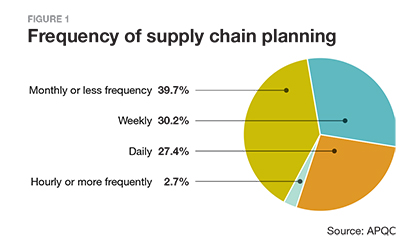
APQC asked organizations responding to its benchmarking survey to indicate the frequency with which they perform supply chain planning. As shown in Figure 1, the largest group of respondents plan monthly or less frequently, but nearly one-third of organizations plan on a weekly or daily basis.

This complete article is available to subscribers only.
Log in now for full access or start your PLUS+ subscription for instant access.
SC
MR
Sorry, but your login has failed. Please recheck your login information and resubmit. If your subscription has expired, renew here.
September-October 2017
When it comes to the next generation of supply chain management, the future just may be now. That’s one of the conclusions reached by Greg Gorbach, an analyst at the research firm ARC Advisory Group, after surveying… Browse this issue archive. Access your online digital edition. Download a PDF file of the September-October 2017 issue.There is no shortage of practices that organizations can adopt to improve their supply chain planning efforts. These include sales and operations planning, optimization of networks and forecasting to improve production scheduling. Yet the overall need remains the same: Regardless of the approach, organizations must find better ways to coordinate suppliers, manufacturers, distributors and even retailers to balance supply and demand to best meet customer requirements.
To that end, APQC recommends organizations not lose sight of the bigger picture. Using its Open Standards Benchmarking® data in supply chain planning, APQC recently looked at how the frequency of supply chain planning, as well as some more strategic aspects of planning (defining a strategy for the next two to three years and the use of predictive analytics to identify potential risks) can potentially affect supply chain performance. Through its analysis, APQC found that it might be worthwhile for organizations to re-evaluate the frequency of their planning and the extent to which they develop a supply chain roadmap and strategy. For organizations looking to use analytics, it would be wise to make sure that they can invest the time and resources for a well-organized analytics effort.
Frequency of planning
APQC asked organizations responding to its benchmarking survey to indicate the frequency with which they perform supply chain planning. As shown in Figure 1, the largest group of respondents plan monthly or less frequently, but nearly one-third of organizations plan on a weekly or daily basis.
SC
MR


Latest Supply Chain News
- The Digital Supply Chain Imperative: From Visibility to Execution
- Elucidating import container flows: A simulation study of Port of New York/New Jersey
- AI runs on compute; scaling it runs on logistics
- Wayfair executive to share lessons from building a tech-driven delivery network in NextGen Keynote
- Surging AI adoption doesn’t match mass layoff narrative
- More News
Latest Resources

 Explore
Procurement & Sourcing News
- Wayfair executive to share lessons from building a tech-driven delivery network in NextGen Keynote
- Surging AI adoption doesn’t match mass layoff narrative
- Tillamook turns supply chain planning into growth engine
- Why supply chains fail at launch: It’s not the plan, it’s the execution
- Look who’s calling (from Mexico): Gang members deported from the U.S.
- AI won’t fix a broken supply chain foundation
- More Procurement & Sourcing
Latest Procurement & Sourcing Resources

Subscribe

Supply Chain Management Review delivers the best industry content.

Editors’ Picks



