
This week I am in Moscow for a conference and a bit of vacation. Overall, I find Moscow to be a bit bleak - miles of low-slung beige and gray block-style buildings reminiscent of the Cold War Soviet government. The exceptions include a small group of new downtown skyscrapers and Red Square.
With my China sourcing consulting business, I have been to Beijing and Tiananmen Square many times but this is the first time I’ve been to Moscow and its famous Red Square. Both cities are heavily industrialized, the seat of their respective governments, and both have famous Squares. So how does Red Square compare to Tiananmen Square?
First, they are both enormous. The Chinese claim that Tiananmen can hold a million people and being there, it seems possible. While not as big, Red Square is quite impressive, with the attached Kremlin grounds and several churches and museums. Both have picturesque historical buildings including the Chinese Forbidden City and the Russian St. Basil’s Cathedral with the colorful onion domes. On the sides of both Squares are the seats of government: The Chinese Communist Party and the Kremlin. Both Squares have remarkable museums with extensive and awesome collections. Both Squares have monuments to workers. Tiananmen has Mao’s Mausoleum and Red Square has Lenin’s Mausoleum.
But the more important thing is that these two Squares were built as places of powerful governments and a show of might and strength. Both Squares are often used for military parades and other official government business. The message seems to be tops-down with leadership and power at the pinnacle and the people at the bottom. You can “feel” this in both places to the point where it is a bit intimidating.
Contrast that with American monuments such as the Washington Mall. The Mall seems to have a totally different feel, more egalitarian, more “Of the People.” Even the White House is surrounded by an open fence, unlike the high walls of the Forbidden City and the Kremlin.
It serves us well to remember and respect these distinctions when we are dealing with global commerce. Most nations of the world maintain tight control over capitalist ventures and international commerce. We need to be aware and sensitive to cultural and governmental differences in our Supply Chain planning and execution.
SC
MR

Latest Supply Chain News
- Schneider Electric’s Jackie Zhu: Why the best leaders build careers across the business
- AI is driving change in supply chain skills and talent
- 4 moves supply chains must make as AI triggers a memory supply shock
- Innovators Netstock, Pickle Robot win NextGen Solution Provider awards
- Bigger trucks versus broken bridges and roads
- More News
Latest Podcast
 Explore
Topics
Latest Supply Chain News
- Innovators Netstock, Pickle Robot win NextGen Solution Provider awards
- Bigger trucks versus broken bridges and roads
- From salon to dock door: Repurposing scheduling software for inbound flow
- The biggest barrier to AI in supply chains isn’t technology
- Rebuilding a planning function around the physical world
- Why companies blame the wrong supplier … and miss the real failure
- More latest news
Latest Resources
About the Author
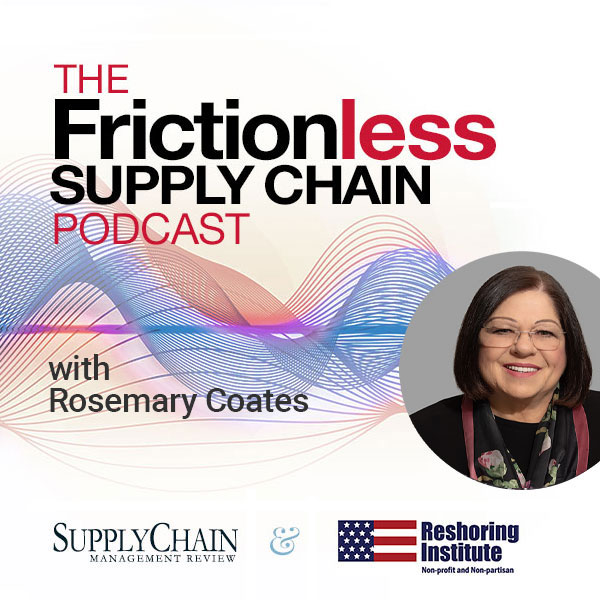
Rosemary Coates, Exec. Dir. Reshoring Institute

Ms. Coates is the Executive Director of the Reshoring Institute and the President of Blue Silk Consulting, a Global Supply Chain consulting firm. She is a best-selling author of five supply chain management books including: 42 Rules for Sourcing and Manufacturing in China and Legal Blacksmith - How to Avoid and Defend Supply Chain Disputes. Ms. Coates lives in Silicon Valley and has worked with over 80 clients worldwide. She is also an Expert Witness for legal cases involving global supply chain matters. She is passionate about Reshoring.
Follow SCMR on social media.
@SupplyChainManagementReview on Facebook
@SCMR on Twitter
SCMR on Linkedin
Subscribe

Supply Chain Management Review delivers the best industry content.

Editors’ Picks



