
Sorry, but your login has failed. Please recheck your login information and resubmit. If your subscription has expired, renew here.
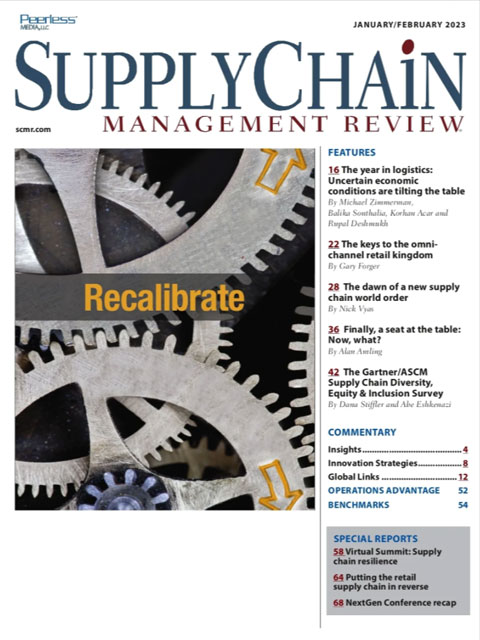
January-February 2023
It feels like a normal holiday season. ”That was the report I got from the VP of global distribution at one of the country’s best known retail brands on the Monday before Black Friday. He added that the last time he felt that way was November of 2019. One of the perks of this job is that I get to talk to a lot of supply chain executives. In my conversations over the last year, I’ve learned two things. Operations, which was perhaps hardest hit at the start of the pandemic, has learned to operate in this new environment. Sure, there are still hiccups caused by absenteeism and inventory shortages. But those are situational—give them supply and… Browse this issue archive.Need Help? Contact customer service 1-508-503-1313 More options
COVID-generated turmoil that reshaped worldwide logistics in 2020 and 2021 has given way to something very different in 2022. Not to stability, exactly, but to another form of uncertainty—one that poses its own set of hazards and opportunities.
To stave off a potential economic catastrophe, the national governments of the United States and other countries injected trillions of dollars of pandemic relief into the world’s financial bloodstream. Fortified by the infusion, the U.S. economy grew 5.7% in 2021—its sharpest upswing since 1984.
Having averted the immediate threat of a potential depression, central banks now had to contend with a very different problem—surging inflation as relief money further boosted demand against still constrained capacity. They increased interest rates more aggressively than any time in history in order keep demand in check and prices down.
Then came Russia’s invasion of Ukraine in late February, which hobbled energy and food supplies, further driving up prices. The combination of varied inflationary factors, geopolitical tensions and sustained interest-rate hikes has cooled spending—and, therefore, the demand for logistical services.
As we indicated in a recent Kearney Global Business Policy Council article, these and related developments have contributed to broader uncertainty about economic conditions over the near and medium term.

This complete article is available to subscribers only.
Log in now for full access or start your PLUS+ subscription for instant access.
SC
MR
Sorry, but your login has failed. Please recheck your login information and resubmit. If your subscription has expired, renew here.
January-February 2023
It feels like a normal holiday season. ”That was the report I got from the VP of global distribution at one of the country’s best known retail brands on the Monday before Black Friday. He added that the last time… Browse this issue archive. Access your online digital edition. Download a PDF file of the January-February 2023 issue.COVID-generated turmoil that reshaped worldwide logistics in 2020 and 2021 has given way to something very different in 2022. Not to stability, exactly, but to another form of uncertainty—one that poses its own set of hazards and opportunities.
To stave off a potential economic catastrophe, the national governments of the United States and other countries injected trillions of dollars of pandemic relief into the world’s financial bloodstream. Fortified by the infusion, the U.S. economy grew 5.7% in 2021—its sharpest upswing since 1984.
Having averted the immediate threat of a potential depression, central banks now had to contend with a very different problem—surging inflation as relief money further boosted demand against still constrained capacity. They increased interest rates more aggressively than any time in history in order keep demand in check and prices down.
Then came Russia’s invasion of Ukraine in late February, which hobbled energy and food supplies, further driving up prices. The combination of varied inflationary factors, geopolitical tensions and sustained interest-rate hikes has cooled spending—and, therefore, the demand for logistical services.
As we indicated in a recent Kearney Global Business Policy Council article, these and related developments have contributed to broader uncertainty about economic conditions over the near and medium term.
SC
MR


Latest Supply Chain News
- Why companies blame the wrong supplier … and miss the real failure
- NextGen Supply Chain Conference unveils agenda focused on AI, execution and the future of leadership
- From fragmented negotiations to coordinated negotiation performance: an AI-enabled approach
- Supply chain resilience isn’t a data problem; it’s a judgment problem
- Beyond the hype: Building flexible and scalable supply chains in a VUCA world
- More News
Latest Resources
 Explore
Software & Technology News
- NextGen Supply Chain Conference unveils agenda focused on AI, execution and the future of leadership
- From fragmented negotiations to coordinated negotiation performance: an AI-enabled approach
- Beyond the hype: Building flexible and scalable supply chains in a VUCA world
- Managing human and AI teams across the supply chain
- The AI-empowered supply chain leader
- Technology isn’t strategy
- More Software & Technology
Latest Software & Technology Resources

Subscribe

Supply Chain Management Review delivers the best industry content.

Editors’ Picks



