
Sorry, but your login has failed. Please recheck your login information and resubmit. If your subscription has expired, renew here.
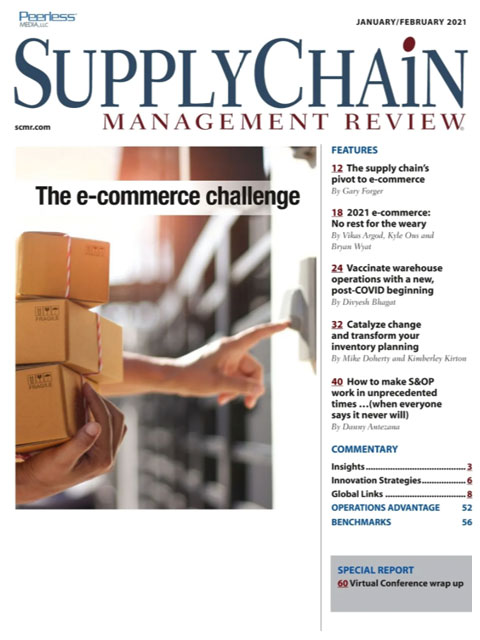
January-February 2021
This morning, I turned on the television and watched the first stretch-wrapped pallets of the just-authorized vaccine being loaded onto a truck at a Pfizer plant in Michigan. From there, the pallets were headed to FedEx’s logistics hub in Memphis where they would be delivered to 153 locations across the 50 states. The event was both historic and mundane: Historic in that the shipments represent the hope of a nation that in the coming months, we’ll begin to put 2020—and COVID—in the rearview mirror; mundane in that this is a scene repeated millions of times a day, without fanfare, in plants and distribution centers across the country. Two of… Browse this issue archive.Need Help? Contact customer service 1-508-503-1313 More options
Emerging from the pandemic’s global disruption are some serious outcomes and lessons.
They are as follows:
- awareness of supply chain management’s value and contributions increased to the point of being a household word;
- supply chain management is clearly a C-Level strategic competitive lever;
- problem-solving intended actions in an ecosystem can produce unintended consequences that exceed the consequences of the initial problem; and
- retire “chain” thinking and accept the fact that we operate in a supply network operating in a network of networks engaged in “ecosystem commerce.”
Given the lessons learned, businesses are facing new and more complex challenges that have dramatically changed customer buying patterns and accelerated new technology and overall management transformation required for all sales channels (mobile, Web, brick-and-mortar) and product flows (inventory deployment, staple stock, cross dock, direct store and last-mile delivery and BOPIS or buy online/pick-up in store).
For most organizations, supply chain practices organizations are forever changing to supply network practices as customers now demand access to more shopping channels and formats than ever and naturally want efficient, seamless and safe shopping experiences with high fill product fill rates.
Businesses must quickly reimagine their baseline requirements, which includes reevaluating the complex trade-offs between cost and customer responsiveness. Businesses must now better prepare for an unfamiliar future and shift their focus to identifying ways to better manage and balance business cost, performance and service during a very transformative period. Future market requirements are highly unlikely to ever return to “normal,” necessitating that leadership look at 2021 as a new beginning to drive transformation to digital supply network processes and practices aimed at enterprise resiliency.

This complete article is available to subscribers only.
Log in now for full access or start your PLUS+ subscription for instant access.
SC
MR
Sorry, but your login has failed. Please recheck your login information and resubmit. If your subscription has expired, renew here.
January-February 2021
This morning, I turned on the television and watched the first stretch-wrapped pallets of the just-authorized vaccine being loaded onto a truck at a Pfizer plant in Michigan. From there, the pallets were headed to… Browse this issue archive. Access your online digital edition. Download a PDF file of the January-February 2021 issue.Emerging from the pandemic’s global disruption are some serious outcomes and lessons.
They are as follows:
- awareness of supply chain management’s value and contributions increased to the point of being a household word;
- supply chain management is clearly a C-Level strategic competitive lever;
- problem-solving intended actions in an ecosystem can produce unintended consequences that exceed the consequences of the initial problem; and
- retire “chain” thinking and accept the fact that we operate in a supply network operating in a network of networks engaged in “ecosystem commerce.”
Given the lessons learned, businesses are facing new and more complex challenges that have dramatically changed customer buying patterns and accelerated new technology and overall management transformation required for all sales channels (mobile, Web, brick-and-mortar) and product flows (inventory deployment, staple stock, cross dock, direct store and last-mile delivery and BOPIS or buy online/pick-up in store).
For most organizations, supply chain practices organizations are forever changing to supply network practices as customers now demand access to more shopping channels and formats than ever and naturally want efficient, seamless and safe shopping experiences with high fill product fill rates.
Businesses must quickly reimagine their baseline requirements, which includes reevaluating the complex trade-offs between cost and customer responsiveness. Businesses must now better prepare for an unfamiliar future and shift their focus to identifying ways to better manage and balance business cost, performance and service during a very transformative period. Future market requirements are highly unlikely to ever return to “normal,” necessitating that leadership look at 2021 as a new beginning to drive transformation to digital supply network processes and practices aimed at enterprise resiliency.
SUBSCRIBERS: Click here to download PDF of the full article.
SC
MR


Latest Supply Chain News
- Schneider Electric’s Jackie Zhu: Why the best leaders build careers across the business
- AI is driving change in supply chain skills and talent
- 4 moves supply chains must make as AI triggers a memory supply shock
- Innovators Netstock, Pickle Robot win NextGen Solution Provider awards
- Bigger trucks versus broken bridges and roads
- More News
Latest Podcast
 Explore
Software & Technology News
- Innovators Netstock, Pickle Robot win NextGen Solution Provider awards
- The biggest barrier to AI in supply chains isn’t technology
- NextGen Supply Chain Conference unveils agenda focused on AI, execution and the future of leadership
- From fragmented negotiations to coordinated negotiation performance: an AI-enabled approach
- Beyond the hype: Building flexible and scalable supply chains in a VUCA world
- Managing human and AI teams across the supply chain
- More Software & Technology
Latest Software & Technology Resources
Subscribe

Supply Chain Management Review delivers the best industry content.

Editors’ Picks



