
Editor’s note: A full deep dive into this topic can be found on Knut Alicke’s substack. You can view that article here: https://knutalicke.substack.com/p/the-planner-was-the-system.
We have spent thirty years and tens of billions of dollars building advanced planning systems—constraint-based optimization solvers, multi-echelon inventory models, and statistical forecasting engines. In theory, these systems should produce better supply chain decisions than any human. They never get tired. They have no political relationships with the sales team that distort their judgment.
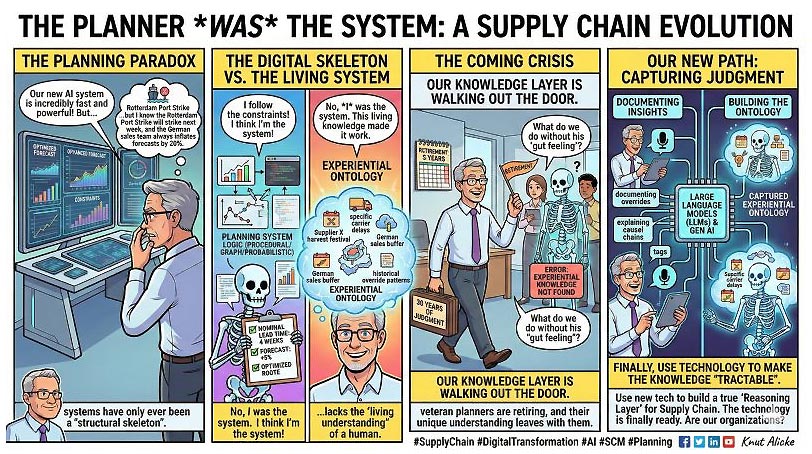
In practice, experienced planners routinely override the planning systems. And they are often right to do so.
The system produces a recommendation; the experienced planner looks at it, and something in their expression says, that’s not right. They change the number. The system logs the override, learns nothing, and produces the same wrong recommendation next month.
The usual explanations—poor data quality, insufficient user adoption, change management failures—are not wrong, but they are superficial excuses. The deeper answer is this: planning systems have never really understood the supply chain they were planning. They were given a structural skeleton and asked to make decisions that require a living, experience-rich understanding of how the supply chain actually behaves. So the experienced planner—carrying that understanding in their head—has been quietly doing the reasoning work the system was supposed to do. For 30 years.
Three generations. The same gap.
Old planning systems ran MRP logic over relational tables. The supplier lead time of four weeks—one number, static. The system did not know that actual lead times ranged from two to eight weeks depending on the season and order volume. It generated hundreds of exception messages per planner per week and asked humans to do all the reasoning. The planner was the missing semantic layer.
The next generation modeled the supply chain as a knowledge graph—a genuine advance that enabled “why” questions the previous generation could never address. But the graph was still populated structurally. It knew the topology. It did not know that the Frankfurt office’s first-submission forecasts run 20% too high because the commercial team learned that supply chain applies a haircut and pre-compensates. The behavioral reality remained absent and required the planners’ experience and input.
The most recent generation adds probabilistic learning—genuinely valuable, but limited to patterns consistent enough to be statistically learnable. It learns that August lead times from a supplier in France are longer. It cannot understand why (summer vacation in France closes down everything). And for knowledge that lives in specific relationships and single painful experiences of the planner, there is simply not enough data for any model from which to learn.
Across all three generations, the behavioral knowledge lives in people’s heads, not in systems.
The ontology is retiring
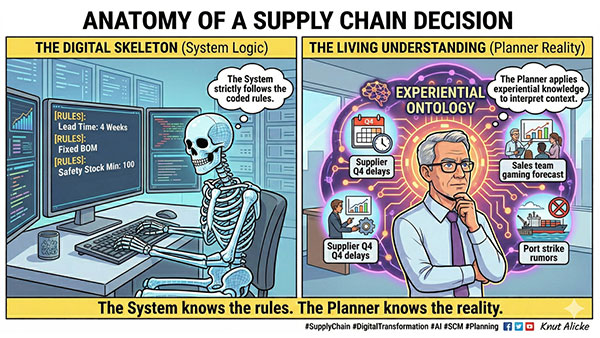
They have been with the company for 30 years. They know which suppliers can be pushed and which need careful handling. They’ve never written this down because writing it down would cause a political incident. They know a key customer always requests urgent delivery in the last week of the quarter to improve their own inventory numbers, costs that could be planned for if anyone paid attention to the quarterly calendar.
This is what Michael Polanyi called tacit knowledge: we know more than we can tell. Organizations have no systematic way to capture it, no mechanism to transfer it, and no plan for what happens when it retires.
This planner is probably retiring within five years.
The experiential ontology
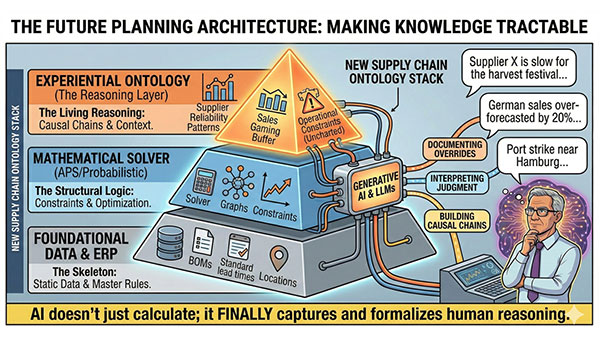
Current planning systems have a structural ontology—they lack an experiential ontology: a knowledge layer that captures not what is formally true about the supply chain, but what has been learned to be behaviorally true through observation, experience, and organizational memory.
The structural ontology says supplier X has a lead time of four weeks, even modeling this probalistic would mean the average lead time is four weeks with a standard deviation of two weeks. The experiential ontology says supplier X has a behavioral lead time that runs to six weeks in Q4 due to factory capacity constraints during the harvest period. This pattern has been observed consistently for seven years. It is not in any contract. It is known only to planners who have managed this relationship over multiple Q4 cycles.
One more example—the most expensive kind. In week five of a six-week sea freight transit, inventory approaches the safety stock threshold. An inexperienced planner sees inventory falling toward what appears to be a danger zone and panics. They place an urgent air freight order at 10 to 12 times the sea freight cost. Four days later, both shipments arrive simultaneously. The safety stock was never breached. The air freight was never necessary. An experienced planner knows that safety stock exists precisely to cover demand volatility during an open replenishment lead time—approaching it while a confirmed order is in transit is normal behavior, not a crisis signal. A planner who does not understand this turns a routine week into an expensive one, every single time.
The experiential ontology does not replace the planning system. It completes it.
GenAI as the new associate
GenAI does not automatically build an experiential ontology. It is not magic. But it provides, for the first time, capabilities that make building one tractable: natural language conversation, reasoning over contextually rich information, and learning from interaction over time. Combined, they enable something specific: a system that can learn from experienced planners by talking to them.
Think of a good new associate joining the planning team. They do not walk in on day one and start making decisions. They observe. They ask questions. They earn trust gradually by demonstrating that their questions get smarter. Over the course of 18 months, they internalize an understanding that no training program could provide.
This is precisely how a GenAI layer should behave—not as a system that processes structured inputs and returns outputs, but as a genuine learning presence that observes planning decisions, asks questions at the right moments, and builds a progressively richer model of the supply chain’s behavioral reality. The crucial point is that planners cannot write their experience/tacit knowledge down. Ask a 30-year planner to document everything they know about a key supplier, and they will produce a paragraph. Engage them in a conversation about a specific late delivery in Q4, and they will produce an hour of structured, causally connected insight. The conversation is crucial
But the GenAI layer does not only learn from what actually happens. It can also create situations—drawing on the operational history encoded in the planning system, or constructing realistic disruption scenarios that routine operations rarely surface—and learn from how planners respond. When an experienced planner walks through their thinking about a force majeure from a sole-source supplier, or a sudden demand spike across three product lines simultaneously, they externalize a reasoning architecture that no behavioral observation would ever reveal. The system learns not just what they decided. It learns how they think. That is the difference between a passive recorder and a genuine new associate—and it is what makes the knowledge base genuinely compound over time.
In practice, this means capturing the reasoning behind every planner override—not through a form, but through a brief natural conversation. “You increased the safety stock for this material by 40%—is this a supplier concern, or something else?” The answer gets stored as a structured knowledge element with entity, behavioral pattern, condition, and—critically—implications for decisions downstream.
The design principle is non-negotiable: every interaction must feel like value exchange, not data extraction. The system must give back more than it asks for, immediately. A downstream risk identified from the planner’s reasoning. A flag that another planner handled a similar situation differently. The moment the interaction feels like filling in a form, engagement collapses.
Before they leave, ask them why
The supply chains that build experiential ontologies now—in this period of volatility, disruption, and talent retirement—will have a compounding advantage that cannot be replicated quickly. Not because they deployed the best technology. Because they finally captured the best knowledge.
That knowledge is sitting in your planning team right now, in the head of someone who is probably not in any leadership presentation, who has probably been in the same role for 15 years, and who is probably thinking about retirement.
Before they leave, ask them why.
About the author
Knut Alicke is a Senior Advisor to McKinsey, Partner Emeritus at McKinsey, a member of the Global Advisory Council for Alcott Globa, co-author of the book Source To Sold, and professor at the University of Cologne.
SC
MR

More Generative AI
What's Related in Generative AI
 Explore
Topics
Procurement & Sourcing News
- Why companies blame the wrong supplier … and miss the real failure
- NextGen Supply Chain Conference unveils agenda focused on AI, execution and the future of leadership
- From fragmented negotiations to coordinated negotiation performance: an AI-enabled approach
- Supply chain resilience isn’t a data problem; it’s a judgment problem
- Why your supply chain risk management plan will fail
- When component verification becomes operational
- More Procurement & Sourcing
Latest Procurement & Sourcing Resources

Subscribe

Supply Chain Management Review delivers the best industry content.

Editors’ Picks



