
Editor’s note: This is the first of a three-part series on manufacturing risk that will appear on scmr.com over the coming weeks. Part 2 will publish on Tuesday, July 7 and Part 3 will publish on Tuesday, July 14.
Most supply chain risk frameworks focus on visible risks: logistics disruptions, supplier financial health, demand volatility, and geopolitical exposure. These risks are real, and the frameworks that address them have become more rigorous over time.
But there is a layer closer to the production line that almost no dashboard captures—the integrity of the component itself.
A counterfeit capacitor. A remarked chip with a falsified date code. A genuine part from a compromised storage environment. None of these failures announce themselves. They enter the supply chain quietly, pass through procurement systems that were not designed to detect them, and surface only when a production line stops—or, worse, when a product fails in the field.
The layer standard frameworks miss
After 27 years in electronic component distribution across the EAEU region, I have watched this pattern repeat—in companies of every size and sophistication level. The ones most exposed to component integrity risk are rarely those with weak procurement processes. They are often the ones with highly effective processes built to address the risks they were designed for, while leaving other exposures largely unexamined.
Standard supplier risk assessments evaluate financial stability, delivery performance, quality certifications, and capacity. These are necessary. What they do not address is whether the specific lot of components in this specific shipment is what the documentation says it is.
The gap between supplier-level risk management and component-level integrity is where counterfeit parts live. In a market where the global counterfeit electronic component problem is measured in billions of dollars annually, this is not a theoretical gap.
What component integrity risk looks like in practice
The failure mode is rarely dramatic. It is usually quiet and delayed. A batch of passive components from an unfamiliar secondary-market source tests within spec in incoming inspection because incoming inspection is sampling-based, and the counterfeit rate in the batch is low enough to survive the sample. The components go into production. Most work. Enough of them fail in the field, over time, under load conditions that the acceptance test did not replicate.
By the time the failure pattern is identified and traced back to the source, the downstream costs—warranty claims, recall logistics, reputational damage, regulatory exposure—have long since exceeded what more rigorous upfront verification would have cost.
The organizational response is almost always the same: tighter incoming inspection, stricter approved vendor lists, better contracts with indemnification clauses. These are rational responses. They are also responses to the last failure, not the next one.
A framework for the layer that’s missing
The CILM (Component Integrity & Lifecycle Management) methodology addresses this gap through a reframing of the core question. Where supplier risk management asks, “Is this supplier reliable?,” component integrity management asks, “Is this specific component what it claims to be, from the source it claims, in the condition it claims?” Related questions; but they require different data, different verification processes, and different risk models.
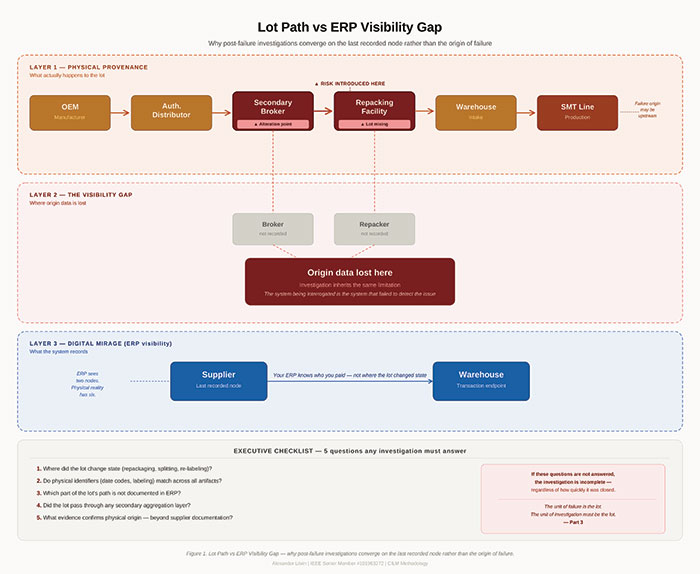
In practice, this means verification is performed at the component lot level, not just at the supplier level. The framework does this through three elements: digital traceability (a verifiable chain of custody for each lot), independent verification (separating the verification function from procurement), and risk-weighted assessment—scoring decisions based on quantified exposure rather than a simple approved/rejected binary.
Why this matters now
The pressure on electronic component supply chains has increased substantially over the past five years. Pandemic-era shortages drove procurement teams toward non-traditional sources. Trade policy shifts and export controls have complicated established supply routes. CHIPS Act implementation and related policy changes are reshaping the competitive landscape for sourcing.
Each of these pressures increases the probability that components enter supply chains from sources that have not been subject to the verification rigor that established channels provide. ERAI, which tracks electronic component fraud reports from industry participants, has continued to document reported incidents throughout this period.
Supply chain managers who have spent the last decade building sophisticated risk frameworks now face a new question: are those frameworks measuring the right things? For component integrity, the answer is frequently no—not because the frameworks are poorly designed, but because they were designed for a different set of risks.
The risk that does not appear in your metrics will eventually appear on your production floor.
About the author
Alexander Litvin is a supply chain executive with 27 years of experience in electronic component distribution. He is an IEEE Senior Member and the originator of the CILM (Component Integrity & Lifecycle Management) methodology. He may be reached at [email protected].
SC
MR


More Risk Management
- Supply chain resilience isn’t a data problem; it’s a judgment problem
- Why your supply chain risk management plan will fail
- Lead time economics: What semiconductor supply chains reveal about strategic planning
- Chokepoints need the ‘Theory of Constraints’
- The hidden supply chain risk no dashboard shows
- More Risk Management
What's Related in Risk Management
 Explore
Topics
Procurement & Sourcing News
- Why companies blame the wrong supplier … and miss the real failure
- NextGen Supply Chain Conference unveils agenda focused on AI, execution and the future of leadership
- From fragmented negotiations to coordinated negotiation performance: an AI-enabled approach
- Supply chain resilience isn’t a data problem; it’s a judgment problem
- Why your supply chain risk management plan will fail
- When component verification becomes operational
- More Procurement & Sourcing
Latest Procurement & Sourcing Resources
Subscribe

Supply Chain Management Review delivers the best industry content.

Editors’ Picks



