
Sorry, but your login has failed. Please recheck your login information and resubmit. If your subscription has expired, renew here.

March-April 2026
The March/April 2026 issue of Supply Chain Management Review examines how supply chain leaders are managing supplier risk, circular supply chain design, AI-driven retail planning, CPG network optimization, and shifting LTL market dynamics to improve resilience and performance. Features include frameworks to prevent supplier failure, operationalize circular economy strategies, prevent retail stockouts using AI, and eliminate costly DC transfer patterns, plus insights from the 34th Annual Study of Logistics and Transportation Trends and a digital-exclusive on the evolving CSCO role. Browse this issue archive.Need Help? Contact customer service 847-559-7581 More options
Supply chains are expanding the use of AI across functions, and that expansion means more data storage and more computation, which all require more electricity use and potentially more greenhouse gas (GHG) emissions during electricity production.
APQC recently conducted a survey of 2,500 business leaders to assess organizations’ environmental sustainability strategy, performance, and governance. The results indicate that AI adoption is outpacing accountability for sustainability. APQC recommends that organizations account for increased energy consumption tied to AI when calculating their sustainability performance. They should also be aware of how AI can affect their emissions goals.
SC
MR
Sorry, but your login has failed. Please recheck your login information and resubmit. If your subscription has expired, renew here.
March-April 2026
The March/April 2026 issue of Supply Chain Management Review examines how supply chain leaders are managing supplier risk, circular supply chain design, AI-driven retail planning, CPG network optimization, and… Browse this issue archive. Access your online digital edition. Download a PDF file of the March-April 2026 issue.Supply chains are expanding the use of AI across functions, and that expansion means more data storage and more computation, which all require more electricity use and potentially more greenhouse gas (GHG) emissions during electricity production.
APQC recently conducted a survey of 2,500 business leaders to assess organizations’ environmental sustainability strategy, performance, and governance. The results indicate that AI adoption is outpacing accountability for sustainability. APQC recommends that organizations account for increased energy consumption tied to AI when calculating their sustainability performance. They should also be aware of how AI can affect their emissions goals.
Planning for the impact of AI
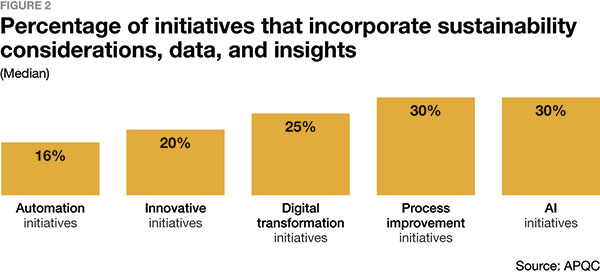
In this research, APQC found that companies are not connecting increased AI usage with the need for an increased focus on sustainability. At the median, only 30% of organizations’ AI initiatives incorporate sustainability considerations, data, and insights. This increases to only 40% at the 75th percentile.
Related infographic: Align AI adoption with climate goals
These results reveal a disconnect between organizational strategy and execution. For 2026, leaders are looking to rely even more on AI for business functions. More AI usage requires more energy, and the production of that energy often yields more GHG emissions. At the same time, companies have established emissions targets and publicized goals for reaching net-zero emissions.
Renewable energy. One approach companies take to reduce GHG emissions is to use energy from renewable sources. Although these sources result in GHG emissions during manufacturing and installation, they yield significantly lower emissions than fossil fuels.
At the median, organizations in APQC’s study report that 50% of their energy consumption comes from renewable sources. This leaves half of the energy sourced from traditional sources. Even at the 75th percentile, only 65% of energy comes from renewable sources. This calls into question how organizations plan to source the energy needed for AI. If they have not already sourced the majority of their energy from renewable sources, the power needed for AI will likely result in increased GHG emissions.
Net zero emissions targets. Of course, GHG emissions matter to companies, countries, and consumers alike. Not surprisingly, all of the organizations in APQC’s research have a target year to achieve net-zero emissions. The target dates are key to corporate strategy and investor expectations.
At the median, companies have set 2040 as their target net-zero year. For the 25th percentile, it’s slightly sooner, with 2035 as the target date. A lot can change in the years between now and the target dates. Whether these targets are attainable given increased use of AI remains to be seen. If companies do not incorporate sustainability data and insights into their AI plans, they will not be able to determine whether AI will have a negative impact on their ability to achieve their target year for net-zero emissions.
Focus on the intersections between sustainability and AI
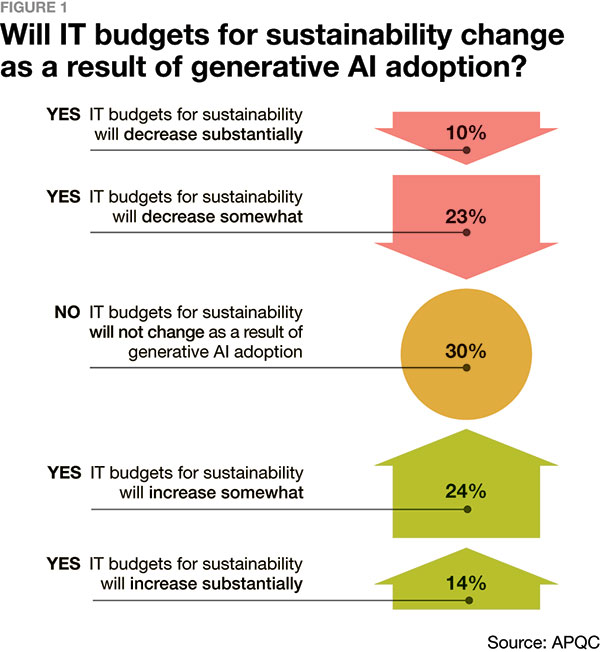
In a related development, companies give mixed responses when it comes to how their IT budgets for sustainability will change as a result of AI. As shown in Figure 1, 33% believe their budgets will decrease, and 38% say they will increase.
As for lack of focus on sustainability, as mentioned previously, at the median, only 30% of organizations’ AI initiatives incorporate sustainability considerations, data, and insights. Let’s put that into context with other initiatives. As Figure 2 shows, sustainability is overlooked in several types of initiatives—many of which could affect energy usage, and thereby GHG emissions.
APQC also looked at whether the reverse is true: do organizations include AI in their sustainability initiatives? At the median, only 20% do so. This amount is likely to increase as company leaders push for more usage of AI across their organizations.
Sustainability in decision-making and strategy
Many departments across the enterprise report that they include sustainability as a consideration in their decision-making. As shown in Figure 3, nine departments meet this criteria for over 50% of organizations.
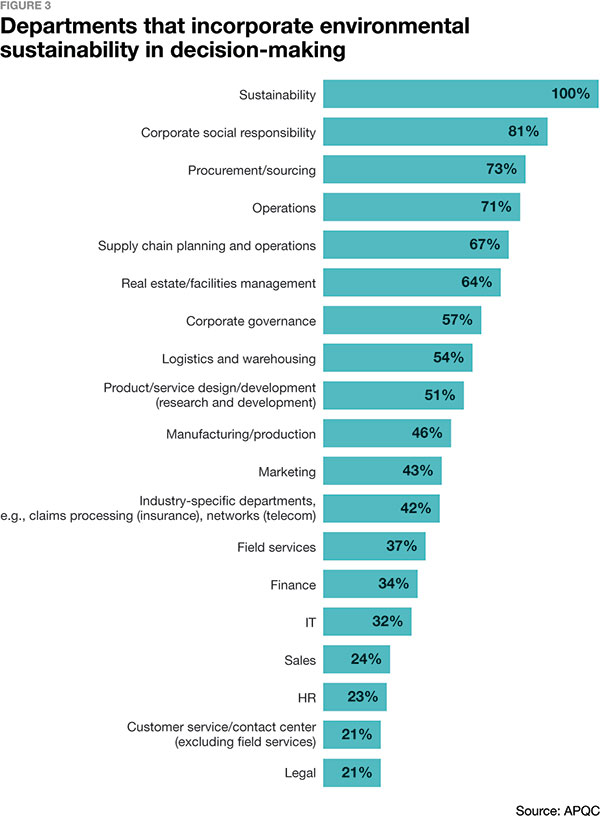
It is worth considering which of the departments on this list are more likely to use AI. For example, customer service is a department with a clear use case for AI, including chatbots, intelligent routing, and personalized customer recommendations. However, sustainability is a consideration for this department in only 21% of organizations.
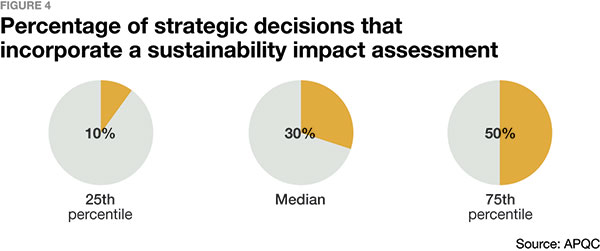
And although many departments consider sustainability when making decisions, this trend doesn’t hold when it comes to including a sustainability impact assessment during strategic decision-making. As shown in Figure 4, a median of only 30% of strategic decisions include this kind of critical assessment.
Leverage carbon budgets to measure emissions
Carbon budgets can serve as a framework for managing GHG emissions, particularly carbon dioxide. They are designed to help organizations monitor emissions to ensure they stay below a certain limit. Even without considering the added impact of AI usage on GHG emissions, organizations may not have the full picture of their carbon impact and cannot establish comprehensive, accurate carbon budgets. This will only become worse as AI use (and therefore energy use and emissions) increases.
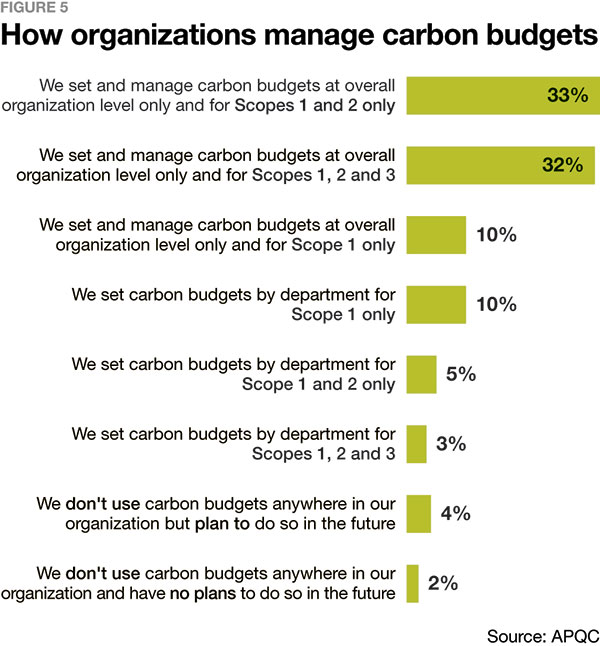
Typically, organizations use the GHG Protocol to measure the different types of emissions tied to their business. This ranges from Scope 1 (direct emissions), to Scope 2 (emissions from purchased or acquired energy), to Scope 3 (emissions a company is responsible for outside of its walls). The majority of total corporate emissions come from Scope 3 sources, which are often overlooked by organizations when managing their carbon budgets.
As shown in Figure 5, only 35% of organizations take all three scopes into account when managing carbon budgets, either at the department or organizational level. Thirty-eight percent take Scopes 1 and 2 into account, and 20% take only Scope 1 into account. This gap highlights the lack of visibility too many organizations face with GHG emissions.
Keep sustainability on track
AI is here to stay, even as organizations refine where it is used and to what extent. Organizations need to keep up with tracking sustainability associated with this new technology. Leaders must make a concerted effort to sync organizational AI goals with broader sustainability goals.
Although most organizations have set carbon budgets, some have not set them across all scopes. Regardless, they should prioritize assessing the impact of GHG emissions from the increased energy consumption that comes from using AI. They can then set explicit AI energy (and thus GHG emissions) targets. These can inform decisions about energy sources.
When possible, companies should revisit their use of renewable energy sources. This can aid in offsetting the increased energy use associated with AI. Further, they can shift AI activities to times and locations with greater availability of renewable energy.
Companies have been operating without a clear image of the sustainability impact of AI, but it does not and should not stay that way. Through better tracking that leads to strategic updates, companies can both embrace the capabilities of AI and keep their sustainability targets on track.
Data in this content was accurate at the time of publication. For the most current data, visit apqc.org.
About APQC
APQC (American Productivity & Quality Center) is the world’s foremost authority in benchmarking, best practices, process and performance improvement, and knowledge management (KM). With more than 1,000 member organizations worldwide, APQC provides the information, data, and insights organizations need to support decision-making and develop internal skills.
This content includes median values sourced from APQC’s Open Standards Benchmarking database. If you’re interested in having access to the 25th and 75th percentiles or additional metrics, including various peer group cuts, they are either available through a benchmark license or the Benchmarks on Demand tool depending on your organization’s membership type.
APQC’s Resource Library content leverages data from multiple sources. The Open Standards Benchmark repository is updated on a nightly cadence, whereas other data sources have differing schedules. To provide as much transparency as possible, APQC will always attempt to provide context for the data included in our content and leverage the most up-to-date data available at the time of publication.
SC
MR


More Sustainable Supply Chains
- Why do supply chains need to think beyond sustainability?
- Circular supply chains: The backbone of a successful circular economy
- Sustainability and AI: A complicated and often overlooked relationship
- Starting inside the company: Supply chain resilience demands new initiatives and investments
- Beyond the ESG debate: How responsible procurement builds stronger supply chains
- More Sustainable Supply Chains
 Explore
Topics
Procurement & Sourcing News
- Wayfair executive to share lessons from building a tech-driven delivery network in NextGen Keynote
- Surging AI adoption doesn’t match mass layoff narrative
- Tillamook turns supply chain planning into growth engine
- Why supply chains fail at launch: It’s not the plan, it’s the execution
- Look who’s calling (from Mexico): Gang members deported from the U.S.
- AI won’t fix a broken supply chain foundation
- More Procurement & Sourcing
Latest Procurement & Sourcing Resources

About the Author
Marisa Brown, Senior Principal Research Lead

Marisa Brown is senior principal research lead, supply chain management, APQC.
Follow SCMR on social media.
@SupplyChainManagementReview on Facebook
@SCMR on Twitter
SCMR on Linkedin
Subscribe

Supply Chain Management Review delivers the best industry content.

Editors’ Picks



