
Sorry, but your login has failed. Please recheck your login information and resubmit. If your subscription has expired, renew here.
December 2017
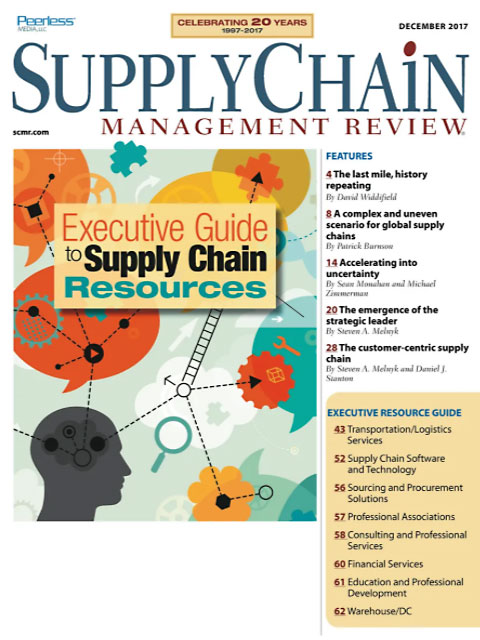
It’s December and time once again for our annual Executive Guide to Supply Chain Resources. This is a comprehensive guide to services, products and educational opportunities targeted specifically to supply chain professionals. As with years past, we’re also featuring several articles we trust will offer food for thought in your supply chain throughout the coming year. Browse this issue archive.Need Help? Contact customer service 1-508-503-1313 More options
Industries churning with economic and political disruption. Technology and innovation undermining old business models. Consumers demanding immediacy, personalization and convenience. These are just some of the insights revealed in the Council of Supply Chain Management Professionals’ “2017 State of Logistics Report” authored by A.T. Kearney. Buffeted by crosswinds as the pace of change accelerates, the logistics industry is accelerating into uncertainty. As the year closes, the geopolitical arena is sending an array of mixed signals that vexes decision-makers, who see consumer confidence rise while GDP growth disappoints, and government officials struggling to take clear action related to growth, infrastructure and trade policy. The industry appears destined for a prolonged bout of cognitive dissonance, coupling frustration over subpar growth with the optimism reflected in rising stock market values, technology investments and consumer confidence data.
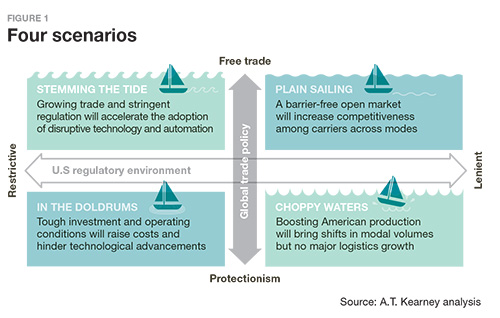
As company leaders weigh options in a fast-changing business environment, they also face increasing political risk. Rising protectionist sentiment around the world threatens to constrict global trade flows, the lifeblood of logistics. Political decisions on tax relief, regulatory reform and trade restrictions will all have an impact on logistics. A.T. Kearney identifies four scenarios that have the potential to significantly affect profitability, and even the future viability of some logistics sectors (see Figure 1).
Scenario 1:
Plain sailing. With trade barriers and onerous regulations minimized, a truly frictionless market emerges and competition among carriers drives down costs. Ship¬pers benefit from lower costs and better service as carriers differentiate themselves through innovation. Investment in supporting infrastructure is essential, but regulators try to balance safety and sustainability with business-friendly deregulation. Meanwhile, powerful incentives to reduce trade inefficiencies spur adoption of new technologies like blockchain-enabled “smart contracts.”

This complete article is available to subscribers only.
Log in now for full access or start your PLUS+ subscription for instant access.
SC
MR
Sorry, but your login has failed. Please recheck your login information and resubmit. If your subscription has expired, renew here.
December 2017
It’s December and time once again for our annual Executive Guide to Supply Chain Resources. This is a comprehensive guide to services, products and educational opportunities targeted specifically to supply chain… Browse this issue archive. Access your online digital edition. Download a PDF file of the December 2017 issue.Industries churning with economic and political disruption. Technology and innovation undermining old business models. Consumers demanding immediacy, personalization and convenience. These are just some of the insights revealed in the Council of Supply Chain Management Professionals' “2017 State of Logistics Report” authored by A.T. Kearney. Buffeted by crosswinds as the pace of change accelerates, the logistics industry is accelerating into uncertainty. As the year closes, the geopolitical arena is sending an array of mixed signals that vexes decision-makers, who see consumer confidence rise while GDP growth disappoints, and government officials struggling to take clear action related to growth, infrastructure and trade policy. The industry appears destined for a prolonged bout of cognitive dissonance, coupling frustration over subpar growth with the optimism reflected in rising stock market values, technology investments and consumer confidence data.
As company leaders weigh options in a fast-changing business environment, they also face increasing political risk. Rising protectionist sentiment around the world threatens to constrict global trade flows, the lifeblood of logistics. Political decisions on tax relief, regulatory reform and trade restrictions will all have an impact on logistics. A.T. Kearney identifies four scenarios that have the potential to significantly affect profitability, and even the future viability of some logistics sectors (see Figure 1).
Scenario 1:
Plain sailing. With trade barriers and onerous regulations minimized, a truly frictionless market emerges and competition among carriers drives down costs. Ship¬pers benefit from lower costs and better service as carriers differentiate themselves through innovation. Investment in supporting infrastructure is essential, but regulators try to balance safety and sustainability with business-friendly deregulation. Meanwhile, powerful incentives to reduce trade inefficiencies spur adoption of new technologies like blockchain-enabled “smart contracts.”
SC
MR


Latest Supply Chain News
- Beyond the hype: Building flexible and scalable supply chains in a VUCA world
- Why your supply chain risk management plan will fail
- When component verification becomes operational
- Caught between a rock and a hard place: Mapping your supply chain
- What options do you really have? Shaping the supply chain resilience funnel
- More News
Latest Resources
 Explore
Software & Technology News
- Managing human and AI teams across the supply chain
- The AI-empowered supply chain leader
- Technology isn’t strategy
- What the INFORMS Analytics+ Conference revealed about the future of supply chain (and why you might be getting left behind)
- The Digital Supply Chain Imperative: From Visibility to Execution
- AI runs on compute; scaling it runs on logistics
- More Software & Technology
Latest Software & Technology Resources

Subscribe

Supply Chain Management Review delivers the best industry content.

Editors’ Picks



