
Most of my clients have started to develop robust approaches to selling inside of China. With the rise of the Chinese middle class and the enormous PRC government market, foreign companies see a huge new market opportunity to sell goods. Chinese factories producing goods for export may also be licensed to produce goods for the growing domestic Chinese market. But beware; logistics and distribution within China to support domestic sales are very different from exporting from China.
Chinese distribution channels may be somewhat longer and more complex than the United States. For example, luxury goods retailers have found a robust market in China’s big cities, but these retailers are also opening stores in the tier-two cities. Logistics for tier-two and tier-three cities may not be as sophisticated and may require unique delivery solutions. In large cities, multi-stop deliveries to several retail stores are coordinated by a retail logistics company. In a tier-three city, the retailer may have to wait a week or more for a single store delivery from the airport, which is passed from trucker to delivery cart.
Setting up an effective and efficient domestic Chinese distribution system will take time. You need to consider and vet logistics providers, resellers, and wholesalers. China is a new and diverse market for delivery of goods so the process may be uneven for a few more years. As a result, you should consider where to locate inventories and distribution centers now and for the future. Further, if you produce and plan to market industrial products, you will need to consider delivery sites and capabilities before shipping goods. Older buildings and factories may not have adequate facilities such as truck docks and fork lift equipment.
Overall, logistics and transportation capabilities are maturing across China and in some areas, logistics capabilities are considered world class. Be sure to select logistics providers and partners with global networks and standards, and measure them regularly and rigorously. For distribution within China, verify the capabilities of partners and understand the delivery sites. Companies should not assume that every delivery site can accept trucks, has fork lifts, or other equipment. Verify where you plan to deliver—dock, warehouse, or other location—and the equipment available.
Visit China often
There is no substitute for regular, structured visits to vendors and logistics providers in China. Companies should never assume that just because policies and procedures are stated in a contract that any of them will be followed. In the Western world, we view a contract and written procedures as the end product to be executed. In China, the contract is just the beginning of doing business together. Contracts and written procedures are often viewed as guidelines and are subject to interpretation. If you want procedures to be followed precisely, you must monitor and audit the Chinese operations regularly.
I typically recommend that you visit China operations quarterly. During these visits, you should audit the processes through observation and by using a validation checklist. Ask to see the operations while people are working and return for a surprise visit later that day or evening.
If you cannot put a full-time person in China to watch over and manage operations, it is important to hire a trusted agent who resides in China to work on your behalf. (Some consulting companies provide these services for a fee.) Even with the addition of local services to oversee operations, companies still need to make an effort to visit China quarterly.
SC
MR

Latest Supply Chain News
- From salon to dock door: Repurposing scheduling software for inbound flow
- The biggest barrier to AI in supply chains isn’t technology
- Rebuilding a planning function around the physical world
- Why companies blame the wrong supplier … and miss the real failure
- NextGen Supply Chain Conference unveils agenda focused on AI, execution and the future of leadership
- More News
Latest Podcast
 Explore
Topics
Latest Supply Chain News
- Innovators Netstock, Pickle Robot win NextGen Solution Provider awards
- Bigger trucks versus broken bridges and roads
- From salon to dock door: Repurposing scheduling software for inbound flow
- The biggest barrier to AI in supply chains isn’t technology
- Rebuilding a planning function around the physical world
- Why companies blame the wrong supplier … and miss the real failure
- More latest news
Latest Resources
About the Author
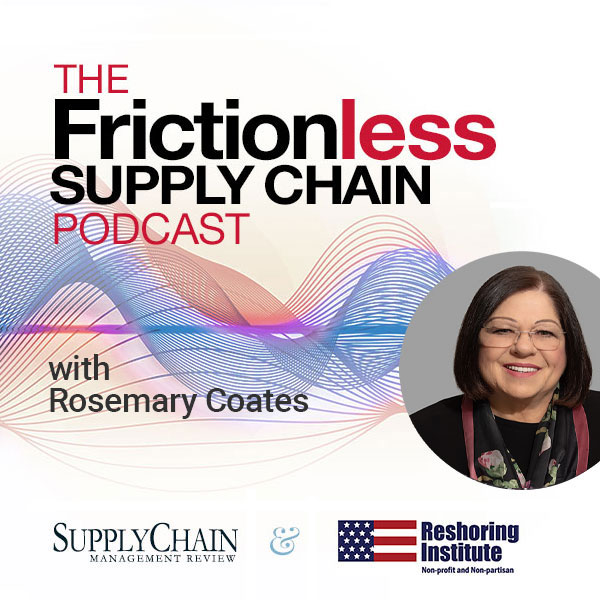
Rosemary Coates, Exec. Dir. Reshoring Institute

Ms. Coates is the Executive Director of the Reshoring Institute and the President of Blue Silk Consulting, a Global Supply Chain consulting firm. She is a best-selling author of five supply chain management books including: 42 Rules for Sourcing and Manufacturing in China and Legal Blacksmith - How to Avoid and Defend Supply Chain Disputes. Ms. Coates lives in Silicon Valley and has worked with over 80 clients worldwide. She is also an Expert Witness for legal cases involving global supply chain matters. She is passionate about Reshoring.
Follow SCMR on social media.
@SupplyChainManagementReview on Facebook
@SCMR on Twitter
SCMR on Linkedin
Subscribe

Supply Chain Management Review delivers the best industry content.

Editors’ Picks



