
Sorry, but your login has failed. Please recheck your login information and resubmit. If your subscription has expired, renew here.

September-October 2023
Best of the best. Best in class. The elite. Whatever terminology you use to describe the top performers in industry, they all have one thing in common: Companies try to emulate them. That is not easy, of course, but honors such as the annual Gartner Supply Chain Top 25 provide a roadmap for firms hoping to reach the upper echelon. As we do each year here at Supply Chain Management Review, our September/October issue dedicates significant real estate to the Gartner Supply Chain Top 25. Why do we do this? Because our mission is to help inform you, the supply chain practitioner, in all the best ways to make your own supply chains more efficient and… Browse this issue archive.Need Help? Contact customer service 1-508-503-1313 More options
Supply chain executives realize that the knowledge and expertise required to stay competitive are dynamic, and the sources of knowledge extend beyond the walls of their firms.
Unsurprisingly, logistics and supply chain executives are increasingly turning to third-party logistics (3PL) firms with complementary capabilities to learn and develop ideas, processes, and services that will improve supply chain performance. This learning by 3PL and customer firms can lead to a competitive advantage for both firms, wrote Ila Manuj, Ayman Omar and Terry Pohlen in a 2014 Journal of Business Logistics article titled, “Inter-organizational learning in supply chains: A focus on logistics service providers and their customers.
However, there are several challenges to optimally managing this learning that resides at the border of firms, both for service providers as well as for the customer, such as a lack of accountability for issues that arise, lack of trust, and divergent 3PL and customer goals. In this research involving 20 senior supply chain executives across 20 firms and various industries, including technology, transportation, manufacturing and retail, and spanning multiple echelons in the supply chain, we develop a framework for engaging supply chain partners in two-way learning that addresses some of the challenges discussed above. The framework lays down a process to help supply chain and 3PL executives in decision-making related to selecting supply chain partners, setting up expectations, addressing risks, and optimizing the value to the service provider and the customer.
SC
MR
Sorry, but your login has failed. Please recheck your login information and resubmit. If your subscription has expired, renew here.
September-October 2023
Best of the best. Best in class. The elite. Whatever terminology you use to describe the top performers in industry, they all have one thing in common: Companies try to emulate them. That is not easy, of course, but… Browse this issue archive. Access your online digital edition. Download a PDF file of the September-October 2023 issue.Supply chain executives realize that the knowledge and expertise required to stay competitive are dynamic, and the sources of knowledge extend beyond the walls of their firms.
Unsurprisingly, logistics and supply chain executives are increasingly turning to third-party logistics (3PL) firms with complementary capabilities to learn and develop ideas, processes, and services that will improve supply chain performance. This learning by 3PL and customer firms can lead to a competitive advantage for both firms, wrote Ila Manuj, Ayman Omar and Terry Pohlen in a 2014 Journal of Business Logistics article titled, “Inter-organizational learning in supply chains: A focus on logistics service providers and their customers.
However, there are several challenges to optimally managing this learning that resides at the border of firms, both for service providers as well as for the customer, such as a lack of accountability for issues that arise, lack of trust, and divergent 3PL and customer goals. In this research involving 20 senior supply chain executives across 20 firms and various industries, including technology, transportation, manufacturing and retail, and spanning multiple echelons in the supply chain, we develop a framework for engaging supply chain partners in two-way learning that addresses some of the challenges discussed above. The framework lays down a process to help supply chain and 3PL executives in decision-making related to selecting supply chain partners, setting up expectations, addressing risks, and optimizing the value to the service provider and the customer.
Fundamentally, the motivation for exploring knowledge and expertise outside the firm is to maintain or gain a competitive advantage. From a supply chain perspective, the sources of competitive advantage lie primarily in offering customers higher efficiency, effectiveness, or both. However, offering customers these aspects may not always lie within the boundaries of a firm or not align with the firm’s core competency.
Several businesses tend to focus on product development or marketing, utilizing external resources, such as 3PLs, to provide efficiency and effectiveness in supply chain operations. Other motivations for outsourcing to 3PL providers are cost savings, expertise/specialization, scalability, personalized services, flexibility, and risk mitigation, wrote Arindham Mukherjee in a June 2023 Supply Chain Management Review article, “How to build a robust and scalable 3PL integration orchestration solution.”
The most common motivation was cost savings. Companies outsource to 3PLs to achieve cost savings as 3PLs can provide distribution and/or transportation services at a lower cost than can be achieved internally. We also found a consistent motivation to leverage 3PL providers’ existing expertise rather than build the expertise from the ground up, which is typically expensive. For example, owning, maintaining, and operating a transportation fleet and distribution facilities involves a long-term capital layout, challenges and risks. Given uncertainties around demand, scalability, flexibility and risk mitigation were other typical motivations offered by executives.
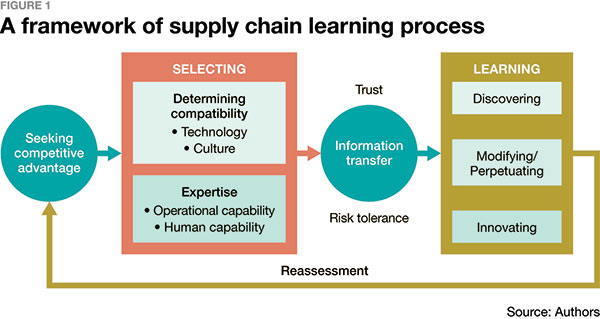
Once the customer firm identifies a primary motivation, it can focus on selecting a supplier. From a supply chain learning perspective, the major supplier selection criteria fall into one of two categories: compatibility and expertise.
Compatibility
In assessing the compatibility of a firm, technology and culture emerged as two key factors in determining the extent of initial information transfer needed to establish a contract. Technology is typically expressed in terms of the ability of the 3PL firm to provide necessary software and order fulfillment technologies to meet customer service expectations, provide tracking ability and adequate recordkeeping. Technology compatibility is the extent to which the systems between the 3PLs and the customers can be integrated or automated to enable seamless information flow. Not surprisingly, a lack of technology was identified by many firms as one of the key reasons for 3PL outsourcing project failures.
Culture, defined as a service provider’s ability to match the customer’s expectations, was also identified as a key success factor. Our interviews with executives indicated a difference in cultural consideration based on company size. We found that larger companies emphasized a direct culture match less, relying more on capabilities. Smaller companies tended to give culture and commonality more consideration. One of our small- to medium-sized company executives emphasized that an informal, personal relationship more aligned with his company’s culture was critical in building the learning relationship.
This company tended to rely more on “gut feeling” based on the personal relationship established. Another executive from a larger company indicated that capabilities were key concerning trust typically defined more methodically in a “legally bulletproof contract.” However, she indicated that it is within personal relationships where trust is built and exercised.
Expertise
Expertise is assessed along operational and human capabilities made available by the 3PL to provide the required service or product. Operational capabilities include capacity, physical means to accommodate specific products, geographic coverage, manpower, etc. Superior performance on these capabilities is considered necessary to enter a business relationship. Excellence in operational capabilities that are most important to the customer is critical to the relationship. However, human capabilities or interpersonal skills and qualities sometimes override operational concerns. These capabilities (communication, empathy, trust, collaboration, adaptability, etc.) contribute to developing productive and enduring relationships. For example, an executive for one customer company discussed how a 3PL CEO always contacts him for lunch or informal discussion when in town. The personal connection that the 3PL CEO established helped build trust and was a significant factor in choosing a 3PL provider. Other company executives discussed how personal information sharing was essential to building relationships and trust.
Objectively, suppliers that score high on the capability and expertise criteria should be the top choice. However, the two supplier selection criteria are embedded in a mesh of trust and risk tolerance. Openness, transparency, and effective communication are critical to the success of the 3PL and the customer, as outlined by Prashant Premkumar,
Saji Gopinath and Arqum Mateen in a 2021 article, “Trends in third party logistics—the past, the present & the future,” published in the International Journal of Logistics Research and Applications. Trust and risk tolerance affect the extent of actual learning that will take place in a 3PL-customer relationship. Trust and risk drive the breadth and depth of interaction, which affects learning.
Trust or perception of the trustworthiness of a supplier emanates from several sources, including cultural compatibility and perceived expertise. Trust allows for better interaction and enables the transfer of knowledge and learning. A firm’s confidence in the partners’ capabilities and ability to deliver expected performance helps overcome hindrances to knowledge transfer, including language, cultural, technological, and hierarchical barriers. The level of trust must increase before information considered guarded, proprietary, or potentially damaging to an organization is shared with outside entities resulting in a higher level of learning.
Risk tolerance
Risk tolerance is the extent of risk a firm or manager is willing to assume, affecting the magnitude of knowledge sharing. Risk tolerance and trust go hand-in-hand in the initial stages of a relationship. With time, as trust increases, the level of risk tolerance may increase. However, several factors can affect risk tolerance, the most important being the level of competition in the external market for the customer firm. Risk tolerance may increase exponentially if the firm is willing to accept the threat of damage to the organization in return for gaining a competitive advantage. For example, sharing proprietary information on product development is inherently risky; however, depending upon the trust and risk tolerance levels and fueled by competitive pressures, the extent of knowledge sharing may vary significantly in different 3PL-customer relationships.
The relative size of the customer and service provider affects trust, risk and learning dynamics. Smaller 3PL customers working with larger suppliers or smaller 3PLs working with larger customers rely more on personal relationships than bigger players. There is more engagement because of lesser negotiation power and higher dependence on one of the parties.
They leverage their close-knit relationships for a fluid exchange of insights, learning opportunities, and innovation unique to their requirements. This close engagement rectifies emerging issues informally rather than relying on formal contracts. Service providers and customers prefer to be “a big fish in a small pond” over “a small fish in a big pond.” Overall, service providers can command better margins, customers can obtain better service, and close interaction fosters innovation.
Larger 3PLs working with large customers are in a more balanced relationship. Due to the volume, the playbook of formal contracts is typically employed. Meetings and updates are scheduled, formal, and frequent, and typically there is a higher level of information systems integration. In such cases, continuous feedback fuels learning, improvement, and innovation. In larger companies, learning is more structured and institutionalized.
Further, because of the resources available on both sides, unique demands are more frequent, and both parties challenge each other for opportunities to innovate. Overall, service providers benefit not only from better margins but also higher business volume, and customers benefit from better service and typically also seek competitive advantage through logistics services.
Knowledge transfer
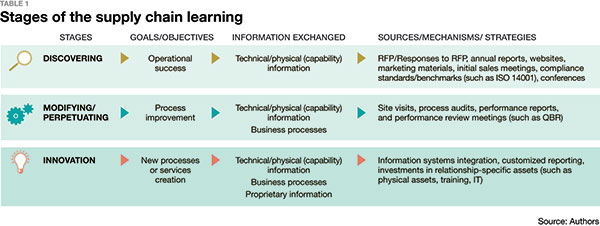
The transfer of knowledge and learning occurs in three interrelated stages: discovering knowledge, modifying and perpetuating knowledge, and innovating. Discovering, the lowest level of learning, is identifiable by the simple exchange of operational and technical information. Modifying and perpetuating focus on the additional step of behavior changes based on operational and technical information exchange. Innovating is focused on the creation of new knowledge that did not exist to either party before information exchange and learning.
Discovery is identifiable by the simple exchange of information. This result is generally, though not exclusively, consistent with the lowest levels of project planning and minimal governance over the relationship. An example of this type of learning could be sharing shipping/tracking information related to an exchange of goods or services. In this step, trust between firms has not been well-established, leading to a low-risk tolerance.
Companies rely primarily on contracts and operational metrics to facilitate information exchange at this stage. Learning at this stage is primarily directed at meeting operational goals. As the level of project planning and governance is increased, so are the expectations of the results. If the service provider expects additional business, they may invest more time and resources to learn about a customer’s business and industry. However, if the service provider perceives themselves as a vendor, they will not invest more in learning. If the customer wants the vendor to evolve into a partner from a mere vendor, it is important to provide explicit or tacit clues to the service provider.
Information beneficial to one or both trading partners is exchanged as learning increases. When information is exchanged and resources are combined, learning and knowledge exchange can extend beyond that of a transactional level. As new knowledge is assimilated into the organization, the result is a conscious decision to change the behavior of the business or, based on the new knowledge, perpetuate the current behavior after an assessment reveals it to be the best possible at that point. For example, a 3PL charges a penalty for oversized packages because the packages are not able to be moved efficiently.
When the 3PL shares information concerning the inefficiencies and the manufacturer modifies the packaging process, 3PL operational costs are reduced due to efficiency improvements, and cost savings are shared with the manufacturer. Companies tend to perpetuate behaviors when modification costs outweigh potential cost savings, whereas they tend to modify behaviors when cost savings can be realized.
The ultimate result of learning is innovation based on new knowledge that did not exist with either party beforehand. It is usually the result of more mature relationships evolving from modifying/perpetuating to innovation. Because information exchange at this level occurs in the context of a mature relationship, this stage demonstrates the highest levels of trust and risk tolerance. Both firms typically invest in relationship-specific technological, physical, and/or human assets, to maximize the value of the relationship. An example of this level is an effort to digitize documents relevant to the transportation processes for a specific 3PL and its customer. In this case, there is innovation between the two partners to improve access, searchability, preservation, interaction, and disaster recovery retention.
Avoiding mismatches
The learning results are not always consistent with the project’s initial goals. The mismatch can result from poor assessments of learning partners’ expertise and potential, compatibility issues arising after the planning stage, and a change in the level of trust due to performance or non-performance related reasons.
The match between goals and results leads to steady progress from one stage to the next. However, low expectations and high outputs can lead to companies jumping directly from the discovering stage to the innovation stage. Table 1 summarizes the discussion so far and lists sources, mechanisms, and strategies to enable better information exchange within the different relationship stages.
It is important to mention that learning stages form a cycle. Executives on both sides constantly assess engagement, knowledge sharing, and knowledge creation within the boundaries of trust between organizations that determine the tolerance level. Executives continually analyze results and compare them to the original goals once the initial milestone stated in the contract is reached or if the service provider does not seem to deliver promised results.
When the results are close to expectations, there may be an incremental increase in trust and risk tolerance. However, major deviations can result in either a significant increase or decrease in trust and risk tolerance. In addition, executives continually assess the balance between risk and reward to determine the level of risk tolerance. For example, firms may assess operational capability, including financial stability, capacity, capability to make changes, and market stability to assume long-term presence. They also assess compatibility concerning technology to share data and culture to identify any personal or physical barriers (language, communication, time zones, corporate and personal culture, etc.). This information is used to assess the potential benefits and risks of information sharing. This balance determines the chain learning that will occur in the relationship. In summary, customers looked at expected and actual outcomes, risk and reward balance, and how much risk-sharing the 3PL was willing to engage in to decide upon the level of information sharing. Given the nature of their operations, one customer firm engaged in minimal information sharing with even their long-term 3PL provider, making the executives at the 3PL always feel like vendors and never partners.
Learning pays off
Finally, the companies that can effectively engage in learning across multiple entities in their supply chain can expect the following benefits: cost reductions for the firm and the supply chain, process improvements, increased efficiency, strengthened core competencies, and increased customer service levels. For example, one company used a 3PL (integrator) to procure a wide variety of wires and connectors used to build harnesses. The 3PL did the procure and quality assurance for the customer. The 3PL, over a period of time, learned the customer’s processes and put forth a proposal to build the harnesses for the customer. The customer was initially skeptical but gradually outsourced harness manufacturing to the 3PL and added an external service provider for the quality assurance of harnesses.
As a result, the customer freed up their employees to focus on value-added work and realized overall cost savings, and the 3PL was able to improve harness availability for the customer while growing both revenues and profit margins.
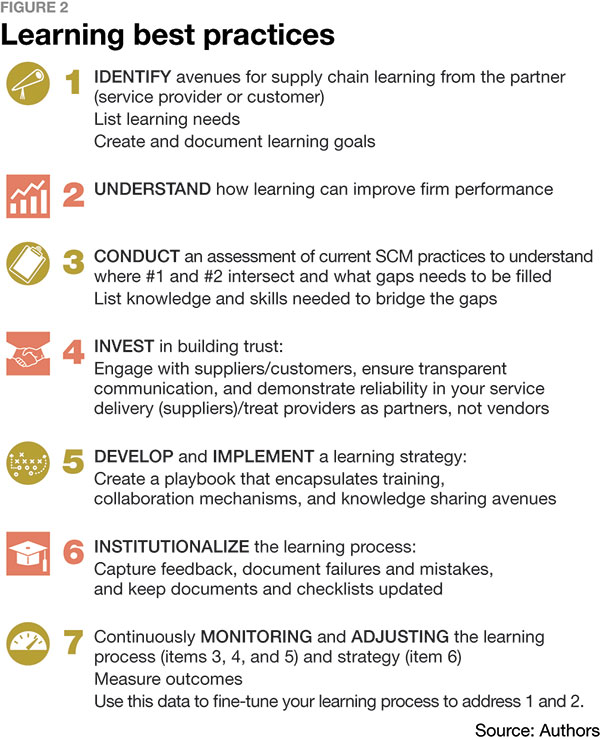
The three phases of supply chain learning—discovering, improving, and innovating—serve as a guiding framework for 3PL companies to adapt to successfully implement and realize supply chain learning. Based on the process framework (presented in Figure 1), we suggest the following best practices for supply chain managers in 3PL companies to achieve supply chain learning.
By following these best practices (Figure 2), 3PL firms and 3PL customers can unlock the potential of supply chain learning, leading to improved service delivery, greater customer satisfaction, and competitive advantage. The dynamic nature of supply chains necessitates this continuous learning, helping companies adapt to changing customer needs, market trends, and emerging challenges.
About the authors
Tom Morgan, Ph.D., is an assistant professor of management at Middle Tennessee State University, teaching supply chain operations, distribution, and international sourcing.
Richard Tarpey, DBA, is an assistant professor of management at the Jennings A. Jones College of Business, Middle Tennessee State University. His research interest includes labor management and supply chain management.
Ila Manuj, Ph.D., is an associate professor of logistics at the University of North Texas, Denton. She has more than 20 years of academic and industry experience conducting applied supply chain research in consultation with companies.
Kiran Patil, Ph.D., is a research-oriented academician, management consultant, and manufacturing engineer with over 10 years of professional experience. He is currently a faculty of supply chain management at Texas Tech University.
Terrance Pohlen, Ph.D., CTL, is the senior associate dean of the G. Brint Ryan College of Business, the director of the Jim McNatt Institute for Logistics Research, the co-director of the Center for Integrated Intelligent Mobility Systems, and professor of logistics at the University of North Texas. His research focuses on mobility systems and transportation management among other areas.
SC
MR


More 3PLs
- The Role of 3PLs in Reducing Supply Chain Cybersecurity Risks
- 34th Annual Study of Logistics and Transportation Trends: The Great Disconnect—Bridging the knowing/doing gap in logistics
- Beyond the algorithm: How Uber Freight is using AI to redefine logistics
- Digital Freight Matching Roundtable: Evolving for a digitized future
- Optimizing value in 3PL relationships through supply chain learning
- More 3PLs
 Explore
Topics
Procurement & Sourcing News
- Innovators Netstock, Pickle Robot win NextGen Solution Provider awards
- From salon to dock door: Repurposing scheduling software for inbound flow
- The biggest barrier to AI in supply chains isn’t technology
- Rebuilding a planning function around the physical world
- Why companies blame the wrong supplier … and miss the real failure
- NextGen Supply Chain Conference unveils agenda focused on AI, execution and the future of leadership
- More Procurement & Sourcing
Latest Procurement & Sourcing Resources
Subscribe

Supply Chain Management Review delivers the best industry content.

Editors’ Picks



