
Sorry, but your login has failed. Please recheck your login information and resubmit. If your subscription has expired, renew here.
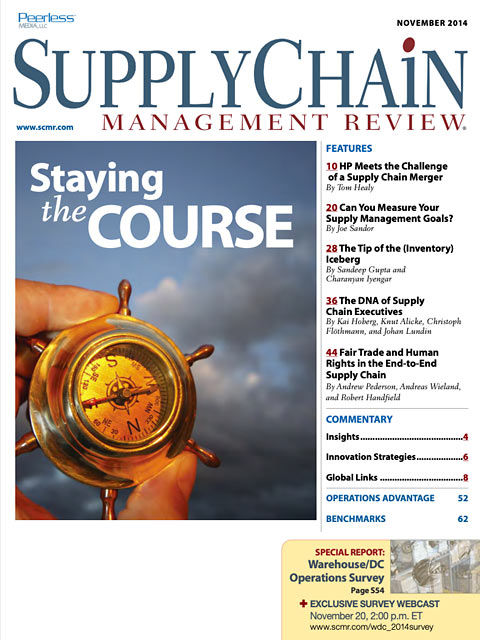
November 2014
Supply chain managers are on the lookout for metrics that will allow them to put a number to their progress - or lack thereof. Welcome to KPI's that allow them to demonstrate the quantifiable value that they deliver. At the same time, Murphy's Law may intervene or they may be called upon to put out fires or come to the rescue and make good on the promises sales and marketing have made to customers - regardless of the cost. So, how do you measure success? I hope this month's issue and online bonus feature help you consider how you measure your progress. Browse this issue archive.Need Help? Contact customer service 1-508-503-1313 More options
The language of procurement speaks to an agenda driven by delivering value. Leading procurement organizations are well-versed in areas that resonate with financial officers and the performance narrative. They lead with hard value contributions of procurement, can discuss their performance across an array of value drivers, and advance intangible value to their organizations as well. Knowledgeable about how their teams are performing, leading CPOs know what they need to do to improve their organization’s performance and are laying out career paths to attract and retain the best talent.
Chief procurement officers who are literate in this new language are building the brand of procurement by making themselves valued partners to chief financial officers and the rest of the C-suite. In 2011, A.T. Kearney began homing in on benchmarking value delivery with Return on Supply Management Assets (ROSMA), a performance measurement framework built to help companies understand and measure how procurement contributes financially to the business.
In the inaugural ROSMA Performance Check report, we have gathered the feedback of hundreds of companies. The insights are powerful.
• Top-quartile performers are reporting hard financial results in excess of seven times their costs and investment base in procurement, providing a strong basis for reinvestment and recognition. These leaders generate about $1.6 million in financial benefits per procurement employee each year, with 35 percent of the financial benefits coming from using advanced methods that create hard value beyond unit cost reduction.
PASTE Same 3 Paragraphs of text here.
 |
This complete article is available to subscribers
only. Click on Log In Now at the top of this article for full access. Or, Start your PLUS+ subscription for instant access. |
SC
MR
Sorry, but your login has failed. Please recheck your login information and resubmit. If your subscription has expired, renew here.
November 2014
Supply chain managers are on the lookout for metrics that will allow them to put a number to their progress - or lack thereof. Welcome to KPI's that allow them to demonstrate the quantifiable value that they… Browse this issue archive. Access your online digital edition. Download a PDF file of the November 2014 issue.|
|
Download Article PDF |
The language of procurement speaks to an agenda driven by delivering value. Leading procurement organizations are well-versed in areas that resonate with financial officers and the performance narrative. They lead with hard value contributions of procurement, can discuss their performance across an array of value drivers, and advance intangible value to their organizations as well. Knowledgeable about how their teams are performing, leading CPOs know what they need to do to improve their organization’s performance and are laying out career paths to attract and retain the best talent.
Chief procurement officers who are literate in this new language are building the brand of procurement by making themselves valued partners to chief financial officers and the rest of the C-suite. In 2011, A.T. Kearney began homing in on benchmarking value delivery with Return on Supply Management Assets (ROSMA), a performance measurement framework built to help companies understand and measure how procurement contributes financially to the business.
In the inaugural ROSMA Performance Check report, we have gathered the feedback of hundreds of companies. The insights are powerful.
• Top-quartile performers are reporting hard financial results in excess of seven times their costs and investment base in procurement, providing a strong basis for reinvestment and recognition. These leaders generate about $1.6 million in financial benefits per procurement employee each year, with 35 percent of the financial benefits coming from using advanced methods that create hard value beyond unit cost reduction.
|
|
SUBSCRIBERS: Click here to download PDF of the full article. |
SC
MR

Latest Supply Chain News
- Bigger trucks versus broken bridges and roads
- From salon to dock door: Repurposing scheduling software for inbound flow
- The biggest barrier to AI in supply chains isn’t technology
- Rebuilding a planning function around the physical world
- Why companies blame the wrong supplier … and miss the real failure
- More News
Latest Podcast
 Explore
Topics
Latest Supply Chain News
- Innovators Netstock, Pickle Robot win NextGen Solution Provider awards
- Bigger trucks versus broken bridges and roads
- From salon to dock door: Repurposing scheduling software for inbound flow
- The biggest barrier to AI in supply chains isn’t technology
- Rebuilding a planning function around the physical world
- Why companies blame the wrong supplier … and miss the real failure
- More latest news
Latest Resources
Subscribe

Supply Chain Management Review delivers the best industry content.

Editors’ Picks



