
Sorry, but your login has failed. Please recheck your login information and resubmit. If your subscription has expired, renew here.
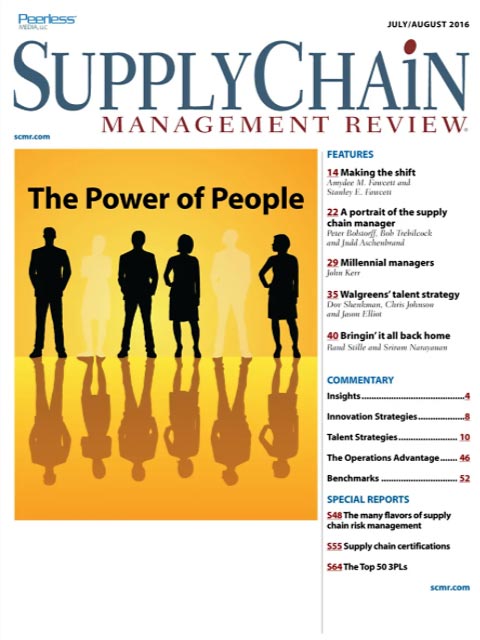
July-August 2016
What’s the difference between us and our competitors? Our people!” I can’t think of an organization that doesn’t publicly state that its people are its most important asset. Yet, anyone who has been in the workforce for any length of time knows that when the rubber hits the road—or something else hits the fan—people are usually the first casualty of cost cutting. It’s far easier to free up your talent for “other opportunities” than it is to close a plant or sell a fleet of trucks. Browse this issue archive.Need Help? Contact customer service 1-508-503-1313 More options
What’s with the Millennials?
That peevish question is often behind the headlines deploring America’s shortage of skilled labor: The implication is that Millennials—the 20- and 30-somethings who should be easing employers’ help-wanted headaches—have a different attitude toward work than did their elders.
While they are regularly characterized as bright, collaborative, creative and digitally savvy, Millennials are also described as entitled, mercurial and self-centered individuals. Both perceptions are generalizations at best, and neither should inform practical hiring plans or retention programs.
To get a first-hand look at how Millennials in our profession think and act—and to give today’s supply chain leaders a feel for their eventual successors—Supply Chain Management Review interviewed four up and coming 30-something managers from varied backgrounds and supply chain specializations.
What did we find? Yes, some have indeed job-hopped; yet others have been with one employer all of their working lives. They are digitally savvy, but they are also business savvy and highly engaged. They are ambitious, but realistic. Perhaps most notably for the health of the profession, they exhibit strong streaks of outreach and collaboration and a commitment to supply chain management.
Meredith Marsico: Paying it forward
Not yet 32, Meredith Marsico is paying it forward for the next generation of supply chain leaders. In her spare time, she co-chairs a breakfast speakers program that often attracts 100 students at the Center for Supply Chain Management at the University of Pittsburgh, where she earned her MBA. “It’s great to see students get excited about supply chain topics,” she says.

Of course, Marsico is not that far removed from those students, having launched her career with a management consulting firm some nine years ago. Marsico says the job, which required a great deal of interaction with customers, prepared her for her current position as director of solution design at DHL Supply Chain, where she is part of a 40-strong solutions design team responsible for everything from the design and implementation of a solution to the ongoing operation of the resulting network, if the customer requires such outsourcing. “My overarching role is to provide a solution that addresses a customer’s pain points, whether it involves distribution, transportation or reverse logistics,” she says.
 |
This complete article is available to subscribers
only. Click on Log In Now at the top of this article for full access. Or, Start your PLUS+ subscription for instant access. |
SC
MR
Sorry, but your login has failed. Please recheck your login information and resubmit. If your subscription has expired, renew here.
July-August 2016
What’s the difference between us and our competitors? Our people!” I can’t think of an organization that doesn’t publicly state that its people are its most important asset. Yet, anyone who has been in the… Browse this issue archive. Access your online digital edition. Download a PDF file of the July-August 2016 issue.|
|
Download Article PDF |
What's with the Millennials?
That peevish question is often behind the headlines deploring America's shortage of skilled labor: The implication is that Millennials—the 20- and 30-somethings who should be easing employers' help-wanted headaches—have a different attitude toward work than did their elders.
While they are regularly characterized as bright, collaborative, creative and digitally savvy, Millennials are also described as entitled, mercurial and self-centered individuals. Both perceptions are generalizations at best, and neither should inform practical hiring plans or retention programs.
To get a first-hand look at how Millennials in our profession think and act—and to give today's supply chain leaders a feel for their eventual successors—Supply Chain Management Review interviewed four up and coming 30-something managers from varied backgrounds and supply chain specializations.
What did we find? Yes, some have indeed job-hopped; yet others have been with one employer all of their working lives. They are digitally savvy, but they are also business savvy and highly engaged. They are ambitious, but realistic. Perhaps most notably for the health of the profession, they exhibit strong streaks of outreach and collaboration and a commitment to supply chain management.
Meredith Marsico: Paying it forward
Not yet 32, Meredith Marsico is paying it forward for the next generation of supply chain leaders. In her spare time, she co-chairs a breakfast speakers program that often attracts 100 students at the Center for Supply Chain Management at the University of Pittsburgh, where she earned her MBA. “It's great to see students get excited about supply chain topics,” she says.
Of course, Marsico is not that far removed from those students, having launched her career with a management consulting firm some nine years ago. Marsico says the job, which required a great deal of interaction with customers, prepared her for her current position as director of solution design at DHL Supply Chain, where she is part of a 40-strong solutions design team responsible for everything from the design and implementation of a solution to the ongoing operation of the resulting network, if the customer requires such outsourcing. “My overarching role is to provide a solution that addresses a customer's pain points, whether it involves distribution, transportation or reverse logistics,” she says.
|
|
SUBSCRIBERS: Click here to download PDF of the full article. |
SC
MR

Latest Supply Chain News
- From salon to dock door: Repurposing scheduling software for inbound flow
- The biggest barrier to AI in supply chains isn’t technology
- Rebuilding a planning function around the physical world
- Why companies blame the wrong supplier … and miss the real failure
- NextGen Supply Chain Conference unveils agenda focused on AI, execution and the future of leadership
- More News
Latest Podcast
 Explore
Latest Supply Chain News
- Why companies blame the wrong supplier … and miss the real failure
- NextGen Supply Chain Conference unveils agenda focused on AI, execution and the future of leadership
- From fragmented negotiations to coordinated negotiation performance: an AI-enabled approach
- Supply chain resilience isn’t a data problem; it’s a judgment problem
- Beyond the hype: Building flexible and scalable supply chains in a VUCA world
- Why your supply chain risk management plan will fail
- More latest news
Latest Resources

About the Author
John Kerr, Special Projects Editor

John Kerr is special projects editor for Supply Chain Management Review where he writes the magazine’s popular “Profiles in Leadership” section. John has an extensive background in business journalism, having worked for Inc and Electronic Business among other publications. In 2002, he founded Ergo Editorial Services (www.ergoeditorial.biz), which provides a range of editorial and marketing services. You can reach John directly at [email protected].
Follow SCMR on social media.
@SupplyChainManagementReview on Facebook
@SCMR on Twitter
SCMR on Linkedin
Subscribe

Supply Chain Management Review delivers the best industry content.

Editors’ Picks



