
If you have spent more than five minutes in the supply chain industry, you know the drill of a typical trade conference. You walk into a massive convention center, grab a complimentary branded tote bag, and brace yourself for the vendor gauntlet. The interactions mostly happen between practitioners searching for solutions and sales teams promising that their latest “AI-enabled control tower” will fix everything—perhaps even your sleep schedule.
Don’t get me wrong: vendors matter. The ecosystem depends on them. But that is not the only way professionals learn and advance. Many of us want something deeper. We want to exchange ideas directly with peers, examine real technical implementations, and ask granular questions about how organizations actually solved the exact operational nightmare we are currently facing.
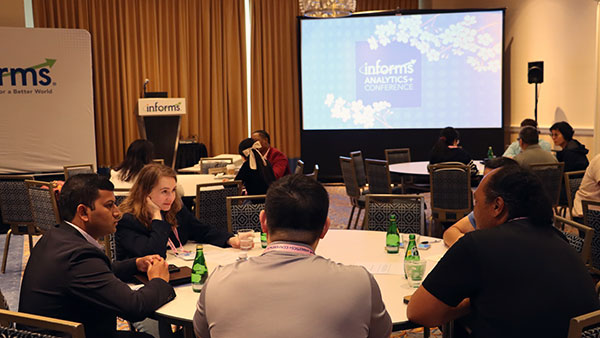
That desire recently led me to the INFORMS Analytics+ Conference.
I’ll admit, my expectations were mixed. INFORMS—the Institute for Operations Research and the Management Sciences—is widely recognized as the leading professional association for analytics, operations research, AI, and data science. Its community includes renowned academics, industry innovators, and some of the most sophisticated analytics teams in the world. As more of a “regular” supply chain practitioner, I initially wondered: Is this going to be too technical? Will they revoke my coffee privileges if I can’t solve a non-linear optimization problem in my head?
What I discovered instead was one of the most intellectually energizing professional experiences I’ve had in years.
The Nobel Prize meets the Super Bowl of operations research
Unlike many vendor-driven trade shows, Analytics+ is centered on ideas, applied innovation, and real-world impact. The focus is not on flashy demos, but on substantive case studies, candid technical discussions, and the measurable business value created through analytics and operations research.
My involvement with the event was twofold, as I judged and coached finalists for the prestigious Franz Edelman award.
If you are unfamiliar with the Edelman Award, you should not feel bad, but you should know about it. Within the analytics and operations research community, it is one of the highest honors in the field. Often described as the equivalent of a Nobel Prize for applied analytics, the award recognizes organizations that have successfully deployed advanced analytical methods to create extraordinary real-world impact.
To even qualify, teams must demonstrate that their solution is not theoretical or experimental, but fully implemented and delivering measurable operational and financial results at scale. The level of rigor is extraordinary. Teams endure multiple rounds of scrutiny, validation, and technical review before ever reaching the finalist stage.
Each year, only six projects make the shortlist.
The finalists then deliver deeply transparent, under-the-hood presentations of their work. They share the realities behind implementation: team structures, organizational challenges, years of development effort, modeling approaches, deployment hurdles, and the specific algorithms and methodologies used. Judges challenge assumptions and probe technical details while practitioners in the audience furiously take notes.
The 2026 finalists showcased exceptional work. Three presentations especially stood out to me:
- Microsoft (the eventual winner) demonstrated how it developed an internal, explainable LLM-powered supply chain planning assistant—precisely the kind of capability supply chain executives across industries are racing to build.
- ECCO Shoes detailed its evolution from a basic one-to-one replenishment model into an Intelligent Auto Replenishment (IAR) system that significantly improved revenue performance while integrating seamlessly into a broader enterprise analytics ecosystem.
- NVIDIA presented a fascinating case study on scaling its supply chain at an unprecedented pace amid explosive AI-driven growth. Interest in the session was so intense that attendees packed the room beyond capacity.
What became abundantly clear throughout these presentations was the power of collaboration between academic expertise and operational experience. Nearly every elite team combined advanced analytical talent with seasoned business practitioners working side by side.
That intersection—where rigorous analytics meets real operational execution—is where the future of supply chain is being built.
The terrifying technology gap
But as I walked the conference halls, talked with attendees, and drank my hard-earned coffee, a more sobering realization emerged: the gap between industry leaders and everyone else is widening at an alarming rate.
While many organizations are still wrestling with fragmented systems, spreadsheet consolidation, and decades-old ERP limitations, leading companies are deploying cutting-edge analytics and AI to generate transformative operational advantages.
We are now living in a world where some companies have LLMs engaging in real-time conversations with demand planners, explaining forecast logic and scenario tradeoffs, while others are still struggling to locate physical inventory in a warehouse.
That gap is no longer theoretical. It is operational, strategic, and increasingly existential.
The uncomfortable reality is that the window to catch up is closing faster than many executives realize. Waiting for vendors to hand over a polished roadmap is no longer enough. Leaders need to actively educate themselves, develop internal analytical literacy, and identify the highest-value opportunities to apply AI and advanced analytics within their own supply chain networks.
The companies doing this well are not simply buying technology; they are building organizational capability.
Where to go from here
The Analytics+ Conference may be over, but the learning does not stop there.
For practitioners looking to move beyond surface-level sales pitches and better understand how advanced analytics is actually transforming supply chains, INFORMS offers an enormous amount of accessible and practical content—even for those without a PhD.
I highly recommend exploring resources such as the Resoundingly Human podcast, the INFORMS Journal on Applied Analytics, and the organization’s extensive video library of Franz Edelman Award presentations and case studies. These materials provide rare visibility into how leading organizations are solving some of the world’s most difficult operational challenges.
Most importantly, the conference reinforced a powerful idea: advanced analytics is no longer a niche specialty reserved for elite technical teams. It is rapidly becoming a core competitive capability for modern supply chains.
If you have been waiting for a sign to stop treating your supply chain as a cost center and start treating it as a data-driven strategic weapon, this is it.
About the author
Marianna Vydrevich is manager of operations research & network optimization at GAF, North America’s largest roofing manufacturer. Vydrevich is a seasoned supply chain expert with a decade of global experience, specializing in supply chain network design and data science. She can be reached at LinkedIn or at [email protected]
SC
MR

More Supply Chain Analytics
 Explore
Topics
Business Management News
- Innovators Netstock, Pickle Robot win NextGen Solution Provider awards
- Bigger trucks versus broken bridges and roads
- From salon to dock door: Repurposing scheduling software for inbound flow
- The biggest barrier to AI in supply chains isn’t technology
- Rebuilding a planning function around the physical world
- Why companies blame the wrong supplier … and miss the real failure
- More Business Management
Latest Business Management Resources
Subscribe

Supply Chain Management Review delivers the best industry content.

Editors’ Picks



