

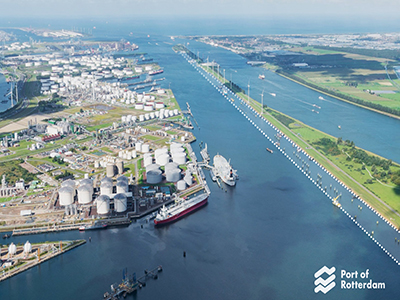
The Port of Rotterdam Authority and IBM today announced their collaboration on a multi-year digitization initiative to transform the port's operational environment using Internet of Things (IoT) technologies in the cloud to benefit the port and its stakeholders.
The initiative will also prepare the Port of Rotterdam's entire site to host connected ships in the future. It begins with the development of a centralized dashboard application that will collect and process real-time water, weather sensor data and communications data, analyzed by IBM IoT technologies.
According to Paul Smits, chief financial officer of the Port of Rotterdam Authority, this will enable a new wave of safer and more efficient traffic management at the port.
 “Speed and efficiency is essential to our business, and requires us to use all of the data available to us,” he says. “Thanks to real-time information about infrastructure, water, air, etc., we can enormously improve the service we provide to everyone who uses the port, and prepare to embrace the connected, autonomous shipping of the future.”
As the largest port in Europe, the Port of Rotterdam handles over 461 million tons of cargo and more than 140,000 vessels annually. Previously the port relied on traditional radio and radar communication between captains, pilots, terminal operators, tugboats and more to make key decision on port operations.
With the new initiative, Port of Rotterdam operators will also be able to view the operations of all the different parties at the same time, making that process more efficient. Spokesmen contend that ocean carriers and the port stand to save up to one hour in berthing time which can amount to about $80,000 in savings.
The Port of Rotterdam's digital transformation project is enabled by IBM's cloud-based IoT technologies and will see the Port of Rotterdam and IBM are working together long-term to uncover other innovative applications of IoT and artificial intelligence. Cisco and Axians are also involved in the project.

As reported here earlier, IBM and Maersk recently struck a deal to introduce blockchain technology to global shipping. Over 18 months, through initial pilots, IBM used blockchain technology to securely digitize, automate, and store critical paperwork.
“Early testing demonstrated that it can significantly reduce administrative costs, which at the time of testing could be as high as 15% of the value of the goods shipped.
SC
MR

More Ports & Shipping
- Strait of Hormuz reopens, but supply chains face a long road to recovery
- Coordinating AI-enabled supply chain operations
- Elucidating import container flows: A simulation study of Port of New York/New Jersey
- Wayfair executive to share lessons from building a tech-driven delivery network in NextGen Keynote
- Eli Lilly’s Mar Gimeno to keynote at NextGen Supply Chain Conference 2026
- Procurement’s moment has arrived
- More Ports & Shipping
Latest Resources
 Explore
Topics
Procurement & Sourcing News
- Why companies blame the wrong supplier … and miss the real failure
- NextGen Supply Chain Conference unveils agenda focused on AI, execution and the future of leadership
- From fragmented negotiations to coordinated negotiation performance: an AI-enabled approach
- Supply chain resilience isn’t a data problem; it’s a judgment problem
- Why your supply chain risk management plan will fail
- When component verification becomes operational
- More Procurement & Sourcing
Latest Procurement & Sourcing Resources

About the Author
Patrick Burnson, Executive Editor

Patrick is a widely-published writer and editor specializing in international trade, global logistics, and supply chain management. He is based in San Francisco, where he provides a Pacific Rim perspective on industry trends and forecasts. He may be reached at his downtown office: [email protected].
Follow SCMR on social media.
@SupplyChainManagementReview on Facebook
@SCMR on Twitter
SCMR on Linkedin
Subscribe

Supply Chain Management Review delivers the best industry content.

Editors’ Picks



