
Sorry, but your login has failed. Please recheck your login information and resubmit. If your subscription has expired, renew here.
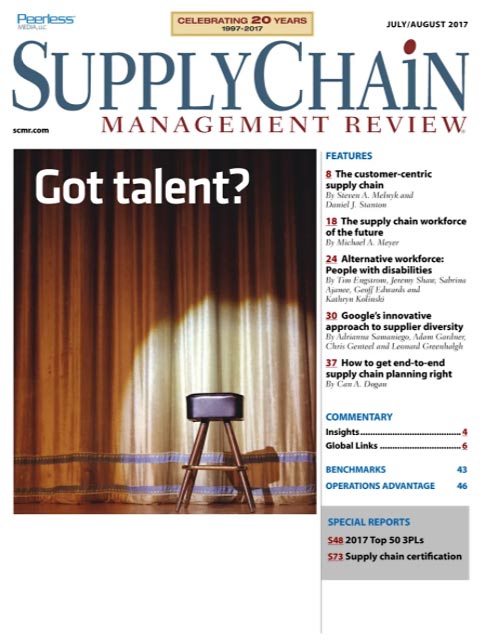
July-August 2017
A few years ago, a Harvard Business Review cover posed the question: What’s the secret to winning in the global economy? The answer: Talent. Browse this issue archive.Need Help? Contact customer service 1-508-503-1313 More options
For decades, supply chain planning (SCP) has been a major challenge for companies of all sizes. A common theme plays out in most cases: Organizations invest substantially—both in time and money—in their planning capabilities, only to see poor results.
Let’s take a recent example. A large consumer packaged goods company was struggling with less than ideal inventory performance and relatively high case fill rates. But because their performance metric was defined to favor the efforts of execution, rather than truly meeting demand on time and in full, their supply chain costs were higher than their peers.
This company had made years of investments in multiple SCP technologies that were only partly satisfactory. Spreadsheets were still persistent across the organization and were commonly used for key parts of the SCP process. When the organization uncovered gaps in their SCP technology capabilities, it remedied these shortfalls with temporary workarounds and the allocation of additional resources.

This complete article is available to subscribers only.
Log in now for full access or start your PLUS+ subscription for instant access.
SC
MR
Sorry, but your login has failed. Please recheck your login information and resubmit. If your subscription has expired, renew here.
July-August 2017
A few years ago, a Harvard Business Review cover posed the question: What’s the secret to winning in the global economy? The answer: Talent. Browse this issue archive. Access your online digital edition. Download a PDF file of the July-August 2017 issue.For decades, supply chain planning (SCP) has been a major challenge for companies of all sizes. A common theme plays out in most cases: Organizations invest substantially—both in time and money—in their planning capabilities, only to see poor results.
Let's take a recent example. A large consumer packaged goods company was struggling with less than ideal inventory performance and relatively high case fill rates. But because their performance metric was defined to favor the efforts of execution, rather than truly meeting demand on time and in full, their supply chain costs were higher than their peers.
This company had made years of investments in multiple SCP technologies that were only partly satisfactory. Spreadsheets were still persistent across the organization and were commonly used for key parts of the SCP process. When the organization uncovered gaps in their SCP technology capabilities, it remedied these shortfalls with temporary workarounds and the allocation of additional resources.
SC
MR


Latest Supply Chain News
- Supply chain resilience isn’t a data problem; it’s a judgment problem
- Beyond the hype: Building flexible and scalable supply chains in a VUCA world
- Why your supply chain risk management plan will fail
- When component verification becomes operational
- Caught between a rock and a hard place: Mapping your supply chain
- More News
Latest Resources
 Explore
Procurement & Sourcing News
- Why companies blame the wrong supplier … and miss the real failure
- NextGen Supply Chain Conference unveils agenda focused on AI, execution and the future of leadership
- From fragmented negotiations to coordinated negotiation performance: an AI-enabled approach
- Supply chain resilience isn’t a data problem; it’s a judgment problem
- Why your supply chain risk management plan will fail
- When component verification becomes operational
- More Procurement & Sourcing
Latest Procurement & Sourcing Resources
Subscribe

Supply Chain Management Review delivers the best industry content.

Editors’ Picks



