
We are experiencing an extraordinary level of volatility in the global supply chain ecosystem right now. There are many factors contributing to the current volatility including, but not limited to, geopolitical changes, logistical bottlenecks resulting from the impacts of climate, and the residual effects of a pandemic. All of these factors have placed extreme pressure on the traditional “just-in-time” model. In today’s volatile environment, it is the companies that can process large amounts of data that ultimately determines whether they will be successful or unsuccessful as enterprises.
By mid-2026, artificial intelligence (AI) will no longer be a concept that is discussed in executive suites around the world. AI will be the driving force behind the global economy and trade. For supply chain executives to be able to remain competitive within this new paradigm, they must focus on moving beyond simply using descriptive analytics (i.e., understanding what occurred) and move toward the use of predictive and prescriptive AI (i.e., predicting what will occur and determining how to react).
The rise of predictive orchestration
The key trend of 2025-2026 will be “predictive orchestration.” The historical approach to supply chain management was a siloed model where procurement, manufacturing & logistics were using different data systems. Today, companies are now using AI-based control towers to integrate those silos. Companies are now using machine learning (ML) algorithms to ingest external signals like weather patterns, port congestion data and even social media sentiment to predict disruptions before physical disruption occurs.
As an example, Generative AI is now being utilized to run digital twin simulations to stress test supply chains against thousands of what if scenarios, allowing for leadership to develop resiliency through design and identify single-source vulnerabilities and dynamically optimize their safety stock levels instead of annually reviewing them.

Generative AI: Beyond the hype to operational utility
Large language models (LLMs) have been in the spotlight with respect to creating content. But in the supply chain context, their real potential is in managing unstructured data. Much of the friction within the supply chain originates from paper-based processes: bills of lading, customs documentation, and multi-page, multi-clause contracts between suppliers and buyers.
Currently Generative AI has begun to automate the contract lifecycle management process which identifies in real time high-risk contract language and suggests alternative sourcing options in response to global events that may cause supply chain disruptions. Additionally, AI-based conversational interfaces are enabling all stakeholders to access data through simple conversation. For example, a warehouse manager does not need to be a data scientist to know their inventory turnover, they simply ask the system “which SKUs are at risk of being out-of-stock as of today if the current west coast port delay continues for three more days,” and receives an immediate response that can enable action.
Autonomous logistics and the physical internet
The last mile of delivery has historically been the most complicated and costly part of the entire supply chain process. The convergence of artificial intelligence and computer vision technologies has provided the driving forces for innovation in this area. Autonomous mobile robots (AMRs) that are used within fulfillment centers have transitioned from simple follow-the-line type robots to autonomous agents that can navigate the changing environment with human workers.
At a global scale, AI is optimizing what is known as the physical internet—a concept where modularized, standardized containers are moved along an open, connected network of routes. In the physical internet, AI serves as the air traffic controller to optimize the flow of these containers and maximize their loads and minimize the number of miles traveled on empty (deadhead) trips. While there may be some cost savings due to improving the efficiency of the delivery of goods through the optimization of routes using AI—there is also a growing sustainability mandate. The use of AI to improve the route taken by vehicles in the delivery of products will help companies meet stricter environmental, social and governance (ESG) requirements by reducing the amount of fuel consumed during the delivery process.
The human-centric AI transition
An inaccurate assumption made about artificial intelligence is that it is designed to replace the human factor in the supply chain. The best AI implementations will be based on a human-in-the-loop (HITL) philosophy. While AI is best suited to process large volumes of data; humans have an advantage over AI when it comes to strategic intuition and managing relationships.
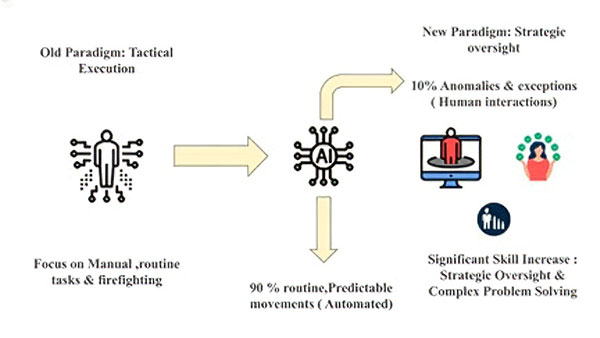
As the supply chain becomes more autonomous, the function of the supply chain professional has evolved toward exception management. While AI manages 90% of routine, predictable movements and flags anomalies as a need for human interaction, this new paradigm requires a significant increase in skill level among professionals—moving from a focus on tactical execution to a focus on strategic oversight.
The challenge of data integrity and cybersecurity
The boost provided by AI is only as strong as the data feeding it. The main obstacle that prevents global businesses from achieving success is what they put into their systems because garbage in, garbage out. The main emphasis of 2026 centers on data clean rooms and blockchain technology that use blockchain-based data provenance to verify AI engine data authenticity while safeguarding it from unauthorized modifications.
The expansion of software-defined systems has created larger attack surfaces for supply chains because these systems now present more opportunities for cyber attackers to launch security threats. The development of AI innovation needs “AI for security” predictive systems that use shipment data analysis to identify irregular patterns that might indicate cyber-breach or physical cargo theft incidents.
Conclusion: The intelligent enterprise
Integration of AI within global supply chains represents an evolution in the science behind commercial transactions rather than simply an update of technology. There will be a “self-healing” supply chain as we move toward having systems that not only recognize issues, but can also autonomously take action to correct those issues by rerouting a ship, switching to an alternative source with secondary suppliers, or changing prices due to an increase in demand.

Academic/consultant professionals need to address the void in understanding between the theoretical capabilities of AI and real-world operational issues. Those who establish an intelligent enterprise, based upon this model, will be able to prosper from the next disruption, while others merely survive.
About the author
Kishan Kumar is an MBA graduate student from Southern Connecticut State University’s School of Business (SCSU Connecticut) where he specializes in management & leadership. Kumar is passionate about bridging strategic vision with operational execution. His experience includes work with operations management and supply chain optimization and strategic planning for consulting, manufacturing, real estate and technology sectors. Kumar holds a bachelor of technology degree from the National Institute of Technology Surathkal, Karnataka and completed executive education at the Indian Institute of Management Kozhikode.
References
Gartner (March 2025). "Gartner Identifies Top Supply Chain Technology Trends for 2025." Gartner 2025 Supply Chain Trends
McKinsey & Company (2025). "McKinsey Technology Trends Outlook 2025." McKinsey Tech Trends 2025
MIT Sloan Management Review (December 2025). "MIT Research Reveals AI’s Strategic Role in Supply Chain Intelligence." MIT SMR Research on Human-AI Teaming
Logistics Management / Gartner (December 2025). "AI’s Energy Appetite is Emerging as a Supply Chain Risk." Gartner Energy Risk Report
ABI Research (October 2025). "2025 Supply Chain Survey: Artificial Intelligence (AI) Usage."ABI Research AI Survey
SC
MR

More Artificial Intelligence
- AI is reshaping the last meter of delivery
- AI-powered supply chains require work redesign, not just process automation
- Why trust, flexibility, and execution now matter more than speed
- Körber Supply Chain, NVIDIA deal advances digital twin capabilities
- Closing the execution gap: Why supply chain investments still struggle to deliver results
- More Artificial Intelligence
What's Related in Artificial Intelligence

 Explore
Topics
Procurement & Sourcing News
- Why companies blame the wrong supplier … and miss the real failure
- NextGen Supply Chain Conference unveils agenda focused on AI, execution and the future of leadership
- From fragmented negotiations to coordinated negotiation performance: an AI-enabled approach
- Supply chain resilience isn’t a data problem; it’s a judgment problem
- Why your supply chain risk management plan will fail
- When component verification becomes operational
- More Procurement & Sourcing
Latest Procurement & Sourcing Resources
Subscribe

Supply Chain Management Review delivers the best industry content.

Editors’ Picks



