
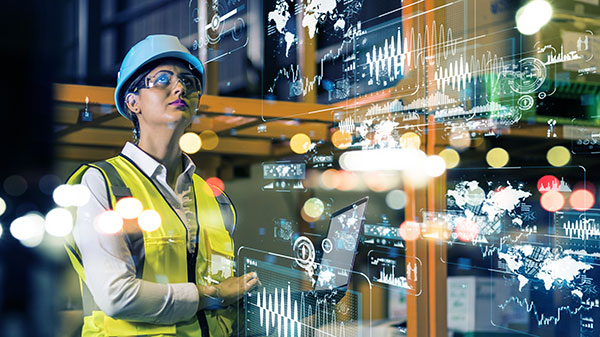
For much of the past decade, supply chain transformation has been framed around automation, robotics, and analytics. More recently, the conversation has shifted sharply toward artificial intelligence. Yet beneath the noise surrounding AI platforms and large-scale systems, a quieter yet arguably more consequential trend is taking shape: the elevation of the frontline worker as a strategic asset in supply chain performance.
Companies adopting AI are realizing that upskilling the worker is a critical part of success.
The worker, whether that be a warehouse worker, a truck driver, a planner or other supply chain executive, sit at the intersection of labor constraints, omnichannel fulfillment, and rising operational complexity. Companies, as a result, are rethinking how technology supports the people doing the work, not just the systems directing it.
That shift was evident in a conversation Supply Chain Management Review had with leaders from Honeywell Industrial Automation at this week’s NRF Retail show in New York. According to them, workforce productivity, engagement, and exception-based execution, rather than automation for its own sake, is the basis of successfully running any operation.
From data overload to actionable insight
One of the recurring lessons of early digital transformation efforts was that more data did not automatically translate into better decisions. Managers were often inundated with dashboards they did not have time to interpret, while frontline workers were left to navigate processes with limited context.
“What we heard back in the days when we were throwing dashboards at people was, I don’t have time to look at dashboards every day, just tell me when there’s a problem,’” explained Scot Stelter, senior director of product.
That insight has become foundational to how many organizations now think about AI. Rather than surfacing more information, AI is increasingly being used to filter, prioritize, and surface only what matters, an approach often described as management by exception. Stelter said this thinking is the basis of a workforce-first mindset.
“The AI can learn what is an exception case,” Stelter explained. “It watches the business and the processes, understands what’s normal, notices anomalies, and then tells me about it.”
The result, he noted, is less manual labor for the workforce and the opportunity to quickly surface issues and address those in a timely manner.
Technology alone is not enough
As the pace of technology adoption continues accelerating, a critical gap has emerged between what systems can do and what people can use. Frontline productivity hinges not just on technology, but on the talent to act on real-time signals effectively. AI, autonomy, and digital transformation are accelerating, but unless organizations build the skills to use them, supply chains will struggle to capture the potential value.
Stelter noted that more data is meaningless without clarity on what action to take next, and that is why Honeywell is working to use AI and bring the most relevant information forward when it is needed. At NRF, Honeywell announced a new solution that is part of this effort to ensure workers are guided and data provided is relevant and not overwhelming the workforce. The Performance+ for Guided Work workforce solution is designed to bring real-time visibility and analytics into frontline warehouse and distribution operations. The offering combines Honeywell’s voice-driven Guided Work technology with advanced analytics to help companies move from reactive responses to more proactive, data-driven decision-making on the warehouse floor.
According to Honeywell, the solution is aimed squarely at “back-of-the-store” environments, where a lack of real-time operational data can slow response times and create inefficiencies. By capturing data at the moment work is performed through hands-free, voice-enabled workflows the system is intended to surface issues as they occur, allowing supervisors to reassign labor, address disruptions, and adjust workflows without waiting for after-the-fact reports.
The frontline worker returns
While AI dominates strategic discussions, labor realities continue to shape daily operations. High turnover, seasonal staffing, and persistent skills gaps have pushed workforce engagement and retention higher on executive agendas.
“What we do is about providing solutions that make the frontline worker more satisfied with their job and more efficient at executing it,” Stelter said. “Everything we do is about driving that productivity and maintaining that frontline worker engagement.”
That emphasis reflects a broader reassessment across supply chains. Across industries, leaders increasingly recognize that people, not just technology, represent the biggest constraint to performance and resilience. At the worker level, the new Performance+ platform builds on guided work concepts that use voice headsets to direct picking, packing, and maintenance tasks while keeping associates’ hands and eyes free. Artificial intelligence enables the system to recognize speech across more than 48 languages, accounting for differences in accents, dialects, and pronunciation, an increasingly important capability in diverse, high-turnover labor environments. Workers can also report incidents such as equipment failures or spills verbally, triggering immediate alerts to supervisors and capturing operational data in real time.
Taylor Smith, CMO for productivity solutions, confirmed that shift. “[Companies] are very focused on the employee side of things,” he said, pointing to rising interest in upskilling, engagement, and knowledge access.
AI as an enabler of upskilling
One of the most significant changes AI enables is faster ramp-up for new or temporary workers. In industries where turnover is high or seasonal labor is common, the ability to make workers productive on day one carries value.
Stelter cited research from call center environments showing that when AI tools were introduced, “new people approached the efficiency of the existing people because you’re capturing all of that knowledge and making it available to all the workers.”
The implication for supply chains is clear: institutional knowledge no longer has to reside solely in experienced employees’ heads. When embedded in workflows, AI can reduce variability in execution and shorten learning curves without replacing human judgment.
Smith described how customers are exploring AI-driven agents that allow workers to ask operational questions directly; questions that previously might have required a supervisor, a binder, or trial and error. “I just got to this packing station and there’s no plastic wrap left, what do I do?,” he posited as an example.
These may not be glamorous use cases, but they address the everyday friction that erodes productivity and morale.
Closing the loop between insight and action
Beyond communication and training, a recurring theme in the discussion was the importance of closed-loop execution. Capturing insight, whether through voice systems, visual inspection, or analytics, only creates value if it leads to timely action. “A lot of the time it’s that lack of closed-loop follow-up that hurts productivity,” Smith said. “We’re starting to close the loop.”
That loop may involve automatically generating tasks, prioritizing work for associates, or flagging issues that require human review. Crucially, how much autonomy organizations grant to systems versus human supervisors varies by risk tolerance and culture.
“It really depends on what level of comfort an organization’s at,” Smith noted. Some prefer confirmation steps, others move toward greater automation. The common denominator is not full autonomy, but clarity: workers arrive knowing what needs attention, and managers intervene only where judgment is required. The Performance+ platform is designed in this way.
From a management perspective, the platform aggregates workforce data into dashboards that track metrics such as picking efficiency, time spent on tasks, and distance traveled. The goal, according to Honeywell, is to digitize manual processes and close the loop between execution and oversight, helping managers identify patterns, flag performance issues as they happen, and make adjustments during the shift rather than after it ends. In practice, this reflects a broader industry push toward exception-based management and continuous performance feedback, where visibility into frontline work becomes a lever for both productivity and employee engagement.
The challenges on the frontline are part of a much larger shift now underway across the industry. According to ASCM2026 trends report, AI, automation, geopolitics, workforce evolution, visibility demands, cybersecurity, and climate challenge are among the forces reshaping supply chains in 2026—a reminder that execution excellence sits alongside visibility and resilience as core strategic priorities. This broader industry context shows that the pressure to improve real-time execution isn’t isolated. Increasingly, copanies are linking frontline productivity with overall supply chain resilience, as fluctuations in demand, labor markets, and global risk reinforce the value of rapid, accurate execution at the operational edge.
The takeaway
Taken together, these trends suggest a reframing of supply chain digital strategy. Instead of viewing frontline technology as a tactical layer under planning systems, companies are recognizing it as a critical enabler of resilience and performance. AI’s most immediate value may not lie in grand optimization models but in helping people execute better by highlighting exceptions, reducing friction, and making expertise accessible at the point of work.
“The goal is always to get to management by exception … the amount of information that a human being has to deal with should go down, not up,” Stelter said.
In an environment defined by uncertainty and constrained labor, that may prove to be one of the most durable competitive advantages supply chains can build.
SC
MR

More Workforce Development
- Surging AI adoption doesn’t match mass layoff narrative
- America wants to reshore manufacturing—but who will do the work?
- Frontline workers are becoming the center of AI-driven supply chains
- The 4 trends mid-market manufacturers need to master to conquer 2026
- ASCM’s Top 10 Supply Chain Trends reveal a year of intelligent transformation
- More Workforce Development
 Explore
Topics
Procurement & Sourcing News
- Why companies blame the wrong supplier … and miss the real failure
- NextGen Supply Chain Conference unveils agenda focused on AI, execution and the future of leadership
- From fragmented negotiations to coordinated negotiation performance: an AI-enabled approach
- Supply chain resilience isn’t a data problem; it’s a judgment problem
- Why your supply chain risk management plan will fail
- When component verification becomes operational
- More Procurement & Sourcing
Latest Procurement & Sourcing Resources
About the Author
Brian Straight, SCMR Editor in Chief

Brian Straight is the Editor in Chief of Supply Chain Management Review. He has covered trucking, logistics and the broader supply chain for more than 15 years. He lives in Connecticut with his wife and two children. He can be reached at [email protected], @TruckingTalk, on LinkedIn, or by phone at 774-440-3870.
Follow SCMR on social media.
@SupplyChainManagementReview on Facebook
@SCMR on Twitter
SCMR on Linkedin
Subscribe

Supply Chain Management Review delivers the best industry content.

Editors’ Picks



