
Sorry, but your login has failed. Please recheck your login information and resubmit. If your subscription has expired, renew here.

March-April 2024
Part of any supply chain manager’s job is risk mitigation. Thanks to COVID-19 and the ensuing, and constant, disruptions that have followed, more companies are now focused on reducing their exposure to supply chain chaos. We’ve heard a lot about diversification in recent years—having multiple suppliers in multiple locations. But risk mitigation goes far beyond diversification, and the recent case of Boeing should serve as a cautionary tale not to avoid those other risks. Browse this issue archive.Need Help? Contact customer service 1-508-503-1313 More options
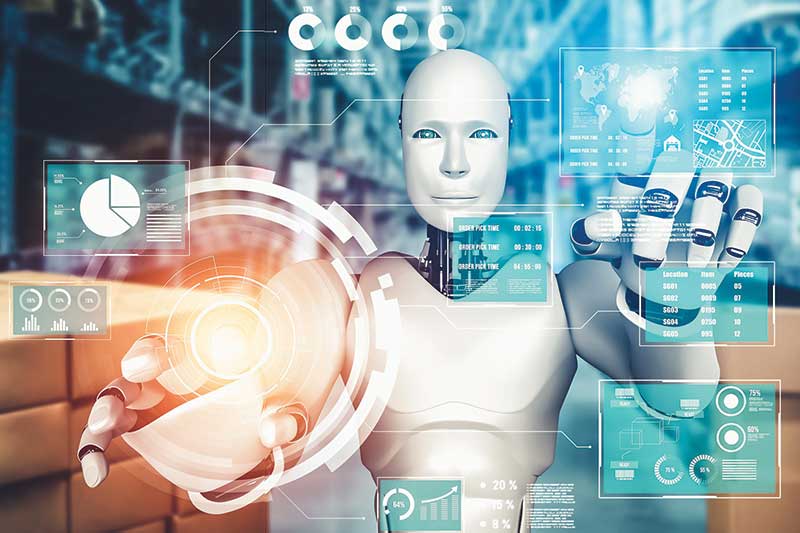
Billionaire Elon Musk took to the X platform recently to agree with David Holz, the founder of artificial intelligence research lab Midjourney, on Holz’s assertion that there will be one billion humanoid robots on earth by the 2040s—a mere 16 years from now.
The thought of humanoids roaming the streets may be frightening for some, yet they are already cruising warehouse floors. We are a far cry from one billion, but they are beginning to find their place. More importantly, at least in 2024, is the technology that underpins those robots—artificial intelligence (AI). AI is rapidly expanding throughout supply chain operations, and it is proving its worth in many areas.
Matt Laukaitis, executive vice president and global general manager of SAP’s Consumer Industries organization, says that AI is connecting customers to the supply chain in ways never before seen. “There are a lot of examples of forecasting data,” he tells Supply Chain Management Review. “But also of getting store associates the available and right inventory.”
Within the retail space, AI is helping ensure inventory is on hand and available for purchase—whether that be at the store or online. But it is also benefiting reverse logistics operations, enabling retailers to resell merchandise quickly using sensors or human inputs to determine where a returned item should enter the re-commerce network and at what price point it should be made available.
“It’s all about having the right data, having clean data,” Laukaitis says. “We’re trying to help our customers be very disciplined with how they [adopt] AI.

This complete article is available to subscribers only.
Log in now for full access or start your PLUS+ subscription for instant access.
SC
MR
Sorry, but your login has failed. Please recheck your login information and resubmit. If your subscription has expired, renew here.
March-April 2024
Part of any supply chain manager’s job is risk mitigation. Thanks to COVID-19 and the ensuing, and constant, disruptions that have followed, more companies are now focused on reducing their exposure to supply chain… Browse this issue archive. Access your online digital edition. Download a PDF file of the March-April 2024 issue.Billionaire Elon Musk took to the X platform recently to agree with David Holz, the founder of artificial intelligence research lab Midjourney, on Holz’s assertion that there will be one billion humanoid robots on earth by the 2040s—a mere 16 years from now.
The thought of humanoids roaming the streets may be frightening for some, yet they are already cruising warehouse floors. We are a far cry from one billion, but they are beginning to find their place. More importantly, at least in 2024, is the technology that underpins those robots—artificial intelligence (AI). AI is rapidly expanding throughout supply chain operations, and it is proving its worth in many areas.
Matt Laukaitis, executive vice president and global general manager of SAP’s Consumer Industries organization, says that AI is connecting customers to the supply chain in ways never before seen. “There are a lot of examples of forecasting data,” he tells Supply Chain Management Review. “But also of getting store associates the available and right inventory.”
Within the retail space, AI is helping ensure inventory is on hand and available for purchase—whether that be at the store or online. But it is also benefiting reverse logistics operations, enabling retailers to resell merchandise quickly using sensors or human inputs to determine where a returned item should enter the re-commerce network and at what price point it should be made available.
“It’s all about having the right data, having clean data,” Laukaitis says. “We’re trying to help our customers be very disciplined with how they [adopt] AI.
SC
MR

Latest Supply Chain News
- Supply chain resilience isn’t a data problem; it’s a judgment problem
- Beyond the hype: Building flexible and scalable supply chains in a VUCA world
- Why your supply chain risk management plan will fail
- When component verification becomes operational
- Caught between a rock and a hard place: Mapping your supply chain
- More News
Latest Resources
 Explore
Software & Technology News
- Managing human and AI teams across the supply chain
- The AI-empowered supply chain leader
- Technology isn’t strategy
- What the INFORMS Analytics+ Conference revealed about the future of supply chain (and why you might be getting left behind)
- The Digital Supply Chain Imperative: From Visibility to Execution
- AI runs on compute; scaling it runs on logistics
- More Software & Technology
Latest Software & Technology Resources

About the Author
Brian Straight, SCMR Editor in Chief

Brian Straight is the Editor in Chief of Supply Chain Management Review. He has covered trucking, logistics and the broader supply chain for more than 15 years. He lives in Connecticut with his wife and two children. He can be reached at [email protected], @TruckingTalk, on LinkedIn, or by phone at 774-440-3870.
Follow SCMR on social media.
@SupplyChainManagementReview on Facebook
@SCMR on Twitter
SCMR on Linkedin
Subscribe

Supply Chain Management Review delivers the best industry content.

Editors’ Picks



