
Sorry, but your login has failed. Please recheck your login information and resubmit. If your subscription has expired, renew here.
March-April 2026
The March/April 2026 issue of Supply Chain Management Review examines how supply chain leaders are managing supplier risk, circular supply chain design, AI-driven retail planning, CPG network optimization, and shifting LTL market dynamics to improve resilience and performance. Features include frameworks to prevent supplier failure, operationalize circular economy strategies, prevent retail stockouts using AI, and eliminate costly DC transfer patterns, plus insights from the 34th Annual Study of Logistics and Transportation Trends and a digital-exclusive on the evolving CSCO role. Browse this issue archive.Need Help? Contact customer service 1-508-503-1313 More options
Supply chain planning tools are not new. Most organizations today rely on established sys-tems for demand planning, supply planning, inventory optimization, and network design. These tools are typically operated in a human-in-the-loop model: planners run scheduled processes (weekly, monthly, or quarterly), review outputs, interpret exceptions, share with multiple silos, and decide on corrective actions. Reports are generated, plans are dissemi-nated, often with limited visibility into how quickly conditions may change between planning cycles.
While this approach has served organizations for years, it becomes increasingly inefficient as supply chains grow more complex. Multi-echelon networks, volatile demand signals, variable lead times, and frequent disruptions require faster detection and response than periodic planning cycles can provide. Specifically, in large, multi-tier organizations, the cognitive and coordination burden placed on planners often leads to delayed decisions and reactive firefighting.
SC
MR
Sorry, but your login has failed. Please recheck your login information and resubmit. If your subscription has expired, renew here.
March-April 2026
The March/April 2026 issue of Supply Chain Management Review examines how supply chain leaders are managing supplier risk, circular supply chain design, AI-driven retail planning, CPG network optimization, and… Browse this issue archive. Access your online digital edition. Download a PDF file of the March-April 2026 issue.Supply chain planning tools are not new. Most organizations today rely on established systems for demand planning, supply planning, inventory optimization, and network design. These tools are typically operated in a human-in-the-loop model: planners run scheduled processes (weekly, monthly, or quarterly), review outputs, interpret exceptions, share with multiple silos, and decide on corrective actions. Reports are generated, plans are disseminated, often with limited visibility into how quickly conditions may change between planning cycles.
While this approach has served organizations for years, it becomes increasingly inefficient as supply chains grow more complex. Multi-echelon networks, volatile demand signals, variable lead times, and frequent disruptions require faster detection and response than periodic planning cycles can provide. Specifically, in large, multi-tier organizations, the cognitive and coordination burden placed on planners often leads to delayed decisions and reactive firefighting.
Recent advances in large-scale computing and AI infrastructure are enabling a shift from human-in-the-loop to human-on-the-loop planning systems. In this model, planning systems continuously monitor the network, detect anomalies, and evaluate risks against service and cost KPIs. Rather than relying on humans to periodically run models and interpret outputs, AI-driven agents proactively highlight emerging risks and recommend actions while keeping humans in control of oversight, validation, and approval.
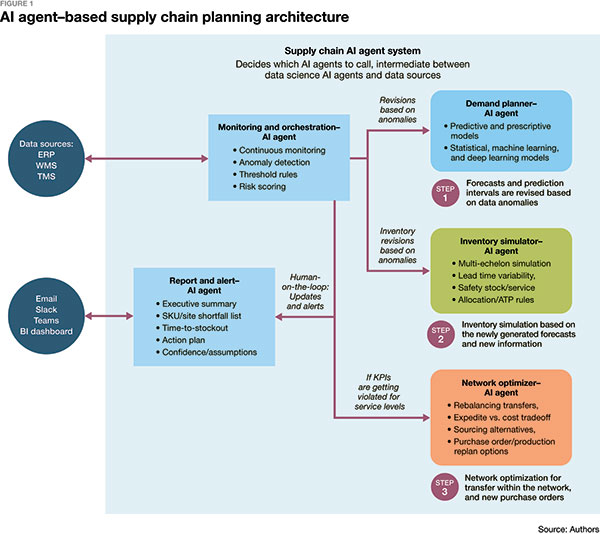
This case study presents an architecture in which multiple specialized AI agents coordinate to monitor the supply chain and respond to anomalies as needed, rather than on fixed schedules. A monitoring and orchestration agent continuously evaluates data from core systems such as ERP, WMS, and TMS. When anomalies are detected, it selectively engages downstream agents—such as demand planning, inventory simulation, and network optimization agents—to reassess forecasts, simulate inventory impacts, and evaluate response options. Planners are alerted only when KPIs are at risk, with recommendations and supporting analysis.
The result is not full automation but a scalable, responsive decision-support framework with humans in the loop. Humans remain accountable for decisions, but the system shifts from reactive analysis to proactive guidance, allowing planners to focus on judgment, trade-offs, and execution rather than on routine problem-solving, anomaly detection, and action-plan coordination.
As shown in Figure 1, the AI agent–based architecture operationalizes traditional sales and operations planning (S&OP) and integrated business planning (IBP) processes in a continuous, event-driven manner. Rather than replacing S&OP or IBP, the architecture enhances these processes.
Continuous plan health monitoring (between S&OP/IBP cycles)
In a traditional S&OP or IBP process, the business plan is assessed during scheduled demand, supply, and executive review meetings. In the architecture shown in Figure 1, the monitoring and orchestration AI agent continuously monitors the approved S&OP/IBP plan using live data from ERP, WMS, and TMS systems. This agent tracks performance against key KPIs, including forecast accuracy, customer service levels, inventory exposure, and capacity utilization. When deviations from the approved plan are detected, the agent evaluates the potential impact and determines whether further planning actions are required.
Demand review (demand planning and forecast consensus). When demand-related deviations are identified, the AI agent initiates a focused demand review in line with standard IBP demand planning practices. The demand planner AI agent reassesses forecasts using updated demand signals and revises forecast ranges to reflect current uncertainty. This step supports demand planners by automatically highlighting exceptions that materially affect the consensus demand plan, allowing planners to focus on judgment and alignment rather than manual analysis.
Supply review and inventory assessment. Revised demand scenarios are passed to the inventory simulator AI agent, aligning with the supply review phase of S&OP/IBP. This agent evaluates inventory coverage, time-to-stockout, service-level risks, and supply feasibility across the network. By simulating inventory and supply outcomes under updated assumptions, the system provides early visibility into potential shortages or excesses that would otherwise come later in the planning cycle.
Reconciliation and scenario evaluation. If misalignment between demand and supply is identified, the network optimization AI agent supports the reconciliation step of IBP. It generates and evaluates scenarios such as inventory rebalancing, expediting, alternative sourcing, or production adjustments. These scenarios allow cross-functional leaders to understand trade-offs between service, cost, and working capital before decisions are escalated.
Executive review and decision support. The report and alert AI agent aligns with the executive review step of S&OP/IBP. It consolidates insights into executive summaries that highlight emerging risks, financial impacts, and recommended actions. This ensures that managers are informed in a timely manner and can make decisions based on a consistent and data-driven view of the plan.
Operating model shift
In traditional S&OP and IBP processes, issues are often identified during scheduled review meetings. In the architecture shown in Figure 1, issues are identified between cycles, allowing formal reviews to focus on decision-making rather than problem discovery.
Generic architecture. As shown in Figure 2, the architecture represents a generic AI agent pattern applicable across demand planning, inventory simulation, and network optimization use cases. The design emphasizes modularity, human oversight, and flexible deployment, allowing agents to operate either as standalone decision-support tools or as part of a coordinated, monitored system. It is not necessary to have all three levels in a system, such as demand planning, inventory simulation, and network optimization; a company can choose one, two, or all three.
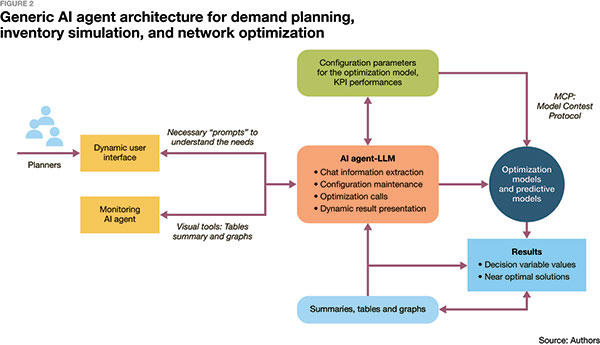
User interaction and independent operation. Planners interact with the system through a dynamic user interface. In this mode, users can operate planning agents independently, similar to traditional planning tools. Natural-language prompts and structured inputs enable planners to specify objectives, constraints, and scenarios without directly configuring mathematical models.
LLM-based AI agent as the control layer. At the center of the architecture is an LLM-based AI agent that interprets user input, maintains configuration parameters, invokes optimization and predictive models, and presents results in business-friendly formats. This layer abstracts technical complexity and enables planners to focus on decisions.
Configuration and planning logic. Configuration parameters for optimization models and KPI targets are maintained separately from model logic. These parameters may be defined by users or updated dynamically based on monitoring signals, ensuring alignment with business objectives.
Optimization and predictive models. Optimization and predictive models represent the analytical engines for forecasting, simulation, and network optimization. These models are invoked via the model context protocol (MCP), which standardizes how context, objectives, and constraints are passed to AI agents.
Results interpretation and presentation. The AI agent translates model outputs, including near-optimal decision variable values and projected performance metrics, into summaries, tables, and graphs suitable for planner review and decision-making.
Integration with monitoring via MCP. The same planning agents can be connected to a monitoring AI agent using MCP. In this integrated mode, anomalies and KPI risks trigger automatic planning runs, enabling event-driven decision support while preserving human oversight.
How this differs from traditional planning tools
Traditional demand planning, inventory planning, and network optimization tools are typically executed on fixed planning cycles (weekly, monthly, or quarterly) and require planners to manually configure scenarios, run models, interpret outputs, and identify exceptions. The responsibility for detecting issues and deciding when to take action rests primarily with human users.
In contrast, the AI agent architecture shown in Figure 2 introduces a fundamentally different operating model. Planning logic is encapsulated within AI agents that can be invoked dynamically as needed, rather than on a schedule. Monitoring and orchestration logic continuously evaluates plan health and determines when demand, inventory, or network models should be re-executed.
Another key difference is the role of the LLM-based AI agent as an interpretation and control layer. Instead of planners interacting directly with model parameters and solver settings, planners express their intent through natural-language prompts or high-level inputs. The AI agent translates this intent into structured configuration parameters and manages model execution.
Traditional planning tools also tend to operate in functional silos, with limited coordination across demand, supply, and network decisions. In the proposed architecture, agents can operate independently or be coordinated through a monitoring agent using the model context protocol (MCP), enabling cross-functional, event-driven decision support.
Finally, while traditional tools emphasize report generation after planning runs, the AI agent architecture emphasizes continuous insight delivery. Results are proactively summarized and visualized to planners when KPIs are at risk, supporting a human-on-the-loop model in which humans retain accountability while the system reduces manual monitoring and coordination effort.
A case-study: How coordinated AI agents prevented a stockout before it happened
Most supply chain leaders are familiar with the pattern: demand changes, but that signal arrives late. By the time planners discover the issue—often during a weekly or monthly review—service levels are already under pressure, and options are limited.
This case illustrates how an AI agent–based planning architecture enables earlier detection and coordinated response, allowing planners to intervene before service levels are affected.
The starting point: A stable plan. A consumer-packaged goods manufacturer was operating under an approved integrated business planning (IBP) plan. Forecasts were stable, inventory was balanced across two distribution centers, and projected service levels exceeded the 95% target. Nothing in the latest S&OP cycle suggested risk.
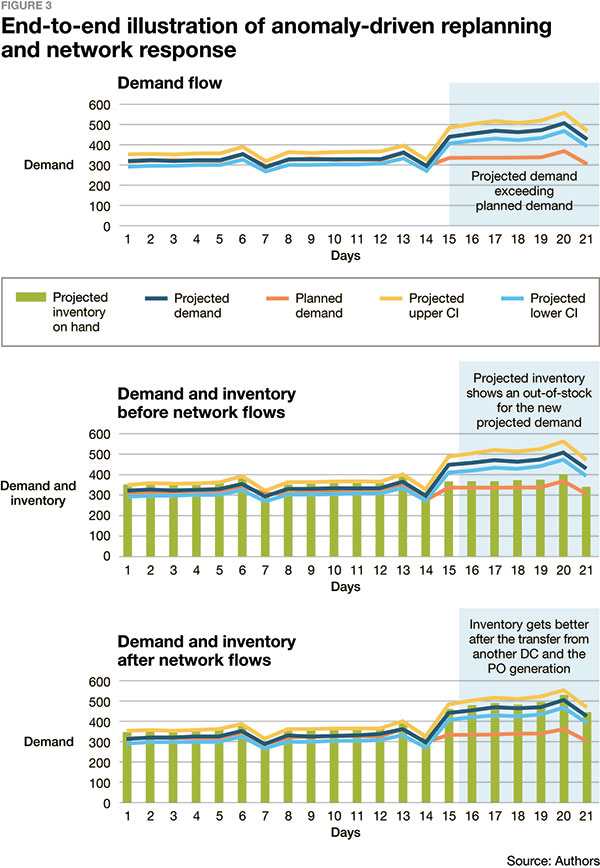
An early warning signal emerges. Five days into the month, the company’s monitoring AI agent detected something unusual. Order intake and point-of-sale data in the East region were running more than 5% above plan and were expected to run 30% above plan from day 18. At the same time, external signals suggested a competitor stockout and an unplanned regional promotion. Individually, none of these signals would normally trigger action. Together, they raised the probability of a service-level breach to over 80% within the next two weeks. Instead of waiting for the next planning run, the system acted immediately.
Forecasts revised—a proactive, resilient plan. The monitoring agent triggered the demand planner AI agent, which reassessed the forecast for the East region using short-term demand signals. The three-week forecast increased from 7,000 to 8,00 units, while forecasts in other regions remained largely unchanged. Crucially, the agent did not regenerate the entire forecast. It focused only on the portion of the network affected by the anomaly, saving time and avoiding unnecessary disruption.
Inventory risk becomes visible. The revised forecast was passed to the inventory simulator AI agent, which evaluated inventory positions under the new demand assumptions. The result: available supply at the East distribution center was insufficient, a stockout was projected within 14 days, and service levels were expected to fall from 96% to just over 80%. At the same time, the simulation showed excess inventory at a central distribution center—inventory that could be redeployed.
AI agent identifies the best response. With service risk confirmed, the network optimization AI agent evaluated possible corrective actions. Expedited production was considered but proved costly and slow. Doing nothing would result in significant lost sales. The optimal solution was a targeted inter-distribution-center transfer. Moving 1,000 units from the central facility to the East facility restored projected service levels above target with minimal transportation cost.
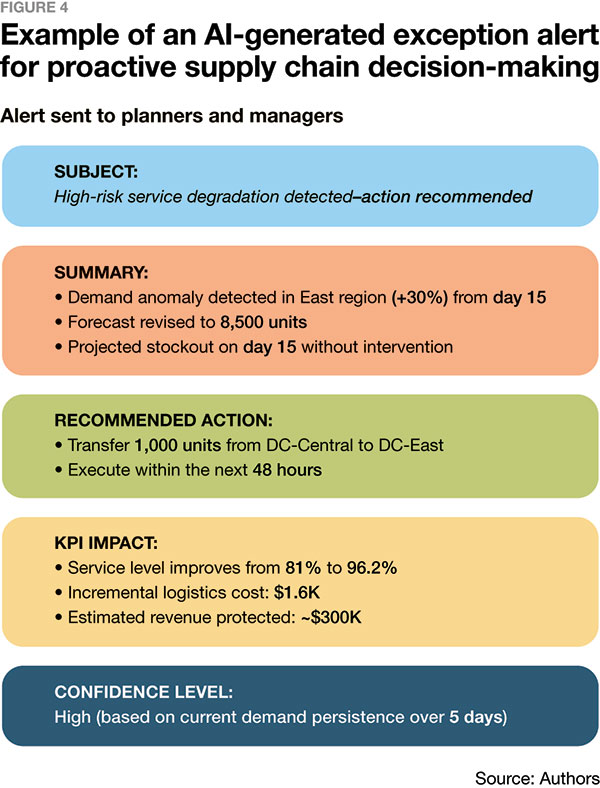
Planners alerted—with a clear recommendation. Rather than sending raw data, the report and alert AI agent delivered a concise, decision-ready alert to managers. The message summarized what had changed, what would happen if no action were taken, and the recommended action, along with the costs, service impacts, and confidence levels. Planners remained fully accountable for approval and execution, but the analytical work had already been completed.
Why this matters
In a traditional planning environment, this issue would likely come up only weeks later—after service failures had already occurred. In this case, AI agents compressed detection, analysis, and coordination into hours.
About the authors
Saravanan (Saran) Venkatachalam, Ph.D. is an associate professor in the Department of Industrial and Systems Engineering at Wayne State University. He can be reached at [email protected].
Arunachalam (Chalam) Narayanan, Ph.D. is the Farrington Professor and assistant chair of academics in the Department of Information Technology and Decision Sciences at the
University of North Texas. He can be reached at [email protected].
SC
MR

More Supply Chain Planning
- From orbit to operations: Winning the race for the earliest disruption signal
- Supply chain’s new normal isn’t stability, it’s change
- Leveraging advanced tech to develop next-level planning
- The always-ready supply chain: Turning disruption into competitive edge
- Beyond the forecast: Rethinking demand-driven planning
- More Supply Chain Planning
What's Related in Supply Chain Planning
 Explore
Topics
Procurement & Sourcing News
- Why companies blame the wrong supplier … and miss the real failure
- NextGen Supply Chain Conference unveils agenda focused on AI, execution and the future of leadership
- From fragmented negotiations to coordinated negotiation performance: an AI-enabled approach
- Supply chain resilience isn’t a data problem; it’s a judgment problem
- Why your supply chain risk management plan will fail
- When component verification becomes operational
- More Procurement & Sourcing
Latest Procurement & Sourcing Resources

Subscribe

Supply Chain Management Review delivers the best industry content.

Editors’ Picks



