
Procurement teams enter 2026 with increasing expectations to reduce costs, manage risk, and move faster despite tight budgets and limited headcount. Artificial intelligence (AI) is widely viewed as part of the solution, but progress is uneven. Deloitte’s 2024 Global CPO GenAI survey found that 92% of chief procurement officers (CPOs) are planning or assessing GenAI capabilities in 2024, yet only 37% were piloting or deploying GenAI in procurement at the time of the survey (Flynn, 2024). Many leaders recognize the opportunity but remain constrained by system complexity, inconsistent data, and unclear starting points.

Most procurement teams already operate enterprise resource planning (ERP) systems, procure-to-pay (P2P) platforms, and sourcing tools, but still rely on manual drafting, spreadsheet-based analysis, and irregular risk reviews. AI can help close these gaps without replacing core systems. Incremental, modular use cases can sit on top of existing workflows and show impact within months. Three practical moves stand out: using GenAI for drafting, applying modular tools for spend and risk, and adopting a simple roadmap that connects pilots to sustained adoption. Together, they help teams achieve faster cycle times, clearer visibility, and measurable savings.
GenAI as a drafting co-pilot
Drafting remains one of procurement’s most time-consuming responsibilities. Request for proposals (RFPs), requests for information (RFIs), statements of work (SOWs), supplier notices, renewal notices, and internal summaries all require specialized attention. The structure of these documents is often repeatable, even though their content requires human judgment, making them an ideal fit for GenAI.
Organizations can build a secure GenAI workspace that contains templates, clause libraries, and past examples. From a short brief such as “renewal RFP for cloud software across three regions with data residency requirements,” the AI can produce first drafts of sections such as scope, evaluation criteria, timelines, and communication plans (Ramamoorthy & Manivannan, 2025). The category manager then reviews the content for accuracy, tone, and risk. This removes the blank-page problem and frees expert capacity during busy sourcing cycles.
GenAI also assists with supplier communication. Invitation letters, clarification questions, debrief notes, and summary briefs can be produced quickly, giving procurement more time to focus on supplier strategy. AI-generated summaries of long proposals help internal stakeholders digest complex information more easily. Many teams already use GenAI for vendor emails and template-based document creation, treating the technology as a co-pilot while retaining full human control (Ramamoorthy & Manivannan, 2025).
Momentum behind GenAI adoption is accelerating. EY’s (2025) Global CPO Survey: 2025 Outlook finds that 80% of CPOs plan to upgrade procurement capabilities by improving processes, developing talent, and adopting new technologies such as GenAI and advanced analytics. The shift is driven by visible benefits such as faster document turnaround, improved cross-regional consistency, and reduced administrative burden. For many organizations, this is the most accessible onramp to AI.
Modular AI for spend and risk
Modular AI tools, lightweight components that integrate through application programming interfaces (APIs), file exchanges, or simple dashboards, provide another path to value. They are easier to deploy than full-suite upgrades and allow teams to focus on specific pain points. Two areas benefit most from this approach: spend classification and supplier risk monitoring.
AI for spend classification
Messy data is a long-standing obstacle. Supplier names may appear differently in different systems, descriptions can be vague, and a large share of spend often sits in “miscellaneous” or “uncategorized” buckets. These issues obscure opportunities and weaken category strategies. AI-based tools now automatically clean and classify spending, normalize supplier names, categorize transactions from free-text descriptions and invoice data, and improve accuracy as teams review and correct low‑confidence records (Gerber, 2025; GEP, 2025).
The business value can be significant. A global software-as-a-service (SaaS) company used AI-based supplier analysis to consolidate vendors, cutting software expenses by 23% and halving sourcing cycle times (Ramamoorthy & Manivannan, 2025). The AI operated as an analytic layer on top of the existing ERP, not a replacement (Ramamoorthy & Manivannan, 2025).
A practical way to begin is to start with one category or region, validate a sample of AI classifications each month, and refine the model over time. As accuracy improves, procurement gains clearer spend visibility, stronger compliance insights, and a cleaner data foundation for future automation.
AI for supplier risk monitoring
Supplier risk is becoming more complex as global markets shift. Traditional methods such as annual questionnaires or static scorecards do not provide real-time visibility. AI-enabled risk scanning offers continuous monitoring by analyzing thousands of signals, including financial health indicators, delivery performance, environmental, social, and governance (ESG) ratings, sanctions list, legal filings, and global news (McMillan, 2025). These signals are linked to internal supplier data to produce timely alerts.
The benefit is early warning. Predictive analytics helped one manufacturer identify potential supply disruptions and adjust sourcing plans before operations were affected, reducing the risk of downtime (Ramamoorthy & Manivannan, 2025). Many modern tools integrate lightly with ERP or supplier relationship management (SRM) systems, offering high visibility without major system changes.
AI-driven risk monitoring improves speed, breadth, and consistency. It does not replace human judgment about how to respond to alerts, but it ensures fewer surprises and more time to act. Many teams begin by monitoring a limited set of their most critical suppliers and focusing on specific risk categories, such as financial stability or regulatory exposure.
A roadmap from pilot to adoption
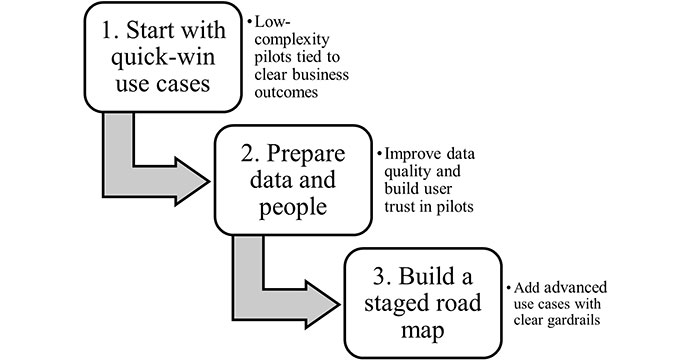
Many organizations have experimented with AI but struggle to embed it into routine procurement work. Progress depends on selecting practical use cases, preparing data and people, and scaling at a manageable pace. A simple roadmap can help sustain momentum (see Figure 1).
Figure 1
Steps to AI-Enabled Procurement
-
Start With high-impact, low-complexity use cases
Early use cases should be easy to deploy and clearly tied to business outcomes. Generative AI–assisted drafting, supplier email generation, contract summarization, and AI-based spend analysis are strong starting points because they deliver fast, measurable improvements. One mid-sized company used an AI assistant to triage routine purchase requests and answer simple internal questions. Cycle time dropped by 40%, strengthening support for broader adoption (Ramamoorthy & Manivannan, 2025).
-
Prepare data and people
Scaling AI requires accessible, reasonably consistent data, including clear supplier naming, category structures, and centralized spend documentation. People also need confidence in AI outputs. Human-in-the-loop workflows help teams validate results and build trust, reducing oversight as accuracy improves.
-
Build a staged roadmap
After initial wins, organizations can expand into areas such as invoice automation, contract clause scanning, and risk heatmaps. A staged roadmap links pilots to enterprise use by embedding outputs into workflows and applying governance over data access, accuracy thresholds, and review procedures.
A practical path for leaders
AI does not need to be disruptive or expensive to deliver meaningful impact. By focusing on practical, incremental moves, GenAI drafting, modular spend analytics, and AI-enabled risk scanning procurement teams can modernize while staying within realistic budgets. Over time, these smaller steps generate significant efficiencies. Targeted AI deployments have already achieved double-digit software savings, faster cycle times, and improved risk detection (Ramamoorthy & Manivannan, 2025). Most importantly, they allow procurement professionals to focus on higher-value work where their expertise matters most.
About the Author
Corrine Chen is an educator, researcher, and former industry executive with over a decade of hands-on experience in supply chain management, procurement, and innovation. She teaches supply chain management courses at the University of Nebraska Omaha. Corrine’s work bridges academia and practice, with published research, applied projects, and a passion for empowering the next generation of supply chain professionals. She can be reached at [email protected].
SC
MR


More Procurement Technology
- From fragmented negotiations to coordinated negotiation performance: an AI-enabled approach
- Spend aggregation gives way to new approaches in a tariff-driven supply chain
- AI is automating procurement; it’s also creating jobs leaders aren’t ready for
- Doing more with less: Practical AI moves for procurement teams in 2026
- Digital procurement transformation on a budget
- More Procurement Technology
What's Related in Procurement Technology

 Explore
Topics
Procurement & Sourcing News
- Why companies blame the wrong supplier … and miss the real failure
- NextGen Supply Chain Conference unveils agenda focused on AI, execution and the future of leadership
- From fragmented negotiations to coordinated negotiation performance: an AI-enabled approach
- Supply chain resilience isn’t a data problem; it’s a judgment problem
- Why your supply chain risk management plan will fail
- When component verification becomes operational
- More Procurement & Sourcing
Latest Procurement & Sourcing Resources
Subscribe

Supply Chain Management Review delivers the best industry content.

Editors’ Picks



