
Sorry, but your login has failed. Please recheck your login information and resubmit. If your subscription has expired, renew here.
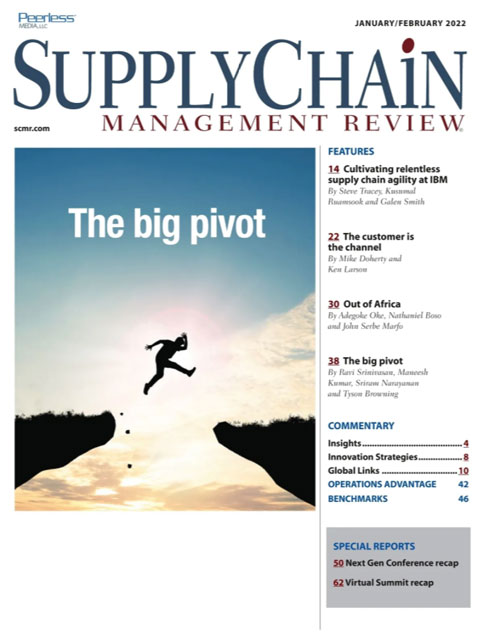
January-February 2022
Well, that’s over, and aren’t we all glad to put 2020 in the rear-view mirror? For a minute, however, let’s look at a silver lining, because I think there is one for supply chain managers. That’s because the pandemic put supply chain in the spotlight like never before—and, with the approval of a vaccine just a few weeks ago in December, supply chain and cold chain are back in the news… While sales usually gets all the attention, maybe 2021 is our time to shine.” That’s the beginning of the column I wrote for the January 2021 issue, and maybe I was a little too pollyannish. Browse this issue archive.Need Help? Contact customer service 1-508-503-1313 More options
IBM, one of the world’s best-known technology companies, runs a complex global supply chain with strategic manufacturing facilities located around the world and workers spread across more than 40 countries to support customers in more than 170 countries. To meet the high configuration product demand, the IBM Supply Chain (IBM SC) operates in a hybrid model of build-to-plan and build-to-order. IBM also collaborates with many hundreds of suppliers across its global, multi-tier supplier network.
Over the past decade, IBM has exhibited a relentless commitment to building smarter supply chains to quickly and effectively navigate global disruptions. The focus has been on building a cognitive supply chain that embraces an agile culture of innovation, invests in team members’ growth and engagement, focuses on clients’ needs and successes and leverages exponential technologies to deliver greater value.
Emphasis on the term agile culture of innovation. In today’s increasingly competitive and turbulent business environment, agility has been widely recognized as one of the fundamental characteristics of forward-looking supply chains that could render positive impacts on financial, market and operational performance. Recently, as companies try to deal with the unprecedented and volatile changes in both demand and supply due to the COVID-19 pandemic, focused attention toward supply chain agility (SCA) is accelerating.
However, there remains a great deal of confusion around the concept of agility. In discussing SCA with various companies, we often ask them to self-evaluate their current level of agility. A typical response is: “We’re very agile. When a situation comes up for an unanticipated customer demand or a supply disruption, we do whatever it takes to satisfy the customer.” Frequently accompanying such a response are heroic stories of how significant the additional efforts and resources are expended to meet those needs. It is apparent from these conversations that what is thought of as agility is in reality heady reactive problem solving, and there remains a confusion between successful fire-fighting capability and what true agility really means.

This complete article is available to subscribers only.
Log in now for full access or start your PLUS+ subscription for instant access.
SC
MR
Sorry, but your login has failed. Please recheck your login information and resubmit. If your subscription has expired, renew here.
January-February 2022
Well, that’s over, and aren’t we all glad to put 2020 in the rear-view mirror? For a minute, however, let’s look at a silver lining, because I think there is one for supply chain managers. That’s because the… Browse this issue archive. Access your online digital edition. Download a PDF file of the January-February 2022 issue.IBM, one of the world’s best-known technology companies, runs a complex global supply chain with strategic manufacturing facilities located around the world and workers spread across more than 40 countries to support customers in more than 170 countries. To meet the high configuration product demand, the IBM Supply Chain (IBM SC) operates in a hybrid model of build-to-plan and build-to-order. IBM also collaborates with many hundreds of suppliers across its global, multi-tier supplier network.
Over the past decade, IBM has exhibited a relentless commitment to building smarter supply chains to quickly and effectively navigate global disruptions. The focus has been on building a cognitive supply chain that embraces an agile culture of innovation, invests in team members’ growth and engagement, focuses on clients’ needs and successes and leverages exponential technologies to deliver greater value.
Emphasis on the term agile culture of innovation. In today’s increasingly competitive and turbulent business environment, agility has been widely recognized as one of the fundamental characteristics of forward-looking supply chains that could render positive impacts on financial, market and operational performance. Recently, as companies try to deal with the unprecedented and volatile changes in both demand and supply due to the COVID-19 pandemic, focused attention toward supply chain agility (SCA) is accelerating.
However, there remains a great deal of confusion around the concept of agility. In discussing SCA with various companies, we often ask them to self-evaluate their current level of agility. A typical response is: “We’re very agile. When a situation comes up for an unanticipated customer demand or a supply disruption, we do whatever it takes to satisfy the customer.” Frequently accompanying such a response are heroic stories of how significant the additional efforts and resources are expended to meet those needs. It is apparent from these conversations that what is thought of as agility is in reality heady reactive problem solving, and there remains a confusion between successful fire-fighting capability and what true agility really means.
SC
MR


Latest Supply Chain News
- From salon to dock door: Repurposing scheduling software for inbound flow
- The biggest barrier to AI in supply chains isn’t technology
- Rebuilding a planning function around the physical world
- Why companies blame the wrong supplier … and miss the real failure
- NextGen Supply Chain Conference unveils agenda focused on AI, execution and the future of leadership
- More News
Latest Podcast
 Explore
Software & Technology News
- NextGen Supply Chain Conference unveils agenda focused on AI, execution and the future of leadership
- From fragmented negotiations to coordinated negotiation performance: an AI-enabled approach
- Beyond the hype: Building flexible and scalable supply chains in a VUCA world
- Managing human and AI teams across the supply chain
- The AI-empowered supply chain leader
- Technology isn’t strategy
- More Software & Technology
Latest Software & Technology Resources

Subscribe

Supply Chain Management Review delivers the best industry content.

Editors’ Picks



