
As the situation in Ukraine continues to deteriorate, many of us in the global supply chain community are keeping close watch. Carriers and forwarders and delivery agents have suspended operations into and out of some Ukraine areas. Importers of Ukrainian goods have to deal with the politics of the situation as well as the logistics. Our supply chains have to remain open and flexible because the situation is changing daily.
If you are an importer, you know the importance of US Customs regulations regarding Country of Origin markings. The regulations are in place so that US consumers can be informed about the origin of the products they buy. You can find C of O markings on adhesive stickers attached to products, on imported food labels, on soft labels in apparel and on the outside of a shipping carton or crate. But what happens when one country takes over another? How should the rules of origin apply?
Customs and Border Protection support the US government’s political position in this matter with the enforcement of C of O regulations. Take for example, the current and very serious dispute over the Crimean Peninsula between Russia and the Ukraine. The US government has taken a clear stand against Russia and one of the ways is through C of O marking requirements. CBP requires products of Crimea to be marked with Country of Origin: Ukraine. This is a very significant point being made by the US government. Goods coming from the Crimea cannot be labeled “Made in Russia” because the US government does not recognize the Russian government there.
On April 28, 2014, the White House issued a press release announcing the implementation of further sanctions against Russia including export restrictions for high-technology goods, subject to the Export Administration Regulations (EAR), which could contribute to Russia’s military abilities.
The U.S. Department of Commerce’s Bureau of Industry and Security (BIS) also announced that, effective immediately, they will “deny pending applications for licenses to export or re-export any high technology item subject to the EAR to Russia or occupied Crimea that contribute to Russia’s military capabilities.” Existing export licenses meeting these conditions will be subject to revocation.
Supply chain professionals often discover that the real reason for a trade law or country regulations is political, not economic. The laws are enforced to further the agenda of the importing country, in this case the US. For the US and Ukraine, this means supporting the Ukrainian government in their fight to keep Ukraine independent.
SC
MR

Latest Supply Chain News
- Schneider Electric’s Jackie Zhu: Why the best leaders build careers across the business
- AI is driving change in supply chain skills and talent
- 4 moves supply chains must make as AI triggers a memory supply shock
- Innovators Netstock, Pickle Robot win NextGen Solution Provider awards
- Bigger trucks versus broken bridges and roads
- More News
Latest Podcast
 Explore
Topics
Latest Supply Chain News
- Innovators Netstock, Pickle Robot win NextGen Solution Provider awards
- Bigger trucks versus broken bridges and roads
- From salon to dock door: Repurposing scheduling software for inbound flow
- The biggest barrier to AI in supply chains isn’t technology
- Rebuilding a planning function around the physical world
- Why companies blame the wrong supplier … and miss the real failure
- More latest news
Latest Resources
About the Author
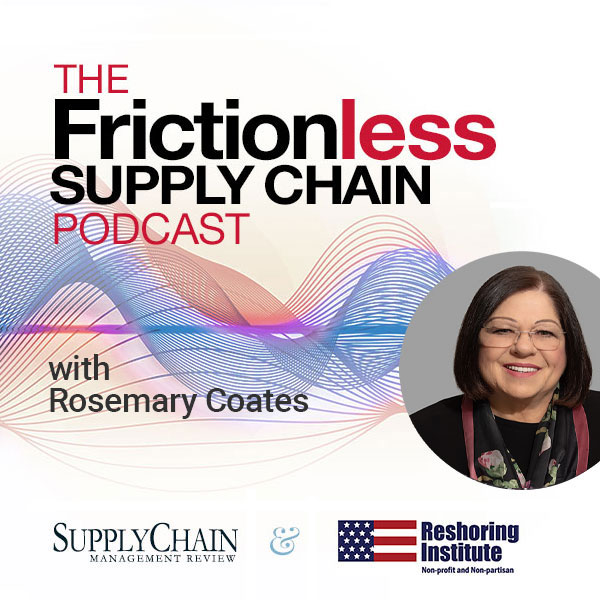
Rosemary Coates, Exec. Dir. Reshoring Institute

Ms. Coates is the Executive Director of the Reshoring Institute and the President of Blue Silk Consulting, a Global Supply Chain consulting firm. She is a best-selling author of five supply chain management books including: 42 Rules for Sourcing and Manufacturing in China and Legal Blacksmith - How to Avoid and Defend Supply Chain Disputes. Ms. Coates lives in Silicon Valley and has worked with over 80 clients worldwide. She is also an Expert Witness for legal cases involving global supply chain matters. She is passionate about Reshoring.
Follow SCMR on social media.
@SupplyChainManagementReview on Facebook
@SCMR on Twitter
SCMR on Linkedin
Subscribe

Supply Chain Management Review delivers the best industry content.

Editors’ Picks



