
Sorry, but your login has failed. Please recheck your login information and resubmit. If your subscription has expired, renew here.
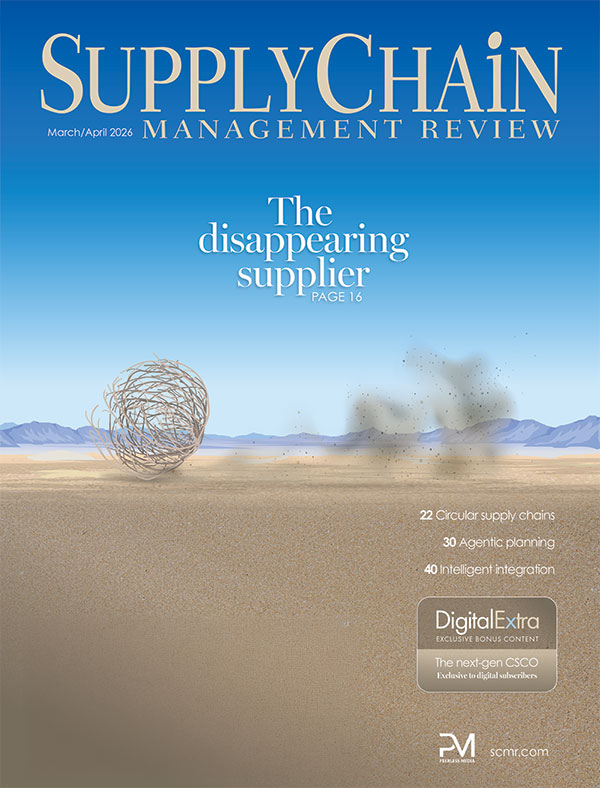
March-April 2026
The March/April 2026 issue of Supply Chain Management Review examines how supply chain leaders are managing supplier risk, circular supply chain design, AI-driven retail planning, CPG network optimization, and shifting LTL market dynamics to improve resilience and performance. Features include frameworks to prevent supplier failure, operationalize circular economy strategies, prevent retail stockouts using AI, and eliminate costly DC transfer patterns, plus insights from the 34th Annual Study of Logistics and Transportation Trends and a digital-exclusive on the evolving CSCO role. Browse this issue archive.Need Help? Contact customer service 1-508-503-1313 More options
The circular economy envisions a system where materials, products, and resources are continually reused, regenerated, and reintegrated into production cycles—minimizing waste and maximizing value. The circular economy is an idea born of necessity. Ideas born of necessity tend to endure. The concept of a circular economy was born from society’s need to thrive without destroying our environment, an environment on which humanity depends.
At the heart of the modern vision of a circular economy lies circular supply chains (CSCs), which enable the flow of materials in closed loops. Beyond their environmental advantages, CSCs can deliver critical benefits in sustainability, resilience, efficiency, and even social and economic well-being.
SC
MR
Sorry, but your login has failed. Please recheck your login information and resubmit. If your subscription has expired, renew here.
March-April 2026
The March/April 2026 issue of Supply Chain Management Review examines how supply chain leaders are managing supplier risk, circular supply chain design, AI-driven retail planning, CPG network optimization, and… Browse this issue archive. Access your online digital edition. Download a PDF file of the March-April 2026 issue.The circular economy envisions a system where materials, products, and resources are continually reused, regenerated, and reintegrated into production cycles—minimizing waste and maximizing value. The circular economy is an idea born of necessity. Ideas born of necessity tend to endure. The concept of a circular economy was born from society’s need to thrive without destroying our environment, an environment on which humanity depends.
At the heart of the modern vision of a circular economy lies circular supply chains (CSCs), which enable the flow of materials in closed loops. Beyond their environmental advantages, CSCs can deliver critical benefits in sustainability, resilience, efficiency, and even social and economic well-being.
CSCs inherently promote sustainability by reducing dependence on virgin materials, minimizing waste, and extending product lifecycles. Through remanufacturing, recycling, and reuse, companies can reduce greenhouse gas emissions and resource extraction, thereby alleviating some environmental and social burdens.
Industries adopting closed-loop supply chains, where all waste is reused to generate new products—a critical aspect of a CSC—for metals and plastics significantly cut carbon footprints while improving material efficiency. The Aluminum Association estimates that recycled aluminum uses up to 95% less energy than aluminum produced from extracted ore. Aligning CSCs with ecological sustainability goals helps organizations as global environmental regulation becomes more stringent and consumer awareness of environmental issues rises.
However, the value of CSCs extends beyond ecological sustainability—these systems also enhance supply chain resilience. As it has become painfully evident that modern supply chains face risks from global disruptions, resource scarcity, and geopolitical tensions.
Circularity mitigates these risks by creating alternative material sources, particularly critical resources such as rare earth elements used in electronics and renewable energy technologies. Recovering and reusing these materials from end-of-life products allows firms to reduce dependency on vulnerable global supply chains.
Circularity also fosters localization, strengthening regional economies and reducing exposure to global shocks. End-of-life materials and products can be collected and processed near urban centers, keeping resource flows closer to where demand exists. This local resource loop aids organizations by allowing them to bypass trade barriers, tariffs, and political conflicts that have historically disrupted global supply chains—such as China’s control over rare earth metal exports. CSCs not only enhance environmental sustainability but also serve as buffers against geopolitical volatility.
The social benefits of CSCs are equally significant. By sourcing materials from local recovery processes rather than from conflict-prone regions, companies can reduce their involvement in exploitative or unethical supply chains. This shift supports human rights, fair labor practices, and community stability, contributing to the broader goals of social sustainability.
Economically, circular supply chains can also become revenue generators. Recovered materials, refurbished products, and industrial byproducts can be new profit streams if managed strategically. Companies that innovate in byproduct design—for instance, converting waste heat into energy or repurposing scrap materials into new products or saleable materials—can achieve both environmental and financial gains. I recently saw an example of this when I visited Australia, where I purchased stuffed koala bear souvenirs made of waste plastic.
Building circular supply chains
While circularity benefits—sustainability, resilience, social responsibility, and economic gains—are compelling, challenges remain. Achieving the benefits of CSCs requires an organization to have a structured and strategic implementation process.
Transitioning to a CSC is an ambitious goal, but it is achievable. It requires thoughtful planning, collaboration, and execution. The following six-step framework outlines how organizations can practically move toward circularity within their supply chains.
1. Understand your market, industry, materials, and products
Organizations must assess their value chains, product lifecycles, and material flows to determine where circularity can be integrated. Mapping the supply chain from raw material extraction to end-of-life materials management, identifying inefficiencies, waste points, and opportunities for resource recovery is an important foundation.
Understanding customer expectations and regulatory environments is especially pertinent as many industries now face sustainability mandates or shifting consumer preferences toward environmentally responsible products. Companies should also evaluate which materials are most critical, scarce, or environmentally impactful to effectively prioritize their circularity efforts.
The case of Patagonia is one example. The outdoor apparel and gear company extensively mapped and increased the transparency of its supply chains to implement circularity, especially through its Worn Wear program. Patagonia mapped its supply chain specifically for circularity by analyzing the materials, processes, and product flows that determine how garments can be repaired, reused, or recycled. By understanding where and how each component was made and what it was made from, the company redesigned products for durability and standardized materials to improve recyclability. It was also able to identify partners capable of fiber-to-fiber recycling. This mapping enabled the organization to build effective repair and take-back systems, expand the Worn Wear trade-in and resale program, and include recycled inputs into production.
Supply chain mapping allowed Patagonia to pinpoint where circular practices were feasible, redesign products accordingly, and create CSC pathways that keep clothing in use longer, reducing dependence on virgin materials.
2. Identify the products and materials that can be easily included
Once the CSC is understood, the next step is identifying where circular practices can begin. Not all materials and products are equally suitable for circularity—some degrade to unmanageable and poor-quality levels, while others such as aluminum can be recycled indefinitely.
Identifying the low-hanging fruit is essential. Products that are durable, modular, or made from recyclable materials are often good starting points. Electronics manufacturers may focus on reclaiming rare metals from used components, while food producers might explore repurposing organic byproducts. This stage often involves lifecycle assessments to measure environmental impacts and determine where interventions can yield high returns in terms of sustainability and cost efficiency.
I have visited and written about facilities that process end-of-life computers. My research colleagues and I found that a triage is necessary to determine whether returned computers can be reused immediately without refurbishment; refurbished for resale; taken apart for usable parts; or destroyed, disassembled, and recycled. Understanding product and quality characteristics at their end-of-life is necessary to determine and design CSC. CSC designs for remanufacturing of complete products and components may be different than elemental materials recycling.
But, even early in the design process, lifecycle assessment (LCA) tools can be used. LCA can quantify environmental impacts (energy, emissions, waste) across the product’s lifecycle. This quantification is important for design and decision-making. There are effective and widely available LCA support tools that have started to mature over the decades—these tools include SimaPro, GaBi, and OpenLCA.
Material flow analysis (MFA) is another material accounting tool to help track flow of materials into, through, and out of an organization or region and across value chains. Similar to LCA, MFA is not a new tool. It has decades of use and development and can be very useful for CSC design and can be applied to help determine current and past flows of products and materials that can be used to feasibly support CSC.
Even general supply chain mapping tools, as in the case of Patagonia, are becoming more popular and can be useful for CSC product and materials identification. Available platforms like Resilinc, Interos, or SAP Ariba can visualize supplier networks and highlight vulnerabilities or circularity opportunities for various material and product sources.
German company Schaeffler Group took advantage of the innovative SAP Returnable Packaging Management module. Schaeffler identified packaging and logistics material, such as pallets, that would need a CSC. The material and industry-specific solution aided returnable and reusable packaging material circular flows. This system included containers, boxes, and pallets—from inter- and intra-company movements and the journey back to the company. It allowed Schaeffler to incorporate end-to-end integration of the container management cycle.
3. Determine the necessary infrastructure and systems required
CSCs depend on robust infrastructure to collect, sort, process, and reintegrate materials. Organizations must evaluate the physical, digital, and logistical supply chain systems needed to close the loop. Evaluation should include designing reverse logistics networks, implementing traceability technologies such as blockchain or internet of things (IoT) sensors, and ensuring quality control for reused materials. Developing standardized procedures for repair, remanufacturing, and recycling helps ensure that recovered materials meet performance and safety requirements. Investments in digital tools for data tracking and performance monitoring can significantly enhance operational efficiency and transparency.
A team I am part of has been studying the transportation, logistics, digitalization, and circularity issues in a joint research effort between Worcester Polytechnic Institute (WPI) and the Université Polytechnique Hauts-de-France. A very fundamental question we have been trying to address focuses on what efforts are needed from an organizational and supply chain perspective; many of which I have touched upon in this article. The broader social and built environment infrastructure needed for circularity is not always clear. It may not be up to the industry to determine the solutions alone. Government and infrastructure development for circularity is necessary. A basic question is whether the current public transportation and logistics infrastructure is satisfactory for effective CSCs. We do not have an answer, but the question needs to be asked by companies and society. This brings us to our next important step.
4. Form the necessary partnerships
No single company, or even supply chain, can achieve circularity in isolation. Building partnerships across the value chain—suppliers, recyclers, logistics providers, governments, and even competitors—is essential. Collaborations can enable access to shared infrastructure, facilitate material exchanges, and promote industry-wide standards—circular economy standardization efforts by the International Standards Organization (ISO) have been in the works for years with some standards developed, but the work continues.
Public-private partnerships can also play a role in developing recycling facilities or incentivizing resource recovery programs. In many cases, industrial symbiosis—where one firm’s waste becomes another’s input—emerges as a powerful model for achieving circular efficiency at scale.
These efforts are occurring with public-private partnerships in various regions of the world. For example, in Japan there is the Regional Circulating and Ecological Sphere (Regional-CES) which calls for innovative business models as well as efforts by urban planners, green technology, and product development efforts. Stakeholders of the Regional-CES approach seek to develop and expand this model around the world, which can effectively support globalizing CSCs.
5. Complete some pilot projects and keep track of data
Before any large-scale implementation, organizations should conduct pilot projects to evaluate circular initiatives in controlled environments. Pilots provide valuable insights into operational challenges, material quality issues, customer acceptance, and cost implications. Meticulous data collection during these trials is vital. Tracking material flows, environmental savings, and economic outcomes allows for data-driven decision-making and continuous improvement.
The lessons learned here inform future scaling efforts and help justify investments to stakeholders.
But to be able to track data, there is a need to determine baseline and ongoing circularity performance. Circular assessment tools exist. For example, the Circulytics tool offered by the Ellen MacArthur Foundation helps evaluate an organization’s circularity and can be applied to supply chain partners as well.
Industry-specific circular performance measurement and evaluation tools also exist. One specific example is the ITU-T L.1023 standard from the International Telecommunication Union (ITU) which provides a method for circular scoring for information and communication technology (ICT) products and components. It also offers a detailed methodology for evaluating product circularity. This standardization effort involved a number of stakeholders such as the Global Electronics Council and EPEAT, as well as university participants including myself and WPI.
Pilot projects do not necessarily have to be supported by industry alone. Over the past two decades, the Chinese government has been a leader in helping organizations and their supply chains improve circular economy practices. To support these CSC efforts, China regularly funds demonstration projects. The motivation here is not only for companies to build their business models, but to help society address resource depletion and extensive emissions from supply chains.
6. Implement and scale
Pilot results are meant to provide evidence; after evidence is gathered, companies can implement CSC practices. Scaling requires careful change management by aligning leadership, workforce, and stakeholders with new processes, technologies and behaviors around the new system. Continuous monitoring ensures that processes remain efficient and adaptive to changing conditions. Over time, the organization can expand its circular network, diversify recovered materials, and integrate new product and process technologies.
Many business models and examples exist or have existed. Some of these go back decades. Xerox long ago adopted a product service system business model based on leasing models for its copiers to be remanufactured and updated. They would lease new models until leases expired. Thereupon older leased copiers would be upgraded or used for parts for new models. The customers accepted the remanufactured copiers because Xerox became The Document Company, not a copier company. The company involved multiple functions of its organization including purchasing, marketing and sales, engineering, and production to help make the business model successful.
Philips uses a similar “product-as-a-service” model for its medical equipment. IKEA has also joined the effort by working toward becoming a fully circular system by 2030. Dell has formed a consortium for ocean plastics recycling called NextWave Plastics to operate a CSC for ocean plastics by building a network of organizations that can manage end-of-life plastic materials.
Ultimately, a structured process emphasizes that circular supply chain implementation is not a one-time initiative but a continuous journey. Commitment, collaboration, and strategic investment mean organizations can transform their supply chains into engines of sustainability, resilience, and long-term value creation. As you can see with the IKEA case, the planning is over years and in the case of countries like China and Japan, decades. The transition to CSCs and circularity does not stop at one project.
Circularity in supply chains is about sustainability and more—it’s about building resilience, driving efficiency, and supporting social and economic progress. While implementation requires careful planning and collaboration, the benefits to organizations are manifold, and the path to circularity, though challenging, offers a powerful route toward a more sustainable and resilient future.
Implementing circular supply chains successfully requires a combination of analytical tools, digital technologies, and management approaches. These tools help organizations collect data, design circular systems, manage reverse logistics, and measure impact.
Challenges and a prospective future
I have presented a way to transition our supply chains to be more sustainable by becoming more circular. A variety of current examples, across countries and industrial sectors, exemplify how CSCs and circular practices can provide resilient, social, environmental and economic benefits. Many tools and practices have shown success and promise, but many of society’s and industry’s current beliefs and practices will need some adjustment.
Many of our current legacy technologies such as enterprise resource planning need adjustment. Systems like SAP S/4HANA for Sustainability or Oracle SCM support some circular data integration across procurement, production, and logistics—but these are optional and have extra costs. To further normalize the idea of CSCs, these organizations could start making them basic offerings.
My research colleagues and I have presented several transitionary requirements within organizations, across supply chains, industrial, governmental, and even community and consumer actions. Organizations will require difficult change-management frameworks. Examples include Kotter’s 8-Step Process or the ADKAR (Awareness, Desire, Knowledge, Ability, and Reinforcement) model to guide organizational transformation and employee engagement. Transition starts internally with some of these models. But, societal and consumer (economic) model transitions are even harder. There are sustainability transition models that exist, but they are complex.
There is a new transitioning perspective that academics and scholars are using to qualitatively present a desirable future: a future with no waste. Studies call this approach “Prospective Theorizing.”
A prospective and desirable future for the circular economy and circular supply chains can be shaped through validated and rigorous prospective theorizing, which helps us envision futures that are not only imaginative but also grounded in evidence, systems thinking, and scientific plausibility.
Researchers use structured foresight methods—such as scenario building, backcasting, and transition modeling. These approaches allow us to identify pathways in which materials circulate continuously, waste becomes a resource, and economic activity decouples from environmental degradation—a relationship decoupling related to ecological modernization theory.
Within prospective theorizing, these approaches ensure that envisioned futures are: (1) plausible—that the envisioned future is aligned with physical, technological, and ecological limits; and (2) feasible and achievable through coordinated changes in technology, policy, business models, and social behavior. Rigorous theorizing within prospective theorizing validates which levers matter most and how complex interactions—between markets, infrastructure, regulation, and culture—shape transition trajectories.
Such prospective models also help define what a socially desirable circular future looks like: one that promotes fairness, well-being, resilience, and shared prosperity. For successful and wide adoption and transition, these elements need to be solidly ingrained in designs and decisions.
Instead of focusing solely on resource efficiency, this future prioritizes inclusive access to products and services, ethical sourcing, meaningful work, and reduced environmental burdens on vulnerable populations. By integrating justice, governance, and community values into foresight frameworks, we can design circular supply chains that support thriving local economies, regenerative ecosystems, and globally sustainable production networks.
This approach is about rigorous prospective theorizing. It is a guide for steering today’s decisions, technologies, tools, and processes toward a circular future that is not only possible, but genuinely better for society.
Together, CSCs play an increasingly important role for this and future generations. These tools and approaches are needed to form an integrated circular economic ecosystem that supports the planning, execution, and scaling of circular supply chains—turning sustainability ambitions into operational reality.
About the author
Joseph Sarkis is a professor in The Business School at Worcester Polytechnic Institute. He is considered a pioneer and scholarly leader in the areas of circular economy and sustainable supply chains. He has more than 600 publications in a wide variety of outlets. His impact has been recognized through highly cited research for many years.
SC
MR


More Sustainable Supply Chains
- Why do supply chains need to think beyond sustainability?
- Circular supply chains: The backbone of a successful circular economy
- Sustainability and AI: A complicated and often overlooked relationship
- Starting inside the company: Supply chain resilience demands new initiatives and investments
- Beyond the ESG debate: How responsible procurement builds stronger supply chains
- More Sustainable Supply Chains
 Explore
Topics
Procurement & Sourcing News
- Why companies blame the wrong supplier … and miss the real failure
- NextGen Supply Chain Conference unveils agenda focused on AI, execution and the future of leadership
- From fragmented negotiations to coordinated negotiation performance: an AI-enabled approach
- Supply chain resilience isn’t a data problem; it’s a judgment problem
- Why your supply chain risk management plan will fail
- When component verification becomes operational
- More Procurement & Sourcing
Latest Procurement & Sourcing Resources
Subscribe

Supply Chain Management Review delivers the best industry content.

Editors’ Picks



