
Sorry, but your login has failed. Please recheck your login information and resubmit. If your subscription has expired, renew here.
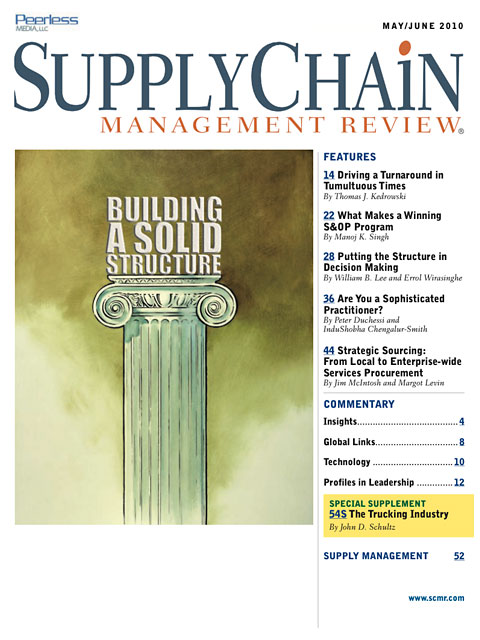
May-June 2010
Spring is a time for renewal. It's a time for re-assessing the way we've been doing things and making changes in a manner that ensures forward progress. That's a recurring theme of the articles in the May/June issue of Supply Chain Management Review. With the building blocks in place and the spirit of renewal in full bloom, who knows what level of supply chain excellence can be achieved? Browse this issue archive.Need Help? Contact customer service 1-508-503-1313 More options
Modern supply chains are networks of material and information flows from raw material suppliers to end users. Many companies today participate in multiple supply chains, as determined by their mix of products and services. Knowledgeable professionals and academicians for some time now have recommended certain supply chain management (SCM) practices to effectively manage the supply chain flows. These practices include, for example, collaboration, performance measurement, and implementation of pertinent information systems such as transportation and warehouse management systems (TMS and WMS). If properly applied, these proven practices bestow supply chain competencies that result in valuable business benefits. Recent studies, however, have revealed a patchwork pattern of adoption of these practices and a modest uptake overall.1
One new study conducted among manufacturers by the authors confirms that many companies may not be as advanced in their SCM practices as publications and academicians have led us to believe. In particular, our survey findings reveal that the adoption of highly recommended SCM practices is less than 100 percent. The findings further identify two distinct groups of companies—what we term the “sophisticated” and the “less sophisticated” practitioners. Sophisticated practitioners, overall, use the recommended practices to a greater degree than less sophisticated practitioners. Notably, the distinctions between the two groups are most apparent across three dimensions of SCM practice that are critical to business success. These are supply chain design, vendor managed inventory (VMI) programs, and information technology (IT) investment.
Our findings are especially surprising because the survey participants are large, international companies belonging to the upper quartile of Fortune’s top-100 list. (For more on the survey, see accompanying sidebar). Apparently, there are opportunities for supply chain improvement in even the largest, most successful companies operating today.
 |
This complete article is available to subscribers
only. Click on Log In Now at the top of this article for full access. Or, Start your PLUS+ subscription for instant access. |
Not ready to subscribe, but need this article?
Buy the complete article now. Only $20.00. Instant PDF Download.
Access the complete issue of Supply Chain Management Review magazine featuring
this article including every word, chart and table exactly as it appeared in the magazine.
SC
MR
Sorry, but your login has failed. Please recheck your login information and resubmit. If your subscription has expired, renew here.
May-June 2010
Spring is a time for renewal. It's a time for re-assessing the way we've been doing things and making changes in a manner that ensures forward progress. That's a recurring theme of the articles in the… Browse this issue archive. Download a PDF file of the May-June 2010 issue.|
|
Download Article PDF |
Modern supply chains are networks of material and information flows from raw material suppliers to end users. Many companies today participate in multiple supply chains, as determined by their mix of products and services. Knowledgeable professionals and academicians for some time now have recommended certain supply chain management (SCM) practices to effectively manage the supply chain flows. These practices include, for example, collaboration, performance measurement, and implementation of pertinent information systems such as transportation and warehouse management systems (TMS and WMS). If properly applied, these proven practices bestow supply chain competencies that result in valuable business benefits. Recent studies, however, have revealed a patchwork pattern of adoption of these practices and a modest uptake overall.1
One new study conducted among manufacturers by the authors confirms that many companies may not be as advanced in their SCM practices as publications and academicians have led us to believe. In particular, our survey findings reveal that the adoption of highly recommended SCM practices is less than 100 percent. The findings further identify two distinct groups of companies—what we term the "sophisticated" and the "less sophisticated" practitioners. Sophisticated practitioners, overall, use the recommended practices to a greater degree than less sophisticated practitioners. Notably, the distinctions between the two groups are most apparent across three dimensions of SCM practice that are critical to business success. These are supply chain design, vendor managed inventory (VMI) programs, and information technology (IT) investment.
Our findings are especially surprising because the survey participants are large, international companies belonging to the upper quartile of Fortune’s top-100 list. (For more on the survey, see accompanying sidebar). Apparently, there are opportunities for supply chain improvement in even the largest, most successful companies operating today.
|
|
SUBSCRIBERS: Click here to download PDF of the full article. |
SC
MR

Latest Supply Chain News
- Schneider Electric’s Jackie Zhu: Why the best leaders build careers across the business
- AI is driving change in supply chain skills and talent
- 4 moves supply chains must make as AI triggers a memory supply shock
- Innovators Netstock, Pickle Robot win NextGen Solution Provider awards
- Bigger trucks versus broken bridges and roads
- More News
Latest Podcast
 Explore
Topics
Latest Supply Chain News
- Innovators Netstock, Pickle Robot win NextGen Solution Provider awards
- Bigger trucks versus broken bridges and roads
- From salon to dock door: Repurposing scheduling software for inbound flow
- The biggest barrier to AI in supply chains isn’t technology
- Rebuilding a planning function around the physical world
- Why companies blame the wrong supplier … and miss the real failure
- More latest news
Latest Resources
Subscribe

Supply Chain Management Review delivers the best industry content.

Editors’ Picks



