
Sorry, but your login has failed. Please recheck your login information and resubmit. If your subscription has expired, renew here.
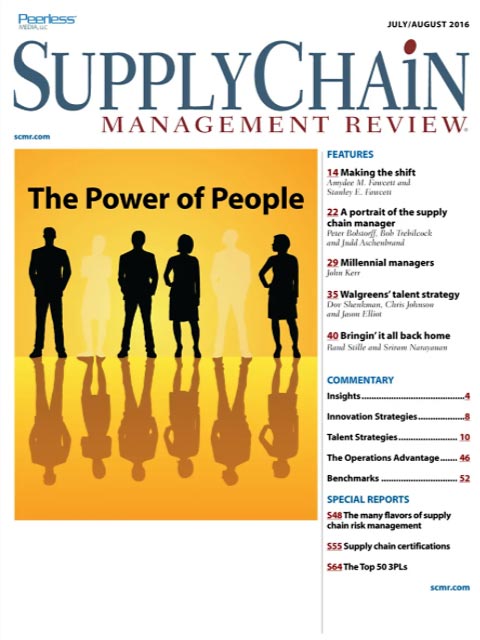
July-August 2016
What’s the difference between us and our competitors? Our people!” I can’t think of an organization that doesn’t publicly state that its people are its most important asset. Yet, anyone who has been in the workforce for any length of time knows that when the rubber hits the road—or something else hits the fan—people are usually the first casualty of cost cutting. It’s far easier to free up your talent for “other opportunities” than it is to close a plant or sell a fleet of trucks. Browse this issue archive.Need Help? Contact customer service 1-508-503-1313 More options
There are many faces of supply chain risk in today’s global business environment, where anything from a natural disaster to supplier insolvency to geopolitical turmoil can temporarily or permanently disrupt the manufacturing and/or transport of goods. Add quality and safety challenges, regulatory and environmental compliance, and even economic changes like fluctuating exchange rates to the list, and it’s easy to see why risk should be a top-of-mind issue for supply chain managers.
While some supply chain disruptions are identified and addressed quickly and without much fanfare, others receive national attention. In April, for example, Toyota, Honda, Sony and other major firms encountered supply disruptions in the aftermath of multiple earthquakes in Japan.
“The earthquakes on Thursday and Saturday, which killed at least 41 people, reflected the vulnerability of Japanese companies to supply chain disruptions caused by natural disasters,” Reuters reported following the event, “and also highlighted the ‘just in time’ philosophy pioneered by Toyota and followed by many others.”
 |
This complete article is available to subscribers
only. Click on Log In Now at the top of this article for full access. Or, Start your PLUS+ subscription for instant access. |
SC
MR
Sorry, but your login has failed. Please recheck your login information and resubmit. If your subscription has expired, renew here.
July-August 2016
What’s the difference between us and our competitors? Our people!” I can’t think of an organization that doesn’t publicly state that its people are its most important asset. Yet, anyone who has been in the… Browse this issue archive. Access your online digital edition. Download a PDF file of the July-August 2016 issue.|
|
Download Article PDF |
There are many faces of supply chain risk in today's global business environment, where anything from a natural disaster to supplier insolvency to geopolitical turmoil can temporarily or permanently disrupt the manufacturing and/or transport of goods. Add quality and safety challenges, regulatory and environmental compliance, and even economic changes like fluctuating exchange rates to the list, and it's easy to see why risk should be a top-of-mind issue for supply chain managers.
While some supply chain disruptions are identified and addressed quickly and without much fanfare, others receive national attention. In April, for example, Toyota, Honda, Sony and other major firms encountered supply disruptions in the aftermath of multiple earthquakes in Japan.
“The earthquakes on Thursday and Saturday, which killed at least 41 people, reflected the vulnerability of Japanese companies to supply chain disruptions caused by natural disasters,” Reuters reported following the event, “and also highlighted the ‘just in time' philosophy pioneered by Toyota and followed by many others.”
|
|
SUBSCRIBERS: Click here to download PDF of the full article. |
SC
MR

Latest Supply Chain News
- Supply chain resilience isn’t a data problem; it’s a judgment problem
- Beyond the hype: Building flexible and scalable supply chains in a VUCA world
- Why your supply chain risk management plan will fail
- When component verification becomes operational
- Caught between a rock and a hard place: Mapping your supply chain
- More News
Latest Resources
 Explore
Latest Supply Chain News
- Why companies blame the wrong supplier … and miss the real failure
- NextGen Supply Chain Conference unveils agenda focused on AI, execution and the future of leadership
- From fragmented negotiations to coordinated negotiation performance: an AI-enabled approach
- Supply chain resilience isn’t a data problem; it’s a judgment problem
- Beyond the hype: Building flexible and scalable supply chains in a VUCA world
- Why your supply chain risk management plan will fail
- More latest news
Latest Resources
About the Author
Bridget McCrea, Contributing Editor

Bridget McCrea is a Contributing Editor for Logistics Management based in Clearwater, Fla. She has covered the transportation and supply chain space since 1996 and has covered all aspects of the industry for Logistics Management and Supply Chain Management Review. She can be reached at [email protected], or on Twitter @BridgetMcCrea
Follow SCMR on social media.
@SupplyChainManagementReview on Facebook
@SCMR on Twitter
SCMR on Linkedin
Subscribe

Supply Chain Management Review delivers the best industry content.

Editors’ Picks



