
Sorry, but your login has failed. Please recheck your login information and resubmit. If your subscription has expired, renew here.
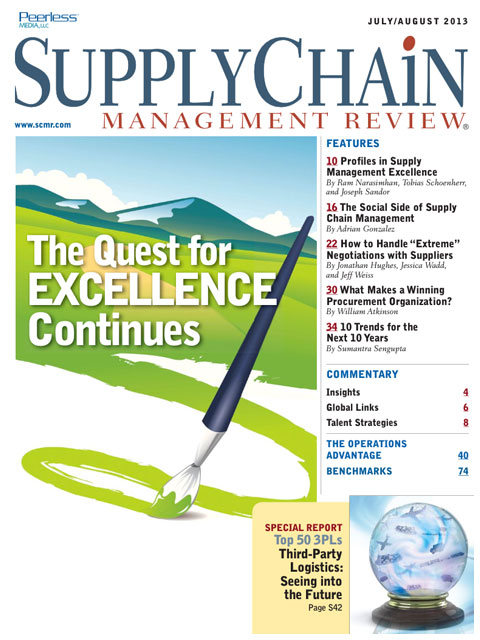
July-August 2013
How do you extend the frontiers of supply management excellence and build a solid competitive advantage? Answers to this pivotal question emerged from an Executive Summit of supply chain leaders convened recently at Michigan State University. The four companies profiled here, all participants in that summit, have adopted principles that promote excellence and continue to expand that frontier. Browse this issue archive.Need Help? Contact customer service 1-508-503-1313 More options
Recently, I happened to be perusing the aisle of a bookstore (there are still a few of them left) and found a book by Pavan Sukhdev titled Corporation 2020. The title was intriguing and the contents were illuminating. Basically, the author argued for a new formula for business success going forward—one that looked at all aspects of doing business and emphasized the corporation’s responsibility to society and to sustainability.
The forward-looking nature of Sukhdev’s book set the wheels in motion for this article. Quite a bit has been written over the years about the future of supply chains. MIT’s SCM 2020 project, for example, bought together leading thinkers and practitioners to address the subject. However, this research and most of the articles I have read on the topic have focused on supply chain operations and not so much on the points of “intersection”—that is, the related activities that are outside of the supply chain’s direct control such as R&D, information technology, and post-sales service. In my list of the top trends, I have incorporated a number of these intersection points.
As we think about the major trends that will affect the next generation of supply chains, we need to consider certain macroeconomic factors. Prominent among these is the changing global economic demographics. Walk into any multinational consumer goods or manufacturing company today and you’re sure to hear a lot of discussion about the BRIC (Brazil, Russia, India, and China) markets. The GDP growth in those countries far exceeds the growth in more fully developed economies. Further, the sheer number of consumers in these countries already accounts for about 40 percent of the world’s population. And by 2050, their combined economies are expected to eclipse that of the world’s richest countries—including the U.S. and European Union.
 |
This complete article is available to subscribers
only. Click on Log In Now at the top of this article for full access. Or, Start your PLUS+ subscription for instant access. |
Not ready to subscribe, but need this article?
Buy the complete article now. Only $20.00. Instant PDF Download.
Access the complete issue of Supply Chain Management Review magazine featuring
this article including every word, chart and table exactly as it appeared in the magazine.
SC
MR
Sorry, but your login has failed. Please recheck your login information and resubmit. If your subscription has expired, renew here.
July-August 2013
How do you extend the frontiers of supply management excellence and build a solid competitive advantage? Answers to this pivotal question emerged from an Executive Summit of supply chain leaders convened recently at… Browse this issue archive. Access your online digital edition. Download a PDF file of the July-August 2013 issue. |
Download Article PDF |
Recently, I happened to be perusing the aisle of a bookstore (there are still a few of them left) and found a book by Pavan Sukhdev titled Corporation 2020. The title was intriguing and the contents were illuminating. Basically, the author argued for a new formula for business success going forward—one that looked at all aspects of doing business and emphasized the corporation’s responsibility to society and to sustainability.
The forward-looking nature of Sukhdev’s book set the wheels in motion for this article. Quite a bit has been written over the years about the future of supply chains. MIT’s SCM 2020 project, for example, bought together leading thinkers and practitioners to address the subject. However, this research and most of the articles I have read on the topic have focused on supply chain operations and not so much on the points of “intersection”—that is, the related activities that are outside of the supply chain’s direct control such as R&D, information technology, and post-sales service. In my list of the top trends, I have incorporated a number of these intersection points.
As we think about the major trends that will affect the next generation of supply chains, we need to consider certain macroeconomic factors. Prominent among these is the changing global economic demographics. Walk into any multinational consumer goods or manufacturing company today and you’re sure to hear a lot of discussion about the BRIC (Brazil, Russia, India, and China) markets. The GDP growth in those countries far exceeds the growth in more fully developed economies. Further, the sheer number of consumers in these countries already accounts for about 40 percent of the world’s population. And by 2050, their combined economies are expected to eclipse that of the world’s richest countries—including the U.S. and European Union.
|
SUBSCRIBERS: Click here to download PDF of the full article. |
SC
MR

Latest Supply Chain News
Latest Podcast

 Explore
Latest Supply Chain News
- Coordinating AI-enabled supply chain operations
- The hidden supply chain risk no dashboard shows
- CSCOs need plant leaders to close the manufacturing transformation gap
- AI is reshaping the last meter of delivery
- Last-mile delivery success begins before the driver arrives
- The Digital Supply Chain Imperative: From Visibility to Execution
- More latest news
Latest Resources
Subscribe

Supply Chain Management Review delivers the best industry content.

Editors’ Picks



