
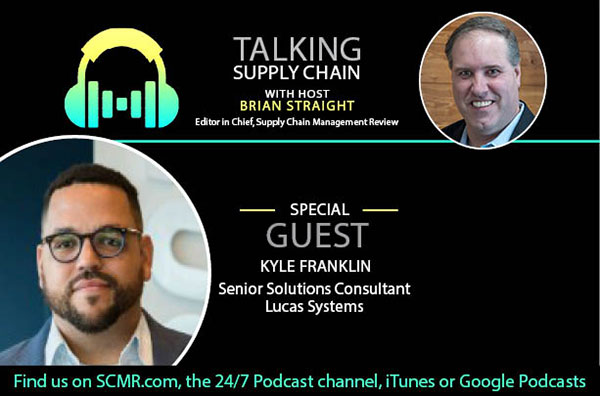
Pallet building is one of the most common activities in distribution centers, yet it remains largely untouched by modern optimization efforts. In this episode, Talking Supply Chain host Brian Straight speaks with Kyle Franklin, senior solutions consultant for Lucas Systems about why palletization has historically been treated as a manual, experience-driven task rather than a strategic lever for efficiency.
Franklin explains that most warehouses rely on tribal knowledge, simple sequencing, or labor incentives to move faster, without fundamentally rethinking how pallets are built or matched across orders. This leads to wasted labor, underutilized space, and avoidable damage.
Franklin outlines the structural problems created by traditional palletization, including long training times for new workers, excessive rehandling at the dock, and restrictive slotting strategies that force warehouses to organize products based on weight rather than demand or velocity. These constraints limit broader warehouse optimization and often result in redundant labor, such as teams dedicated solely to rebuilding unstable pallets before shipping. According to Franklin, these inefficiencies can quietly consume 5% to 20% of labor time in many operations.
The conversation then shifts to how Lucas Systems is applying AI, advanced algorithms, and warehouse execution software to digitize pallet-building intelligence. Franklin describes tools such as dynamic pallet building and best pallet matching, which optimize pick sequencing, reduce travel, and pair orders strategically to minimize warehouse movement. By embedding pallet logic earlier in the picking process, rather than treating palletization as a final step, organizations can improve utilization, reduce spot fixes, and lower physical strain on workers.
Finally, the episode explores the broader downstream impact of smarter palletization. Better-built pallets improve trailer cube utilization, reduce damage, speed dock operations, and support more reliable delivery performance for customers. Franklin emphasizes that pallet optimization offers a rare combination of flexibility, speed, and return on investment, especially for existing warehouses that cannot easily deploy large-scale automation. In a volatile supply chain environment, he argues, software-driven pallet optimization is a practical way for leaders to boost resilience without locking themselves into rigid physical systems.
Subscribe to the Supply Chain Management Review podcast
Sign up today and get the next podcast episode sent to you. Subscribe via Apple and Google Podcasts or choose another podcast platform. Subscribe via RSS or download an MP3 or media file.Latest Supply Chain Management Review podcast episodes
Here are a few of our latest podcast episodes.- Talking Supply Chain: The Strait of Hormuz is open, but normal is not near.
- Talking Supply Chain: Building the Supply Biome.
- Talking Supply Chain: Moving from AI pilot to execution with AWS’ Petra Schindler-Carter.
- Talking Supply Chain: How logistics leaders are winning in volatile times.
- Talking Supply Chain: AI and the new trade barrier.
- Talking Supply Chain: Rethinking supplier relationships.
SC
MR

Subscribe

Supply Chain Management Review delivers the best industry content.

Editors’ Picks



