
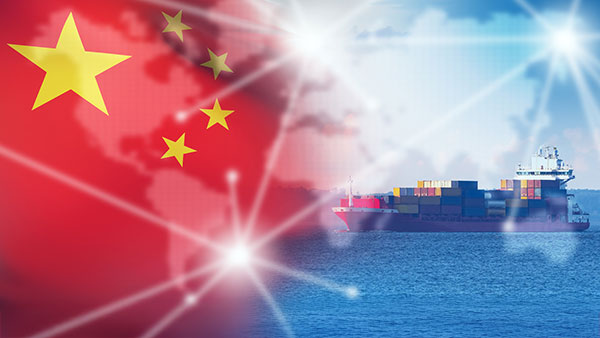
We’ve been so focused on what’s happening with trade and tariffs in the U.S. that we seem to have lost track of what’s happening in China. But global supply chains originating in China are still an important part of sourcing and manufacturing for a majority of American manufacturers. Despite the tariff wars, China’s sourcing, manufacturing, and trade is still going on.
The Chinese economy hasn’t suffered much from tariffs. Imports from China to the U.S. were down by 29% in 2025, but China’s economy grew by 5%—far outpacing the U.S.’s 2.3%. China has rapidly and successfully developed and expanded its global markets in response to the declining U.S. markets.
Now, with the Supreme Court ruling against President Donald Trump’s use of IEEPA tariffs, there is some relief in sight for Chinese tariffs. Imports from China, however, are now subject to Trump’s newly proposed 15% tariff, still subject to 301 China penalty tariffs, and 232 tariffs on aluminum and steel. There are also anti-dumping and countervailing penalties imposed on unfair trade practices.
Reciprocal triffs
As Trump used his executive powers to place tariffs on China—first 35%, then 145%, then 65%—China responded with tariffs on its imports from America. But instead of a blanket percentage on imports from the U.S., China has targeted specific sectors, including agriculture, high tech, and autos, for high import tariffs. In addition, the Chinese government has made an effort to develop alternative sources for commodities such as soybeans from producing countries such as Brazil, thereby reducing its dependency on U.S. agriculture.
Trade sanctions
In addition, China has imposed trade sanctions. After the U.S. imposed significant sanctions on the export of high-tech products, including AI chips, China imposed sanctions of its own on exports of any goods related to the U.S. military. Uniforms, night-vision goggles, and all kinds of day-to-day products sold to the U.S. Department of Defense or to defense contractors have been restricted.
The Trump administration negotiated a deal with Nvidia in 2025 to permit the export of certain AI chips (like the H20 and H200) to China, in exchange for a 15% to 25% share of revenue on those sales, which the U.S. government would receive. While China gladly accepted the Nvidia chips, it did not back down on any Chinese sanctions.
Now, China is requiring end-use certificates from its exporters to confirm that restricted exports are not ending up in the hands of the U.S. government or black-listed consignees. The U.S. has had end-use identification in place for years. China is mirroring this policy.
Rare earth elements
Rare earth elements and other critical minerals have become a flashpoint for trade with China. Today, China controls about 95% of processed rare earths, which are critical to manufacturing electronics used in consumer goods, industrial goods, aerospace, and defense-related products. America is vulnerable in terms of the supply of these raw materials. While there are new mines and processing plants being built in the U.S., it will be years before the supply is fully online.
China is using this situation as gentle leverage in trade negotiations—so far. But China could use this “big stick” to gain a significant advantage in trade policy, as it has done with Japan in the past.
China is not waiting
China is not waiting for the U.S. to dictate trade policy. While the U.S. has been focused domestically on the Trump administration’s approach to trade, China is taking action to promote policy in its own interest. Those of us working in global supply chain management need to take heed and remain attentive to what is happening in China.
SC
MR

More Global Trade
- Strait of Hormuz reopens, but supply chains face a long road to recovery
- Importers don’t need more information—they need less noise
- AI is creating new market access barriers to trade
- Trade wars won’t break supply chains. But the consumer impact will trouble brands
- What’s happening In China?
- More Global Trade
What's Related in Global Trade
 Explore
Topics
Procurement & Sourcing News
- Why companies blame the wrong supplier … and miss the real failure
- NextGen Supply Chain Conference unveils agenda focused on AI, execution and the future of leadership
- From fragmented negotiations to coordinated negotiation performance: an AI-enabled approach
- Supply chain resilience isn’t a data problem; it’s a judgment problem
- Why your supply chain risk management plan will fail
- When component verification becomes operational
- More Procurement & Sourcing
Latest Procurement & Sourcing Resources
About the Author
Rosemary Coates, Exec. Dir. Reshoring Institute

Ms. Coates is the Executive Director of the Reshoring Institute and the President of Blue Silk Consulting, a Global Supply Chain consulting firm. She is a best-selling author of five supply chain management books including: 42 Rules for Sourcing and Manufacturing in China and Legal Blacksmith - How to Avoid and Defend Supply Chain Disputes. Ms. Coates lives in Silicon Valley and has worked with over 80 clients worldwide. She is also an Expert Witness for legal cases involving global supply chain matters. She is passionate about Reshoring.
Follow SCMR on social media.
@SupplyChainManagementReview on Facebook
@SCMR on Twitter
SCMR on Linkedin
Subscribe

Supply Chain Management Review delivers the best industry content.

Editors’ Picks



