
Sorry, but your login has failed. Please recheck your login information and resubmit. If your subscription has expired, renew here.
July-August 2018
At Supply Chain Management Review, we’ve been writing about the talent crisis in our profession since at least 2012 when our MIT contributors were publishing a column on talent strategies. Last winter, the topic touched home when I picked up my local newspaper one Saturday morning. One of the lead stories was about two initiatives launched by C&S Wholesale Grocers with two local academic institutions: Keene State College and Franklin Pierce University. Browse this issue archive.Need Help? Contact customer service 1-508-503-1313 More options
Blockchain has recently gained notoriety as the underlying technology behind the rise of bitcoin and other cryptocurrencies. However, its true value is far greater, with the potential to fundamentally change the nature of any transaction that requires trust and verification in industries from retail, banking/ finance and government to healthcare, transportation and oil and gas. Proponents say blockchain will lower costs, improve planning and strengthen brand reputations. Opponents say the technology is overhyped and not as efficient as traditional processes. A.T. Kearney’s view? We see blockchain as a nascent technology that is still maturing but offers great promise in driving efficiencies in your supply chain.
A ledger innovation
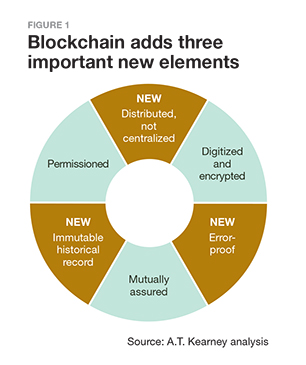 Ledgers have been at the heart of every economic transaction since ancient times. From the first clay tablet that recorded characteristics of contracts, deeds and purchases to today’s high-speed computers, companies rely on accurate, secure and reliable data. Blockchain is a ledger innovation that can make your data more robust, secure and error proof.
At its core, blockchain technology is a “distributed ledger,” with each ledger representing a “chain of blocks” containing data from multiple transactions, such as asset characteristics, price, date and parties involved. Blocks are continuously linked to each other forming a chain that is a complete historical list of all transactions. This ledger is continually shared and reconciled by all members. Because the records are stored by many keepers and available for all authorized users to see, it is auditable and verifiable.

This complete article is available to subscribers only.
Log in now for full access or start your PLUS+ subscription for instant access.
SC
MR
Sorry, but your login has failed. Please recheck your login information and resubmit. If your subscription has expired, renew here.
July-August 2018
At Supply Chain Management Review, we’ve been writing about the talent crisis in our profession since at least 2012 when our MIT contributors were publishing a column on talent strategies. Last winter, the topic… Browse this issue archive. Access your online digital edition. Download a PDF file of the July-August 2018 issue.Blockchain has recently gained notoriety as the underlying technology behind the rise of bitcoin and other cryptocurrencies. However, its true value is far greater, with the potential to fundamentally change the nature of any transaction that requires trust and verification in industries from retail, banking/ finance and government to healthcare, transportation and oil and gas. Proponents say blockchain will lower costs, improve planning and strengthen brand reputations. Opponents say the technology is overhyped and not as efficient as traditional processes. A.T. Kearney's view? We see blockchain as a nascent technology that is still maturing but offers great promise in driving efficiencies in your supply chain.
A ledger innovation
Ledgers have been at the heart of every economic transaction since ancient times. From the first clay tablet that recorded characteristics of contracts, deeds and purchases to today's high-speed computers, companies rely on accurate, secure and reliable data. Blockchain is a ledger innovation that can make your data more robust, secure and error proof.
At its core, blockchain technology is a “distributed ledger,” with each ledger representing a “chain of blocks” containing data from multiple transactions, such as asset characteristics, price, date and parties involved. Blocks are continuously linked to each other forming a chain that is a complete historical list of all transactions. This ledger is continually shared and reconciled by all members. Because the records are stored by many keepers and available for all authorized users to see, it is auditable and verifiable.
SC
MR


Latest Supply Chain News
- AI is driving change in supply chain skills and talent
- 4 moves supply chains must make as AI triggers a memory supply shock
- Innovators Netstock, Pickle Robot win NextGen Solution Provider awards
- Bigger trucks versus broken bridges and roads
- From salon to dock door: Repurposing scheduling software for inbound flow
- More News
Latest Podcast
 Explore
Software & Technology News
- Innovators Netstock, Pickle Robot win NextGen Solution Provider awards
- The biggest barrier to AI in supply chains isn’t technology
- NextGen Supply Chain Conference unveils agenda focused on AI, execution and the future of leadership
- From fragmented negotiations to coordinated negotiation performance: an AI-enabled approach
- Beyond the hype: Building flexible and scalable supply chains in a VUCA world
- Managing human and AI teams across the supply chain
- More Software & Technology
Latest Software & Technology Resources
Subscribe

Supply Chain Management Review delivers the best industry content.

Editors’ Picks



