
Sorry, but your login has failed. Please recheck your login information and resubmit. If your subscription has expired, renew here.
September-October 2015
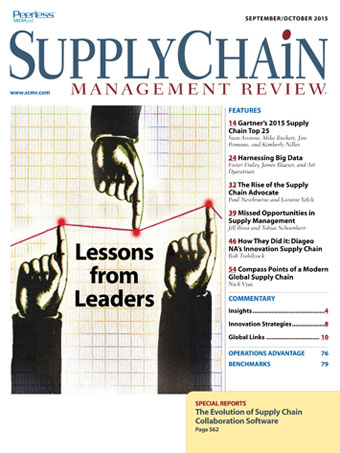
It’s September, which means the kids are going back to school, and soon, you’ll spend the evenings helping them with their lessons. September is also the month that we publish Gartner’s annual look at the Top 25 supply chains. While the Top 25 is a celebration of great supply chains, the leaders also offer lessons for the rest of us who aspire to the top. It’s news you can use right now in your planning. And, we’ll have you home for dinner on Tuesday. We hope you’ll join us for this inaugural event. Browse this issue archive.Need Help? Contact customer service 1-508-503-1313 More options
In an ideal world, every trading partner in a supply chain pulls together to achieve the best balance between cost and service. Supply chains synchronized in this way are efficient, agile, and able to respond quickly to shifts in the market.
In the real world, such a high level of collaboration is difficult to achieve. Rather than perform together like a well-tuned orchestra, multiple trading partners often play their own tunes. They are more likely to pull in different tactical and strategic directions, impairing end-to-end visibility and coordination. The resulting lack of alignment and supply chain visibility creates costly inefficiencies and slows responses to the market.
Bringing these entities into line requires changes in behavior that comply with the supply chain’s overarching performance objectives. To get buy in, these changes must be orchestrated in a way that benefits each party in the value chain—otherwise there is little incentive to participate in the change management exercise.
 |
This complete article is available to subscribers
only. Click on Log In Now at the top of this article for full access. Or, Start your PLUS+ subscription for instant access. |
SC
MR
Sorry, but your login has failed. Please recheck your login information and resubmit. If your subscription has expired, renew here.
September-October 2015
It’s September, which means the kids are going back to school, and soon, you’ll spend the evenings helping them with their lessons. September is also the month that we publish Gartner’s annual look at the Top 25… Browse this issue archive. Access your online digital edition. Download a PDF file of the September-October 2015 issue.|
|
Download Article PDF |
In an ideal world, every trading partner in a supply chain pulls together to achieve the best balance between cost and service. Supply chains synchronized in this way are efficient, agile, and able to respond quickly to shifts in the market.
In the real world, such a high level of collaboration is difficult to achieve. Rather than perform together like a well-tuned orchestra, multiple trading partners often play their own tunes. They are more likely to pull in different tactical and strategic directions, impairing end-to-end visibility and coordination. The resulting lack of alignment and supply chain visibility creates costly inefficiencies and slows responses to the market.
Bringing these entities into line requires changes in behavior that comply with the supply chain's overarching performance objectives. To get buy in, these changes must be orchestrated in a way that benefits each party in the value chain—otherwise there is little incentive to participate in the change management exercise.
|
|
SUBSCRIBERS: Click here to download PDF of the full article. |
SC
MR

Latest Supply Chain News
- From salon to dock door: Repurposing scheduling software for inbound flow
- The biggest barrier to AI in supply chains isn’t technology
- Rebuilding a planning function around the physical world
- Why companies blame the wrong supplier … and miss the real failure
- NextGen Supply Chain Conference unveils agenda focused on AI, execution and the future of leadership
- More News
Latest Podcast
 Explore
Latest Supply Chain News
- Why companies blame the wrong supplier … and miss the real failure
- NextGen Supply Chain Conference unveils agenda focused on AI, execution and the future of leadership
- From fragmented negotiations to coordinated negotiation performance: an AI-enabled approach
- Supply chain resilience isn’t a data problem; it’s a judgment problem
- Beyond the hype: Building flexible and scalable supply chains in a VUCA world
- Why your supply chain risk management plan will fail
- More latest news
Latest Resources
Subscribe

Supply Chain Management Review delivers the best industry content.

Editors’ Picks



