
Sorry, but your login has failed. Please recheck your login information and resubmit. If your subscription has expired, renew here.
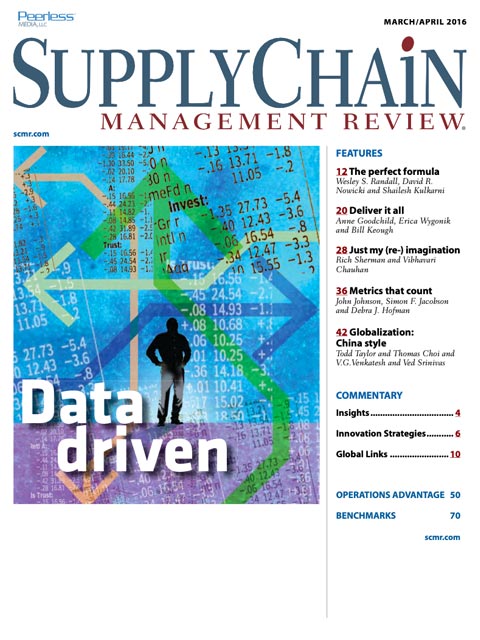
March-April 2016
When I visit my millennial-aged daughter in Chicago, I’m amazed at the number of packages dropped off by UPS, FedEx and the USPS at her three-unit building on a daily basis. It’s as if she and her neighbors are single-handedly keeping Amazon in business. All those drop-offs got me to wondering: Does any of this make sense if you think about a carbon footprint? Rather than deliver millions of packages to one address at a time every day, wouldn’t it be more sustainable if we all just drove to the mall to do our shopping? After all, doesn’t research indicate that a signi cant percentage of consumers, especially millennial consumers like my… Browse this issue archive.Need Help? Contact customer service 1-508-503-1313 More options
The complexity of modern supply chains and the advancement of technology in the field have led organizations to place greater importance on the need for supply chain employees to possess STEM (science, technology, engineering and math) skills. APQC has found that a slight majority of organizations look for STEM skills in their new hires for supply chain positions. The most highly sought after of these skills are engineering and operations research, or the use of analytics to optimize transportation networks.
As in many fields, STEM skills are not widely available or fully developed among supply chain professionals. APQC has found that some organizations are tackling this problem by creating development programs for new professionals.
However, lasting solutions provide development of STEM skills among both new and more tenured employees. Some organizations have found this balance and seen positive results for the business.
 |
This complete article is available to subscribers
only. Click on Log In Now at the top of this article for full access. Or, Start your PLUS+ subscription for instant access. |
SC
MR
Sorry, but your login has failed. Please recheck your login information and resubmit. If your subscription has expired, renew here.
March-April 2016
When I visit my millennial-aged daughter in Chicago, I’m amazed at the number of packages dropped off by UPS, FedEx and the USPS at her three-unit building on a daily basis. It’s as if she and her neighbors are… Browse this issue archive. Access your online digital edition. Download a PDF file of the March-April 2016 issue.|
|
Download Article PDF |
The complexity of modern supply chains and the advancement of technology in the field have led organizations to place greater importance on the need for supply chain employees to possess STEM (science, technology, engineering and math) skills. APQC has found that a slight majority of organizations look for STEM skills in their new hires for supply chain positions. The most highly sought after of these skills are engineering and operations research, or the use of analytics to optimize transportation networks.
As in many fields, STEM skills are not widely available or fully developed among supply chain professionals. APQC has found that some organizations are tackling this problem by creating development programs for new professionals.
However, lasting solutions provide development of STEM skills among both new and more tenured employees. Some organizations have found this balance and seen positive results for the business.
|
|
SUBSCRIBERS: Click here to download PDF of the full article. |
SC
MR

Latest Supply Chain News
- Supply chain resilience isn’t a data problem; it’s a judgment problem
- Beyond the hype: Building flexible and scalable supply chains in a VUCA world
- Why your supply chain risk management plan will fail
- When component verification becomes operational
- Caught between a rock and a hard place: Mapping your supply chain
- More News
Latest Resources
 Explore
Topics
Latest Supply Chain News
- Why companies blame the wrong supplier … and miss the real failure
- NextGen Supply Chain Conference unveils agenda focused on AI, execution and the future of leadership
- From fragmented negotiations to coordinated negotiation performance: an AI-enabled approach
- Supply chain resilience isn’t a data problem; it’s a judgment problem
- Beyond the hype: Building flexible and scalable supply chains in a VUCA world
- Why your supply chain risk management plan will fail
- More latest news
Latest Resources
Subscribe

Supply Chain Management Review delivers the best industry content.

Editors’ Picks



