
In my research over the last few decades, I've discovered that a good forecast without a business environment that supports integration is of little value. A forecast is one element of good business decision-making, and without effective cross-functional integration it is difficult for companies to effectively utilize demand forecasts and make decisions that maximize outcomes for the enterprise as a whole.
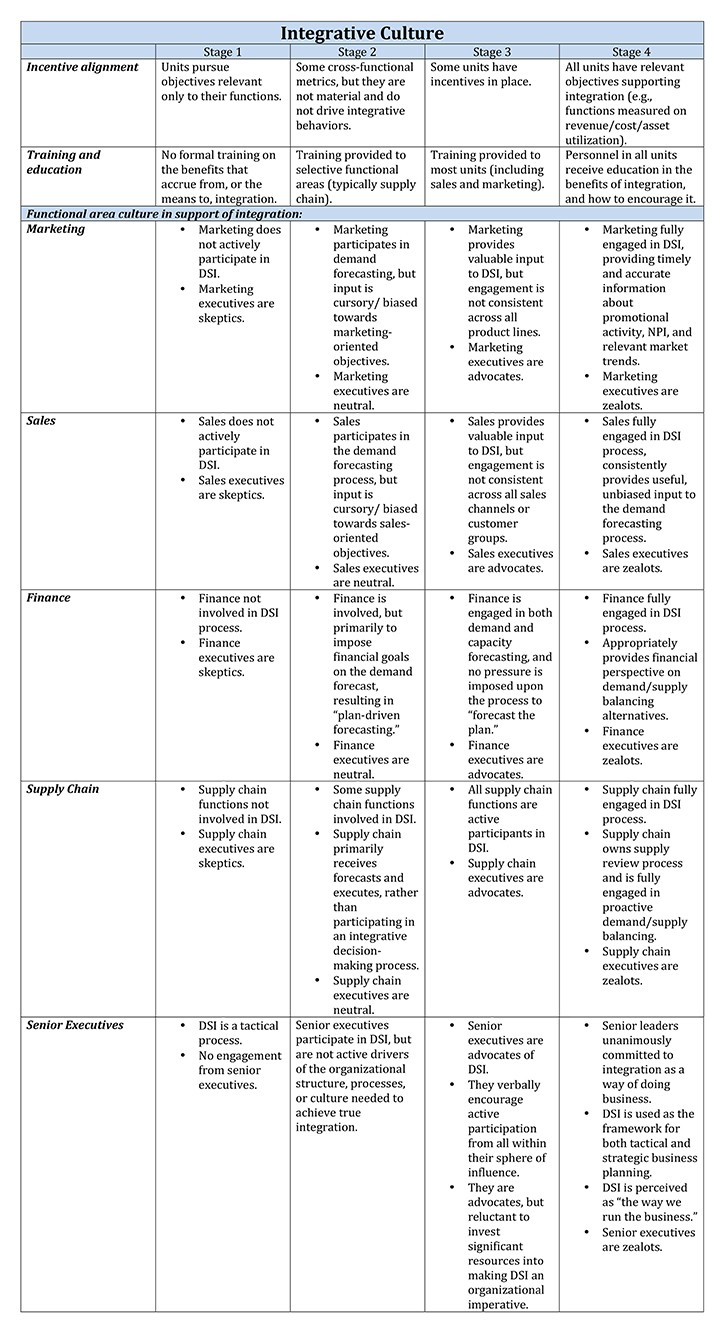
To really achieve integration, more focus needs to be directed to the organizational structure necessary for success or the corporate culture that so influences individual behavior. A firm must address organizational structure, integrative processes (such as S&OP), and integrative culture.
I've developed a template for business integration assessments that uses these three dimensions. This template can be used either for self-assessment or to guide an engagement to perform an unbiased assessment from an external auditor.
The following tables describe elements of organizational structure and integrative culture that range from “worst practice,” or Stage 1, to “best practice,” or Stage 4. For purposes of brevity, and because numerous maturity models exist for assessing it, integrative processes is not included. Instead of S&OP, which is a bad descriptor in integrative processes for many reasons, I use Demand/Supply Integration (DSI).

SC
MR

Latest Supply Chain News
- 4 moves supply chains must make as AI triggers a memory supply shock
- Innovators Netstock, Pickle Robot win NextGen Solution Provider awards
- Bigger trucks versus broken bridges and roads
- From salon to dock door: Repurposing scheduling software for inbound flow
- The biggest barrier to AI in supply chains isn’t technology
- More News
Latest Podcast
 Explore
Latest Supply Chain News
- Innovators Netstock, Pickle Robot win NextGen Solution Provider awards
- Bigger trucks versus broken bridges and roads
- From salon to dock door: Repurposing scheduling software for inbound flow
- The biggest barrier to AI in supply chains isn’t technology
- Rebuilding a planning function around the physical world
- Why companies blame the wrong supplier … and miss the real failure
- More latest news
Latest Resources
Subscribe

Supply Chain Management Review delivers the best industry content.

Editors’ Picks



