
Sorry, but your login has failed. Please recheck your login information and resubmit. If your subscription has expired, renew here.
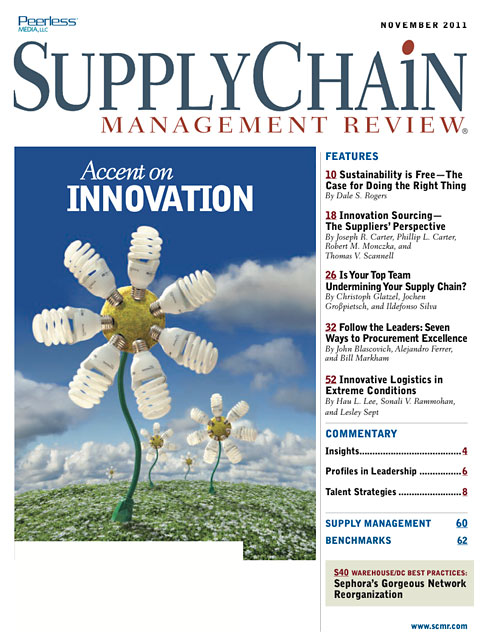
November 2011
Innovation. It’s a hard competency to come by. Can schools teach you to be innovative? Is work experience really the only way to open your eyes to what’s possible? Or is the innovative spark something that lurks in an individual’s DNA—and you either have it or you don’t? Innovation. It’s a hard competency to come by. Can schools teach you to be innovative? Is work experience really the only way to open your eyes to what’s possible? Or is the innovative spark something that lurks in an individual’s DNA—and you either have it or you don’t? Innovation has worked in the Gambia situation and in supplier sourcing. Surely, there must be… Browse this issue archive.Need Help? Contact customer service 1-508-503-1313 More options
In 1979 Philip B. Crosby published the book Quality Is Free.1 For many of us, this little book turned on a light. It contained the revolutionary idea that quality did not add cost to a product. Instead, building quality into a product or process was, at the very least, a breakeven proposition. Crosby wrote that making quality a sure thing was really an exercise of “getting people to do better all the worthwhile things they should be doing anyway.” This applies to sustainability just as well. And, as Crosby said about quality all those years ago, building sustainability into products and processes is “free.”
At the time that Crosby wrote Quality is Free, the careers of company managers usually moved through a specific function such as manufacturing or sales. In general, these individuals were not likely to have much experience with quality issues. Yet while ignorance of quality management may have been the norm in 1979, that’s not the case today. Quality is woven into the fabric of most organizations. Nearly every successful firm around the globe is working to build quality into all of its products and processes.
While quality now is widely understood to be a critical competitive variable and the “ante” to play the game, sustainability does not yet enjoy that same status. But we believe that over the next several years sustainability, like quality, will become an integral part of the organization. Further, sustainability will be a critical part of every firm and every supply chain.
 |
This complete article is available to subscribers
only. Click on Log In Now at the top of this article for full access. Or, Start your PLUS+ subscription for instant access. |
Not ready to subscribe, but need this article?
Buy the complete article now. Only $20.00. Instant PDF Download.
Access the complete issue of Supply Chain Management Review magazine featuring
this article including every word, chart and table exactly as it appeared in the magazine.
SC
MR
Sorry, but your login has failed. Please recheck your login information and resubmit. If your subscription has expired, renew here.
November 2011
Innovation. It’s a hard competency to come by. Can schools teach you to be innovative? Is work experience really the only way to open your eyes to what’s possible? Or is the innovative spark something that lurks… Browse this issue archive. Download a PDF file of the November 2011 issue. |
Download Article PDF |
In 1979 Philip B. Crosby published the book Quality Is Free.1 For many of us, this little book turned on a light. It contained the revolutionary idea that quality did not add cost to a product. Instead, building quality into a product or process was, at the very least, a breakeven proposition. Crosby wrote that making quality a sure thing was really an exercise of “getting people to do better all the worthwhile things they should be doing anyway.” This applies to sustainability just as well. And, as Crosby said about quality all those years ago, building sustainability into products and processes is “free.”
At the time that Crosby wrote Quality is Free, the careers of company managers usually moved through a specific function such as manufacturing or sales. In general, these individuals were not likely to have much experience with quality issues. Yet while ignorance of quality management may have been the norm in 1979, that’s not the case today. Quality is woven into the fabric of most organizations. Nearly every successful firm around the globe is working to build quality into all of its products and processes.
While quality now is widely understood to be a critical competitive variable and the “ante” to play the game, sustainability does not yet enjoy that same status. But we believe that over the next several years sustainability, like quality, will become an integral part of the organization. Further, sustainability will be a critical part of every firm and every supply chain.
|
SUBSCRIBERS: Click here to download PDF of the full article. |
SC
MR

Latest Supply Chain News
- Why companies blame the wrong supplier … and miss the real failure
- NextGen Supply Chain Conference unveils agenda focused on AI, execution and the future of leadership
- From fragmented negotiations to coordinated negotiation performance: an AI-enabled approach
- Supply chain resilience isn’t a data problem; it’s a judgment problem
- Beyond the hype: Building flexible and scalable supply chains in a VUCA world
- More News
Latest Resources
 Explore
Latest Supply Chain News
- Why companies blame the wrong supplier … and miss the real failure
- NextGen Supply Chain Conference unveils agenda focused on AI, execution and the future of leadership
- From fragmented negotiations to coordinated negotiation performance: an AI-enabled approach
- Supply chain resilience isn’t a data problem; it’s a judgment problem
- Beyond the hype: Building flexible and scalable supply chains in a VUCA world
- Why your supply chain risk management plan will fail
- More latest news
Latest Resources
Subscribe

Supply Chain Management Review delivers the best industry content.

Editors’ Picks



