
Editor’s Note: This guest feature is authored by Lalit Wadhwa, Avnet Electronics Marketing & Douglas Kent, Vice President, Supply Chain Services Development High-tech Industry Ecosystem.
The globalization of the design chain and supply chain in the high-tech industry has played an important role in the success of technology companies, enabling them to bring their products to market quickly and to a wider customer base. At the same time, globalization has introduced significant complexity in the form of geographically dispersed suppliers and customers, design and manufacturing partners and logistics infrastructure and channels. With product lifecycles continuing to shrink, time to market is critical. Sensing and adequately responding to customer demand is an ever increasing challenge for every node in the design chain and supply chain. Traceability, regulatory compliance and sustainability have become important factors to be considered right from product design and development stage, and are shaping decisions across all nodes of the design and supply chain. Returns and reverse logistics are impacting decisions not only in the demand management process, but have assumed a critical role in meeting sustainability goals and complying with the regulatory framework. The complexity of globally extended supply chains in the high-tech industry is illustrated here, with major nodes working collaboratively to optimize throughput.
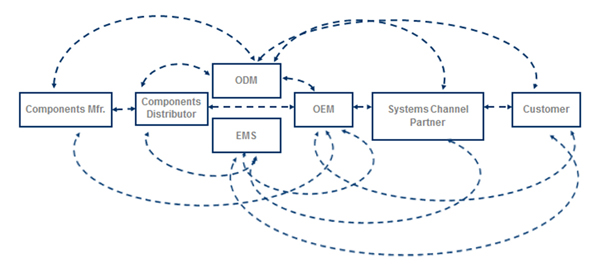
Supply Chain Landscape
Given that the complex ecosystem described above has evolved rapidly, it comes as no surprise that the supply chain landscape and the associated challenges have shifted significantly. Supply chain challenges have moved beyond the goals of reducing inventory, working capital, other assets and total supply chain costs. Supply chains must be able to address a host of new challenges, primary amongst those being:
Managing risk in a more uncertain world: The high-tech industry recognizes that globalization and interdependence on multiple partners in extended supply chains has made identifying, measuring and managing risk much more difficult. Natural disasters over the past few years have led to greater urgency in understanding and managing risks associated with increasing number of nodes in supply chains. New vulnerabilities have been introduced and each additional supplier, manufacturing site or distribution center is a potential failure point in the extended network. Companies have experienced large disruptions that have had significant impact on revenue, customer experience and brand loyalty. While configuring supply chains that account for every single risk is not feasible, some demonstrate better resilience – that is, their ability to rebound from disruptive events is significantly better than others.
Enhancing the depth and quality of customer engagement in order to better understand shifting customer needs: Nodes in the high-tech supply chains recognize that profitable revenue growth depends on ability to continually address evolving customer needs and ensuring product, process and service innovation. Metrics related to customer goal achievement are being increasingly tracked as a subset of supply chain performance measurement. Supply chain planning has evolved beyond suppliers and internal S&OP, and customer participation in demand planning is vital. Ability to receive and interpret demand signals from the source with high degree of automation provides an opportunity for innovation in the customer engagement.
Globalization of end markets and procurement: New markets have provided significant revenue streams. This growth has been accompanied by new challenges related to distribution channels, logistics, regulatory compliance, inventory optimization and leadership talent. Globalization of procurement has introduced challenges related to lead-time increase, product quality, counterfeits and IP protection.
- Need for deeper visibility into the extended supply chain: In the high-tech ecosystem, an OEM’s manufacturing strategy frequently uses a combination of multiple contract manufacturers (CM) and wholly owned subsidiaries. Each of these globally dispersed sites receives or generates independent data streams related to demand signals, forecasts, sales orders, supplier purchase orders and input, and finished inventory. In such an environment, managing operational execution along multiple points in the extended supply network becomes increasingly complex and challenging. In the absence of timely visibility, the performance of the value chain suffers. With dispersed manufacturing sites using different ERP systems, the challenges get compounded.
It can be summarized from the above discussion, that in absence of timely visibility into the supply chain, extending from the supply network to the demand side, it is difficult to address the other challenges. The relationship between supply chain maturity and supply chain visibility is illustrated here.

Challenges due to lack of Visibility
While enough information is being captured at every node in the dispersed supply chain, visibility continues to be a significant challenge, specifically for mid-sized OEMs in the high-tech industry. OEMs have attempted to address the visibility gap by implementing data solutions that have included some combination of spreadsheets with hundreds of data points, in-house developed applications, and third-party solution providers. Each solution has had some inherent drawbacks, such as the ability to manage complexity, scalability, depth and timeliness of information visibility; limited analytics; or significant upfront investment. Unsurprisingly, the challenge has not been limited to visibility of partner data – in many cases, access to supply chain data in disparate systems within the organization has been equally challenging.
In the high-tech industry, lack of visibility in extended networks manifests as three major issues.
Working capital optimization issues: Unplanned duplication of inventory across multiple sites and hubs, excess or short supply of component inventory, and obsolescence due to demand modification are some examples.
Higher operational costs: Expedites leading to increased process and freight costs, and manual intervention to flag and resolve supply or demand related issues are two prime examples.
- Impact on customer engagement: Inability to adequately respond to upswings in customer demand signals impacts the revenue stream, and the overall relationship.
Addressing Visibility Gaps
As one of the world’s largest industrial distributor of electronic components, subsystems, enterprise computing and storage products, Avnet Inc. (NYSE: AVT), leverages its extensive worldwide infrastructure and footprint to offer solutions that address the above issues, and offers real-time visibility into transactional and analytical data points across the extended network. These solutions are a combination of product-centric value-added services, along with information and analytics services, and address the needs of OEMs in the technology industry with dispersed and complex supply networks. The combination helps simplify the supply network design and provides a coherent global / multi-site view of transactional and analytical data across the OEM’s extended manufacturing footprint.
The basic solution that addresses the visibility gaps is illustrated below, with Avnet integrating the material flow and associated information across multiple global sites.

OEMs connect through a secure web portal, Supply Chain Central (scc.avnet.com), to access information related to orders, invoices, forecasts, product backlog, inventory, inventory aging, supply constraints, EOL notifications, transportation and tracking, and component level traceability data. OEMs leverage the near real-time visibility across multiple sites, to drive the following advantages:
Manage planning, procurement, and inventory for globally dispersed manufacturing sites through Avnet-managed physical or virtual hubs, at the individual site level, as well as at an aggregate level.
Manage supply variability and (or) demand variability and improve response to unforeseen events through the movement of inventory between Avnet-managed hubs by leveraging visibility into data points such as raw material forecasts, supply commit dates, inventory levels and constraints.
Leverage on-demand access to data points related to spend, supplier performance, component lifecycle management and on-time performance to benchmark supply base performance, aggregated across the multiple sites.
- Conduct scenario planning related to supply network agility and responsiveness, and leverage this information for demand shaping.
Leading OEMs with a focus on demand driven fulfillment chains, have expressed a need for solutions that provide deeper and wider visibility of their network. These OEMs need a level of visibility to critical data points that extends from multi-tiers in the supply network, all the way across to their demand generation network and customer base. To address these requirements, Avnet deploys a cloud based E2open platform as a visibility and collaboration tool spanning all network partners, designs the network collaboration processes and on-boards the network constituents. The concept and design is referred to as “Control Tower.” In addition to creating a consistent view across multiple enterprises in the OEM’s network, the Control Tower delivers significant benefits in multi-enterprise process design and process innovation. A representative illustration of the supply and demand side multi-tier ecosystems, and the collaboration platform is included below.

Leveraging Supply Chain Visibility – Cost to Serve
An exciting application that leverages supply chain visibility is the Cost to Serve analysis (CTSA). The analysis helps understand total costs involved in delivering a solution to a customer, evaluates cost-service tradeoffs and helps ensure that customer requirements are addressed in a profitable manner. Interest in Cost to Serve capabilities has increased over years, though many organizations in the high-tech industry have struggled to model all supply chain activities in their network, identify associated costs and then properly allocate those costs. At the other end of the spectrum, companies with mature CTSA capabilities are actively engaged in Cost to Serve Optimization (CTSO) that involves “what-if” analyses to optimize manufacturing, transportation, inventory and pricing strategies.
Avnet leverages its CTSA / CTSO capabilities to assist customers move up the CTSA maturity curve through a three step process. The process validates costs associated with each supply chain in the customer’s business, and allows customers to analyze the cost impact by changing performance attributes of individual supply chains. Customers can then optimize their supply chains to specific performance levels and cost, while ensuring competitiveness in their markets.
This following discussion provides an overview of the framework and the process that can be used for CTSA.
The analysis and quantification of all activities and associated costs incurred in order to fulfill customer demand for a product is referred to as Cost to Serve Analysis (CTSA). Since the combination of every Customer Category – Channel – Product Category would have disparate set of activities and associated costs, CTSA must account for multiple supply chains that exist in the business.
Cost to Serve Framework, Source: Inforum
Step 1: Identification of Data Requirements, Data Sources and Data Collection: In most cases, there are seven types of data elements that must be identified.
Product related, such as Part Number, Description, Cost, Price, Unit Weight
Bill of Materials related, such as mapping raw materials, intermediate materials and packaging materials to final product
Site related, such as demand locations, manufacturing locations and supply locations
Demand related, such as customer, product, quantity and shipment frequency
Supply related, such as product, supplier and production site
Inventory related, such as product, safety stock, obsolescence rate and handling costs
- Transportation related, such as origin and destination, mode, transit time, shipping weight and shipping cost
These data elements reside in ERP, off-ERP databases, excel files and service providers systems. The role of the finance team is critical here to ensure that cost allocations are done correctly and any assumptions are documented.
Step 2: Create Supply Chain Matrix: This phase defines the number of supply chains in relation to its customers and products. Columns in the matrix represent Demand – Channel - Customers, while the rows represent Supply - Business Category - Product Category. A probable supply chain matrix for a storage products manufacturer is shown here.
If done right, columns would add up to total revenue (Demand) and rows would add up to total cost (Supply).
Step 3: Supply Chain Prioritization and Performance Prioritization: The supply chains identified in the prior step are ranked based on pre-selected criteria and weight. A higher number denotes a higher ranking. The resultant matrix is illustrated below.
With the above matrix, the supply chains within project scope can be finalized. Supply chains with a higher overall rating are more critical to the company.
As the final step, the objective is to prioritize supply chain performance based on competitive requirements in the industry or market. For each supply chain attribute, the company must determine if it needs to perform at a superior level (90th percentile), advantage level (between superior and parity) or at parity to most competitors (50th percentile).
The resultant unique combination of ratings defines the overall strategy for each supply chain that the company has. Referred to as the Performance Prioritization matrix, this ensures that optimization of cost-service tradeoffs are aligned with competitive requirements of the specific supply chain.
Summary
Technology solutions have created a more viable path to achieving multi-tier visibility across network partners in a global supply chain. Visibility allows identification and mitigation of risks, and is required across the plan, source, make, deliver and return processes of the extended supply chain. Companies can leverage the visibility to drive segmentation of their supply chains, and optimize each supply chain for profitability and customer service.
SC
MR

Latest Supply Chain News
- Supply chain resilience isn’t a data problem; it’s a judgment problem
- Beyond the hype: Building flexible and scalable supply chains in a VUCA world
- Why your supply chain risk management plan will fail
- When component verification becomes operational
- Caught between a rock and a hard place: Mapping your supply chain
- More News
Latest Resources
 Explore
Topics
Latest Supply Chain News
- Why companies blame the wrong supplier … and miss the real failure
- NextGen Supply Chain Conference unveils agenda focused on AI, execution and the future of leadership
- From fragmented negotiations to coordinated negotiation performance: an AI-enabled approach
- Supply chain resilience isn’t a data problem; it’s a judgment problem
- Beyond the hype: Building flexible and scalable supply chains in a VUCA world
- Why your supply chain risk management plan will fail
- More latest news
Latest Resources
Subscribe

Supply Chain Management Review delivers the best industry content.

Editors’ Picks



