
Neither of this month's featured two books – The Innovator's Dilemma and Thank You For Being Late – was written about supply chain. But don't be fooled. Both deal with innovation in the supply chain dead on.
The Innovator's Dilemma, By Clayton M. Christensen
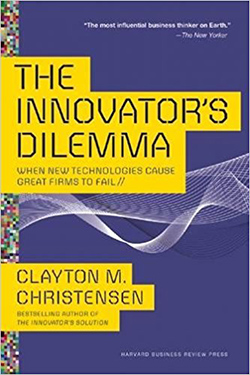 Every so often, a book comes along that stands the test of time. And that is even more notable when the subject matter is as fluid as innovation. But Harvard's Professor Clayton Christensen's The Innovator's Dillemma is still a must read 20 years after it was first published.
Christensen says in an updated preface that his core question is - “Why is (company) success so difficult to sustain?”
The answer is both unsettling and counterintuitive, he says. Business leaders live firmly in the world of listening to and responding to customers. They also focus on investments in innovations that promise the highest returns.
“But these two principles, in practice, actually sow the seeds of every company's ultimate demise. That's why we call it the innovator's dilemma: Doing the right thing is actually the wrong thing,” Christensen writes.
He goes on to explain that leading firms are best at improving the performance of existing products. Sometimes the improvements are incremental or sustaining. Other times they are radical. But they are still improvements of existing products that have an established customer base that continues to support the company.
But then there are disruptive innovations that redefine product performance trajectories. These products are fundamentally different than established ones.
To begin, they are typically technologically straightforward with off-the-shelf components. They are simpler than existing products - no matter how innovative in their own right. Just as important, they usually offer different but non-mainstream attributes than their predecessors.
These differences mean current customers are unlikely to be as interested as new customers the company has yet to discover. Hence, the innovator's dilemma. Not exactly a corporate sweet spot initially.
Christensen's observations were published 20 years ago. But it's tough to say they are any less valid in a world that is eagerly awaiting what will transform the smartphone in our pockets.
Thank You For Being Late, By Thomas L. Friedman
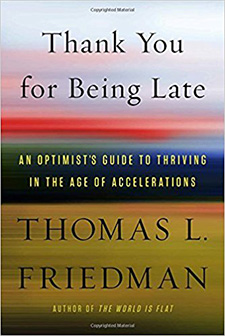 The subtitle to Tom Friedman's latest book is “an optimist's guide to thriving in the age of accelerations.” Now you know where he stands on the survive or thrive conundrum we are all facing.
From where the New York Times columnist and best selling author sits, the world is living through one of the greatest inflection points since the printing press. This time around the three “largest forces on the planet – technology, globalization and climate change – are all accelerating at once.”
It's happening because of three core developments – smartphones, expanded bandwidth and unprecedented connectivity through the cloud. Just as important, the three all got their start at much the same time – 2007. That synchronicity accelerated change.
In the third section of the book called ‘Innovating,' he writes “since the technological forces driving this change in the pace of change are not likely to slow down, how do we adapt.” The instinctive reaction is to stick your paddle in the water to slow down. But that is the wrong thing to do - a parallel thought to Clay Christensen's innovator's dilemma of how companies develop disruptive technologies (see other book review).
Friedman goes on to say that average is over for countries and the workforce and geopolitics and climate. The terms of engagement here are different now and aren't going back to what they were. Everyone is going to have to raise their game and change their approach.
But there is a cost to all this acceleration. The U.S. surgeon general told Friedman that the biggest disease today is isolation. “How ironic. We are the most technologically connected generation in human history – and yet more people feel isolated than ever,” writes Friedman. “I hope this book will inspire you to pause in stride and find your anchor. And don't worry if it makes you late.”
Gary Forger is the contributing editor of NextGen Supply Chain. He can be reached at [email protected].
SC
MR

Latest Supply Chain News
- Supply chain resilience isn’t a data problem; it’s a judgment problem
- Beyond the hype: Building flexible and scalable supply chains in a VUCA world
- Why your supply chain risk management plan will fail
- When component verification becomes operational
- Caught between a rock and a hard place: Mapping your supply chain
- More News
Latest Resources
 Explore
Latest Supply Chain News
- Why companies blame the wrong supplier … and miss the real failure
- NextGen Supply Chain Conference unveils agenda focused on AI, execution and the future of leadership
- From fragmented negotiations to coordinated negotiation performance: an AI-enabled approach
- Supply chain resilience isn’t a data problem; it’s a judgment problem
- Beyond the hype: Building flexible and scalable supply chains in a VUCA world
- Why your supply chain risk management plan will fail
- More latest news
Latest Resources
Subscribe

Supply Chain Management Review delivers the best industry content.

Editors’ Picks



