
Sorry, but your login has failed. Please recheck your login information and resubmit. If your subscription has expired, renew here.
December 2016
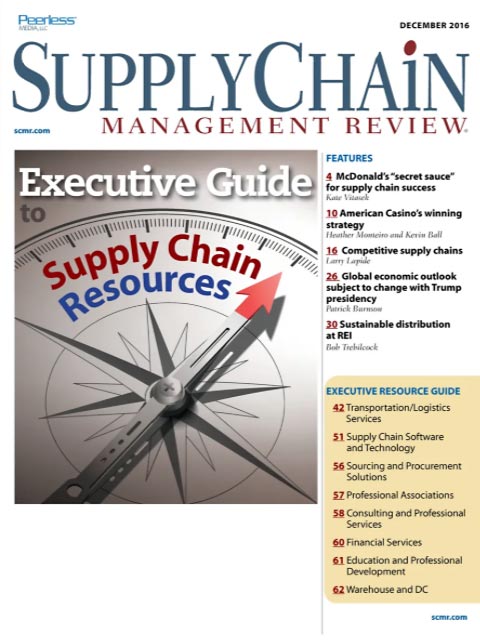
It’s December and thus time once again for our annual “Executive Guide to Supply Chain Resources.” This is a comprehensive guide to services, products and educational opportunities targeted specifically to supply chain professionals. As with years past, we’re also featuring several articles we trust will offer food for thought in your supply chain in the coming year. Browse this issue archive.Need Help? Contact customer service 1-508-503-1313 More options
Supply chain management (SCM) has long been promoted by manufacturers as a way to reduce costs, improve value, and create mutual benefit, higher commitment and long-term viability. However, most organizations in the service sector have been slow to embrace the principles of supply chain management, especially when it comes to the procurement of goods and services. As a result, they leave money on the table by neglecting the numerous benefits that can accrue from carefully managing the supply chain.
In many service industries, procurement is the dominant paradigm for purchasing the items that are critical to delivering the services that define their businesses. But procurement is transactional: Rather than creating mutual benefit, a purchasing agent buys goods directly from a supplier, frequently on a low-cost basis, with little to no consideration to what happens down the supply chain beyond that direct supplier. In that model, negotiations, goods and money move solely between the supplier and the buyer.
SCM involves looking beyond that supplier to managing relationships and product flow with other members of the supply chain such as distributors, manufacturers and transportation providers. In SCM, negotiations, goods and money may move between various parties within the supply chain and not just the buyer and supplier. Incorporating principles of SCM in service supply relationships can increase the quality of the supply, reduce the risk of supply disruption and lower the total cost of materials.
 |
This complete article is available to subscribers
only. Click on Log In Now at the top of this article for full access. Or, Start your PLUS+ subscription for instant access. |
SC
MR
Sorry, but your login has failed. Please recheck your login information and resubmit. If your subscription has expired, renew here.
December 2016
It’s December and thus time once again for our annual “Executive Guide to Supply Chain Resources.” This is a comprehensive guide to services, products and educational opportunities targeted specifically to… Browse this issue archive. Access your online digital edition. Download a PDF file of the December 2016 issue.|
|
Download Article PDF |
Supply chain management (SCM) has long been promoted by manufacturers as a way to reduce costs, improve value, and create mutual benefit, higher commitment and long-term viability. However, most organizations in the service sector have been slow to embrace the principles of supply chain management, especially when it comes to the procurement of goods and services. As a result, they leave money on the table by neglecting the numerous benefits that can accrue from carefully managing the supply chain.
In many service industries, procurement is the dominant paradigm for purchasing the items that are critical to delivering the services that define their businesses. But procurement is transactional: Rather than creating mutual benefit, a purchasing agent buys goods directly from a supplier, frequently on a low-cost basis, with little to no consideration to what happens down the supply chain beyond that direct supplier. In that model, negotiations, goods and money move solely between the supplier and the buyer.
SCM involves looking beyond that supplier to managing relationships and product flow with other members of the supply chain such as distributors, manufacturers and transportation providers. In SCM, negotiations, goods and money may move between various parties within the supply chain and not just the buyer and supplier. Incorporating principles of SCM in service supply relationships can increase the quality of the supply, reduce the risk of supply disruption and lower the total cost of materials.
|
|
SUBSCRIBERS: Click here to download PDF of the full article. |
SC
MR

Latest Supply Chain News
- Supply chain resilience isn’t a data problem; it’s a judgment problem
- Beyond the hype: Building flexible and scalable supply chains in a VUCA world
- Why your supply chain risk management plan will fail
- When component verification becomes operational
- Caught between a rock and a hard place: Mapping your supply chain
- More News
Latest Resources
 Explore
Latest Supply Chain News
- Why companies blame the wrong supplier … and miss the real failure
- NextGen Supply Chain Conference unveils agenda focused on AI, execution and the future of leadership
- From fragmented negotiations to coordinated negotiation performance: an AI-enabled approach
- Supply chain resilience isn’t a data problem; it’s a judgment problem
- Beyond the hype: Building flexible and scalable supply chains in a VUCA world
- Why your supply chain risk management plan will fail
- More latest news
Latest Resources
Subscribe

Supply Chain Management Review delivers the best industry content.

Editors’ Picks



