
Imagine asking your smart speaker to play music or switch on the lights. You don’t think about the commands, code, or systems working in the background. You just order and it gets delivered. That same simplicity is now entering supply chains. Autonomous fulfillment works quietly behind the scenes to turn a customer’s order into action: AI predicts demand, robots pick items and automated delivery networks move goods. To the customer, it feels effortless; they click “buy” and the system gets to work.
Why is this shift happening now?

Customer expectations have never been higher. Two-day delivery is now considered standard with 30% of customers expecting same-day options and more than half sayin they would pay extra for sustainable products. Meanwhile, supply chain leaders are juggling multiple product ranges, unpredictable demand spikes, labor shortages and rising input costs. To keep pace, many companies have restructured their networks for greater cost efficiency.

Adding to the complexity, stricter regulations now require precise inventory and delivery systems to guarantee product safety and quality. These shifts are making it clear the next phase of fulfillment can’t rely on human-driven approaches alone as it simply can’t respond with the speed, accuracy, and cost profile demanded.
Managing increasingly diverse product portfolios across global supply networks calls for advanced solutions that deliver both accuracy and adaptability.
Where does autonomous fulfillment come in?
To keep pace, supply chain technology is moving beyond isolated automation toward autonomous fulfillment: connected, pioneering capabilities that combine agentic AI, advanced robotics and digital twin simulation to enable seamless human and machine collaboration and reliable decisions with minimal manual oversight.
Autonomous fulfillment represents a spectrum of capabilities. At one level, it involves augmented decisioning, where AI-driven systems orchestrate workflows across order management, distribution, transportation, and trade and return—with supervisors validating decisions and managing exceptions. At the highest level, it enables fully autonomous operations, including dark warehousing where multi-agent systems analyze, decide and act independently, coordinating resources and resolving disruptions without human intervention.
Autonomous fulfillment is making supply chains fast, accurate and resilient enough to match the simplicity of a single “order” command and the expectation that what you ask for arrives on time.
But what does autonomous fulfillment really mean?
Let’s focus on the basics. Autonomous fulfillment is a scalable, orchestrated system composed of four parts:
- Processes: Reinventing core supply chain processes, i.e., defining which activities can be automated vs. augmented vs. agenticized, and which require traditional redesign to drive consistency across sites/channels/regions. This is hard work that has now become easier with the help of digital twin process models powered by Gen AI.
- Data foundation: Establishing trust and repeatability through clean, standardized and harmonized data required to fuel AI-driven decisions and digital twin simulations across the value chain.
- Agentic architecture: Deploying intelligent AI agents that sense, decide and act across plan, source, make, deliver and return, automating analytics, orchestrating tasks and dynamically resolving disruptions end-to-end.
- Workforce enablement: Aligning human capability with autonomous models by shifting workers into supervisory and value-added roles, supported by AI upskilling and collaboration with automation.
Together, these pillars support a layered approach: robust data and a modern technology architecture form the foundation. Best-of-breed functional platforms (spanning the core supply chain—plan, source, make, deliver and return) sit above and orchestrate activities across planning and execution horizons. This system is powered by AI agents and digital twins to close the loop between decide and do.
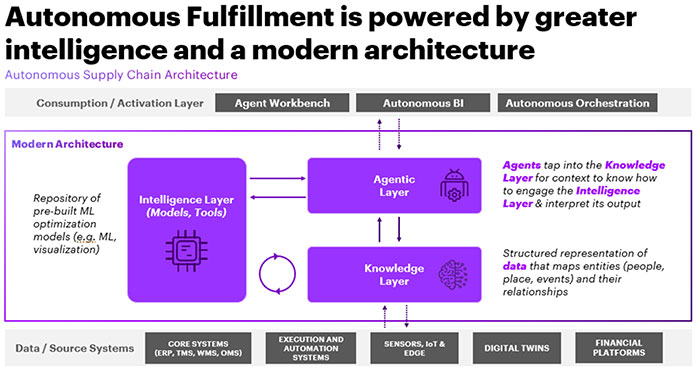
This integrated system plans and executes tasks like picking, packing, transport orchestration and returns, continuously optimizes against constraints such as service SLAs, labor, asset capacity and cost. All while freeing humans to focus on strategic decisions.
But how do these play out across fulfillment subdomains?
1. Order management: smarter promises, fewer surprises
AI agents, oftentimes in collaboration with robots, can check stock, shipping options and even weather before promising a delivery date. If something changes, they replan instantly. The result is higher on-time performance with fewer manual expedites, particularly during peaks. Trend analyses highlight AI’s growing role in real-time decisioning and dynamic sourcing and allocation, directly impacting order execution.
2. Warehouse management: robots and humans in sync
- Autonomous warehousing is about orchestration across people, robots and intelligent systems—all working as one. Automated Storage and Retrieval Systems (ASRS) and Autonomous mobile robots (AMRs) move goods while AI dynamically allocates tasks between humans and machines, reprioritizing work in real time to eliminate rigid waves.
- Digital twins model the entire facility and material flow, enabling safe trials of slotting, layouts, and labor strategies before go-live and enabling continuous optimization. Digital twins also enable training and testing of robots before go-live reducing design time and time to deploy, ensuring fewer surprises.
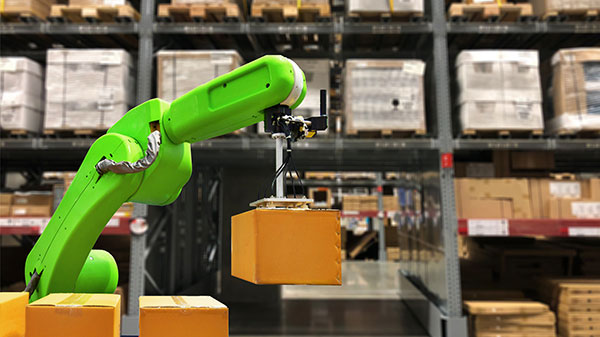
- Physical automation, AI-powered decisioning, and simulation converge to create a coordinated, outcome-driven environment. Robots handle repetitive tasks, freeing human workers for supervisory, strategic and value-added roles, while AI agents orchestrate workflows across warehouses, the transportation network and return product flows.
Together, these capabilities form a comprehensive autonomy layer, delivering productivity, safety and adaptability at scale.
3. Transportation: routes that think for themselves
Instead of static plans, AI continuously picks the best routes and modes based on traffic, cost and service goals. This supports ‘execution aware’ planning and reduces waste from static, batch processes.
4. Global trade: compliance without the paperwork pain
Classification, embargo screening and document creation are ripe for AI assistance. Agentic workflows can pre-validate paperwork, escalate edge cases and learn from rulings, cutting dwell time and penalties while maintaining compliance. This is also where AI governance and auditability become essential.
5. Reverse logistics: returns that pay for themselves
Computer vision and robotics accelerate triage (resell/repair/recycle) while AI agents steer items to the most profitable disposition, considering demand, repair capacity and ESG targets.
The value case: measurable impact
Accenture’s latest survey suggests that autonomous supply chains can deliver material financial benefits. Respondents project an increase of up to 5% in EBITA and a 7% improvement in return on capital employed alongside productivity and inventory gains, when paired with the right operating model changes. These include shorter order lead times, faster response to disruptions and significant improvements in asset utilization and labor productivity.
But organizations don’t go “fully autonomous” overnight
As AI and robotics mature, more organizations are moving from point tools to end-to-end orchestration that connects planning and execution, with workforce and technology integration as the defining success factor. Autonomous fulfillment transformation requires a strategic roadmap that drives rapid value, builds intelligent and adaptive operations and enables continuous optimization across the fulfillment network:
1. Assess and reinvent processes.
Begin by digitizing end-to-end fulfillment processes using advanced process mining and modeling tools to map systems, data and costs i.e., build a process digital twin. Identify inefficiencies and non-value-added work and standardize where possible. Engage stakeholders through collaborative workshops and prioritize high-impact initiatives that accelerate transformation across processes, technology and workforce.
2. Build autonomy on trusted data
Trusted data is the foundation of autonomy. Create a fulfillment-specific semantic layer using knowledge graphs to unify domain knowledge. Convert structured and unstructured data into reusable data that delivers actionable insights. Integrate data, logistics platforms and sensors for real-time visibility and establish strong governance to ensure data quality and trust. PUMA India redesigned its supply chain using advanced analytics and digital twin technology to speed up fulfillment and reduce costs. The transformation optimized hub and warehouse layouts, improved material flow, and enabled faster dispatches. As a result, delivery speed is expected to increase by up to 70%, costs drop by 10% and express-delivery capacity doubles, creating a more agile, sustainable network.
3. Enable intelligent, self-driving fulfillment
Leverage an agentic architecture (powered by trusted data) to deploy autonomous agents that sense, decide and act with minimal human intervention. Use digital twins for real-time replication and predictive optimization and combine advanced physical automation with digital intelligence to dynamically execute tasks. Connect AI agents and automation systems through closed-loop intelligence for continuous learning and adaptation. Take the example of KION Group who are planning to improve their intelligent warehouse offering by leveraging NVIDIA omniverse. This approach is likely to create intelligent, adaptive fulfillment systems that could predict disruptions, optimize performance, and enable continuous improvement, thereby building overall supply chain resilience.
4. Enable workforce transformation
Technology alone doesn’t drive transformation, people do. Build a future-ready organization by rethinking workflows to enable seamless collaboration between humans and AI. Equip leaders to model new behaviors and guide teams through adoption. Identify emerging skill needs and launch adaptive learning paths, fostering a culture of continuous change with clear vision and inclusive engagement.
5. Drive value through continuous optimization and advanced capabilities
Autonomous fulfillment is an ongoing evolution. Implement advanced strategies across order management, warehouse automation, smart transportation, intelligent global trade and reverse logistics. Continuously track value realization and performance improvement to stay competitive and future ready.
What’s next?
Autonomous fulfillment represents a structured, value-first evolution. By connecting AI agents, robotics, and digital twins across the supply chain, organizations can unlock faster, more resilient and more sustainable operations while making work safer and more rewarding for people.
But autonomy isn’t limited to fulfillment alone; it is gradually spreading across planning, sourcing, manufacturing and R&D/engineering. According to a recent Accenture study, 63% of companies view autonomous supply chains as a strategic priority and 25% have already begun implementing autonomous capabilities in parts of their operations.
The question now is how fast organizations can scale these capabilities to match real-time customer expectations. The future of fulfillment is simple on the surface and deeply intelligent beneath it. To the customer, it’s still the same: they browse, click and order. But what they receive is changing: faster delivery with greater accuracy, better product quality, richer engagement at even lower prices. And it all happens because behind that single click, AI-enabled autonomous systems and optimization are continuously working to make fulfillment smarter, faster and more efficient.
About the authors
Patricia Riedl is Managing Director and Americas Supply Chain & Operations Lead at Accenture. Paras Mehta is Managing Director – Strategy & Consulting and Fulfillment Lead at Accenture.
SC
MR

More Autonomous Fulfillment
 Explore
Topics
Procurement & Sourcing News
- Why companies blame the wrong supplier … and miss the real failure
- NextGen Supply Chain Conference unveils agenda focused on AI, execution and the future of leadership
- From fragmented negotiations to coordinated negotiation performance: an AI-enabled approach
- Supply chain resilience isn’t a data problem; it’s a judgment problem
- Why your supply chain risk management plan will fail
- When component verification becomes operational
- More Procurement & Sourcing
Latest Procurement & Sourcing Resources
Subscribe

Supply Chain Management Review delivers the best industry content.

Editors’ Picks



